
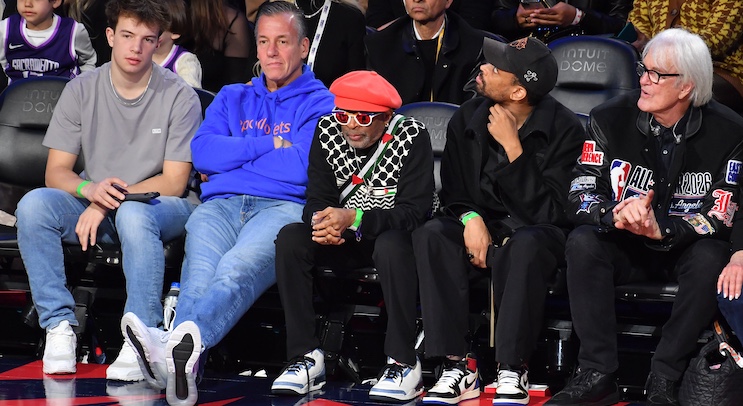
On January 26, the famed director and New York Knicks bad-luck charm Spike Lee posted a Palestinian flag to social media. Perhaps the timing was coincidental, but something else happened on that day: The remains of the last hostage left in Gaza were recovered.
It had been an excruciating 843 days for Ran Gvili’s loved ones, and for the country as a whole, before the clock in Hostage Square was turned off. Gvili was a hero—he was on medical leave for a broken shoulder when he heard that Gaza had invaded Israel and Palestinian terrorists were attacking innocents. He ran into the fray despite his injury and despite the chaos of the moment, just to save the lives of innocent people who were set upon by the murderous soldiers of a death cult.
Gvili acted with an almost superhuman level of courage and self-sacrifice. Spike Lee posted a picture of a flag.
Again, maybe Lee meant nothing by it.
This past weekend, a milestone was achieved in Spike Lee’s beloved NBA. The All-Star Game featured, for the first time, an Israeli-born player. Deni Avdija, the former Maccabi Tel-Aviv standout, received more All-Star fan votes than LeBron James. That made sense: As Babe Ruth might have said, Avdija was having a better season.
The international character of the NBA is important to its identity. Under former commissioner David Stern, the league truly went global in a way it had never before. Consider this: the NBA MVP award has not gone to an American-born player since 2018. It almost certainly will continue that streak this year.
In tribute to its status as a truly global league, this year the NBA set up its All-Star competitions to pit U.S. players against the rest. Avdija thus joined his fellow world All-Stars, who each had their country of origin’s flag sewn on the back of their jerseys. For Jewish fans, Avdija wearing his NBA uniform with a Star of David on the back was a moment of great pride. For Israelis specifically, it marked a return to some semblance of normalcy and inclusion, though discrimination against Israeli Jews in global sports and entertainment remains widespread. Thus the NBA was set to accomplish what the Olympics routinely fail to: a sense of global shared humanity that is above politics.
Then Spike Lee showed up.
Lee thought it would be fun to come to the game wearing a flag, too. Not the flag of his own home country, of course. Nor did Lee wear the flag of his favorite player. Instead, he dressed like a Palestinian flag, just to stick it to Deni and the Jews.
People noticed, of course—it was hard to miss. But then something interesting happened: Spike Lee denied that his getup had anything to do with Avdija.
Now, I don’t think most people are stupid enough to believe that. But it’s interesting that Lee felt the need to pretend he wasn’t doing what everyone knows he was doing.
Spike Lee’s a coward and a fool. But his cowardice here suggests something important: Spike Lee knows what he did was spiteful and bigoted, that it cannot be defended on its merits. Wealthy celebrities who live their politics, like Spike Lee does, exist in a bubble of their own making. They have the empathy and maturity of internet trolls. The basic standards of human decency that normal people try to live by are entirely absent from the world of Spike Lee.
But they are not absent from the basketball fans who tuned in just to watch a game. Spike Lee was on their turf—the land of normal people.
There is a wonderful moment in the fourth season of The Crown, the Netflix dramatization of the modern history of the English royals. Margaret Thatcher and her husband are guests of the royal family, and the hosts have set up two bedrooms for the couple so that they may sleep in separate rooms. With a “when in Rome” spirit, Denis Thatcher suggests following this tradition. “Don’t you dare,” snaps the Iron Lady. “We don’t want to catch any upper-class habits.”
In America, our royals are our cultural icons. Any senior U.S. senator would give the world to spend a day with Taylor Swift’s power. Some supporters of Joe Biden still blame George Clooney for bringing down the president of the United States.
Spike Lee’s behavior was America’s version of tasteless upper-class habits. Most normal people still recoil from the dehumanizing politics of the wealthy, elite hivemind, at least for now. Which is why Lee had to pretend he wasn’t practicing those habits. He had to pretend he was a decent fellow.