
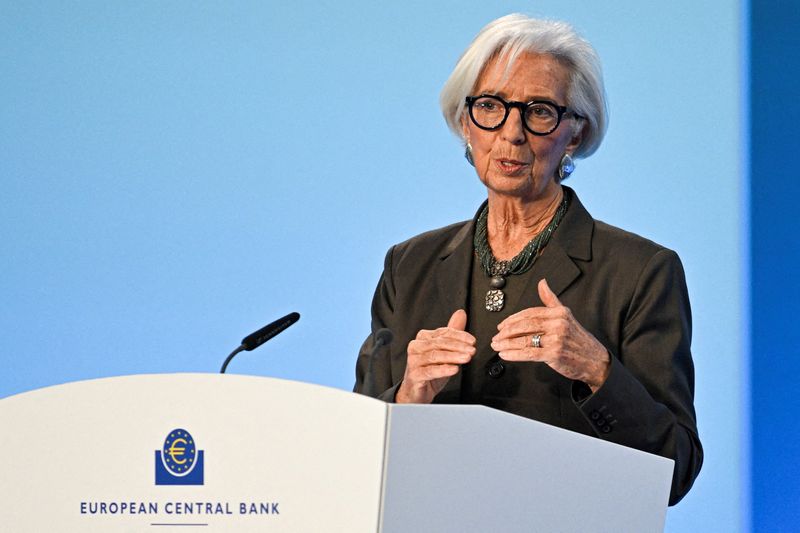
FRANKFURT, Feb 18 (Reuters) – European Central Bank President Christine Lagarde plans to leave her job early, ahead of next year’s French presidential election, to give outgoing French leader Emmanuel Macron a say in picking her successor, the Financial Times said on Wednesday.
Lagarde’s term leading Europe’s most important financial institution is due to end in October 2027, but a victory by the far-right party National Rally (RN) in the spring 2027 French vote could complicate selection of the next ECB chief.
RN president Jordan Bardella on Tuesday accused Macron of attempting to stage a “democratic power grab” that would let him maintain influence even after leaving office.
France is the second-biggest European Union economy and no ECB president has been picked without a sign-off from Paris.
Concerns about central bank independence have risen with U.S. President Donald Trump’s campaign against Federal Reserve Chair Jerome Powell, demanding sharp interest rate cuts.
Citing a person familiar with the matter, the FT reported Lagarde had not decided the exact timing of her departure but was keen that Macron and German Chancellor Friedrich Merz be the key European leaders choosing who succeeds her. Macron cannot run for a third presidential term.
A German government spokesperson said Berlin would “always propose a suitable candidate” to head the ECB, who would support Germany’s “ideas of stability” – a reference to its preference for strict inflation targeting and sound public finances.
ECB SAYS LAGARDE HAS NOT MADE A DECISION
“President Lagarde is totally focused on her mission and has not taken any decision regarding the end of her term,” an ECB spokesperson said.
That is a departure from earlier guidance. Last year, when the FT suggested she may leave early, the ECB said Lagarde was “determined to complete her term”.
Market reaction to Lagarde’s possible departure was muted on Wednesday as potential successors are not expected to transform policy.
THREE BIG ECB JOBS COULD BE IN PLAY
“The ECB takes monetary policy decisions by building consensus, and whoever replaces Lagarde is unlikely to radically shift or change the way the ECB works, in particular should her replacement be one of those being touted in the media,” Nomura economist Andrzej Szczepaniak said.
Lagarde’s early departure could strengthen the case for EU leaders to make ECB Executive Board appointments as a package when the terms of chief economist Philip Lane and market operations chief Isabel Schnabel expire next year.
Story Continues
ECB presidential appointments are subject to political horse-trading, so filling the three jobs together might make sense, especially as the bloc’s biggest economies – France, Italy and Germany – have de facto permanent seats on the board.
Candidates often mentioned for the top job include former Dutch central bank chief Klaas Knot, Bank for International Settlements General Manager Pablo Hernandez de Cos and German Bundesbank president Joachim Nagel.
Schnabel has expressed interest in the role but EU law may prevent her candidacy: board members serve non-renewable terms.
“All the likely candidates are mainstream central bankers and, even if the eventual successor is not one of the current supposed front-runners, he or she would be sure to be from a similar background,” Andrew Kenningham at Capital Economics said.
BANK OF FRANCE GOVERNOR ALSO QUIT EARLY
The FT report comes a week after Bank of France Governor Francois Villeroy de Galhau said he would step down early, which will allow Macron to name his replacement.
The RN said that move was aimed at putting in place allies against the eurosceptic party, in case there was a change of power in France.
Villeroy says his choice to step down is a personal one.
Polls show either RN leader Marine Le Pen or her protege Bardella could succeed Macron, although the nationalist, anti-immigrant party has made little headway with France’s economic establishment, which frets over its shifting positions.
While leaders from the 21 euro zone countries could in theory pick a candidate France disagrees with to head the ECB, practice suggests a candidate needs German and French support to clinch the role.
Some analysts questioned whether attempting to bypass the far right – or far left – could have unintended effects.
“The road to hell is paved with good intentions and (Lagarde) has very honourable intentions,” Pictet Wealth Management’s head of macroeconomic research Frederik Ducrozet said. “But this would send the signal that European elites are trying to control the institution and it could prove counterproductive for everything else that the EU is trying to achieve.”In Britain, outside the European Union, the populist Reform UK party, which is leading in opinion polls, said on Wednesday it would make changes to the way the Bank of England operates, but stressed it would respect its independence.
ECB IN A ‘GOOD PLACE’
Lagarde would leave the ECB at a relatively tranquil time.
Inflation is at target, interest rates are in a neutral setting, and euro zone economic growth is at potential – a rare combination that some have called a central banker’s nirvana.
Markets currently expect the ECB to keep rates on hold all year, although exceptional uncertainty in the global environment could quickly change the outlook.
(Reporting by Ananya Palyekar in Bengaluru, Balazs Koranyi and Francesco Canepa in Frankfurt and Andreas Rinke in Berlin; Editing by Christopher Cushing, Kim Coghill, Toby Chopra, Ros Russell and Catherine Evans)