
Theseus: A New Housing Typology by Emma Agnes Sheffer and Joe Robert Russell
Buildner just revealed the winners of their Unbuilt Award 2025. The second edition of the series, the competition “honors architectural ideas not yet realized.”
The challenge was organized into three categories: small, medium, and large-scale projects, with participants invited to submit proposals that could be conceptual, unbuilt, paused, or published but unrealized.
“This year’s prize-winning projects reflect a shared commitment to architecture as both cultural speculation and practical solution,” Buildner shared. “From climate-adaptive systems to thoughtful urban insertions and new models for collective space, the awarded work demonstrates how unbuilt ideas can shape architectural discourse with clarity, precision, and critical imagination. Across categories, the strongest entries conveyed a refined balance between concept and execution, supported by compelling drawings, models, and visual storytelling.”
The 2026 edition of the award is open for entries, with an upcoming registration deadline on February 26th. In the meantime, we have listed below the 2025 winners.
Small-scale category winner and Student Award winner
Nomadic Permanence: Architecture as Resilient Machine by Yuanyuan Cao
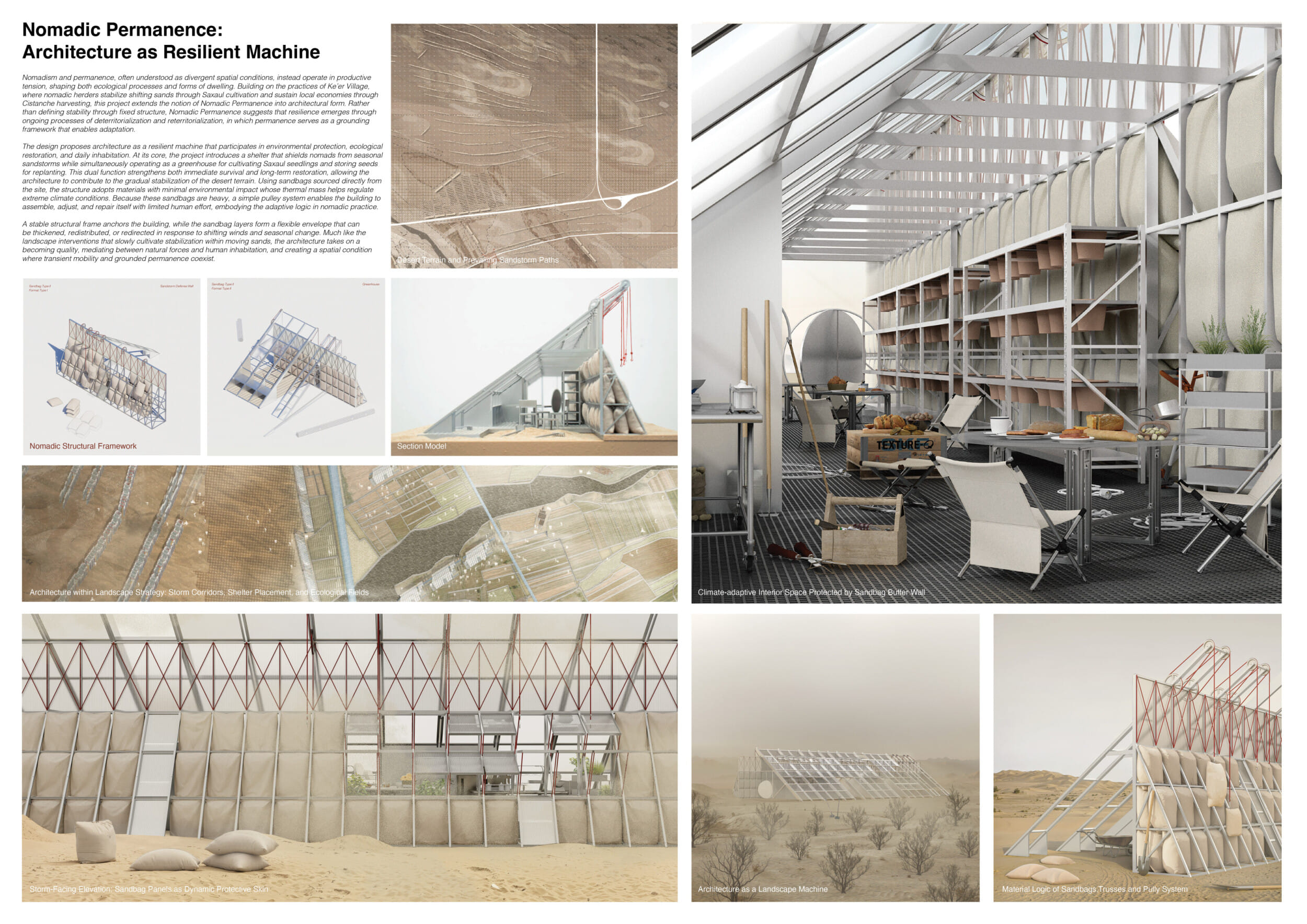
Nomadic Permanence: Architecture as Resilient Machine by Yuanyuan Cao
Jury comment: “Nomadic Permanence presents a climate-adaptive framework situated in desertified landscapes, merging the logic of resilient shelter with ecological regeneration. The proposal introduces a modular architecture that acts as a self-sufficient, reconfigurable machine, integrating food production, stormwater retention, sand stabilization, and inhabitation. Constructed primarily from lightweight metal framing and locally sourced sandbags, the structure leverages on-site materials and minimal permanent infrastructure. The spatial layout is organized around a sloped roof section with solar panels and tensile fabric skins, beneath which adaptive interior functions unfold in response to environmental needs. The design reimagines permanence as a temporal accumulation of cycles, offering a strategy that addresses displacement, climate adaptation, and food insecurity simultaneously. The architecture is not fixed, but instead a device that accumulates meaning through use, weathering, and stewardship.”
Medium-scale category winner
. the wine path by Tigran Danielian
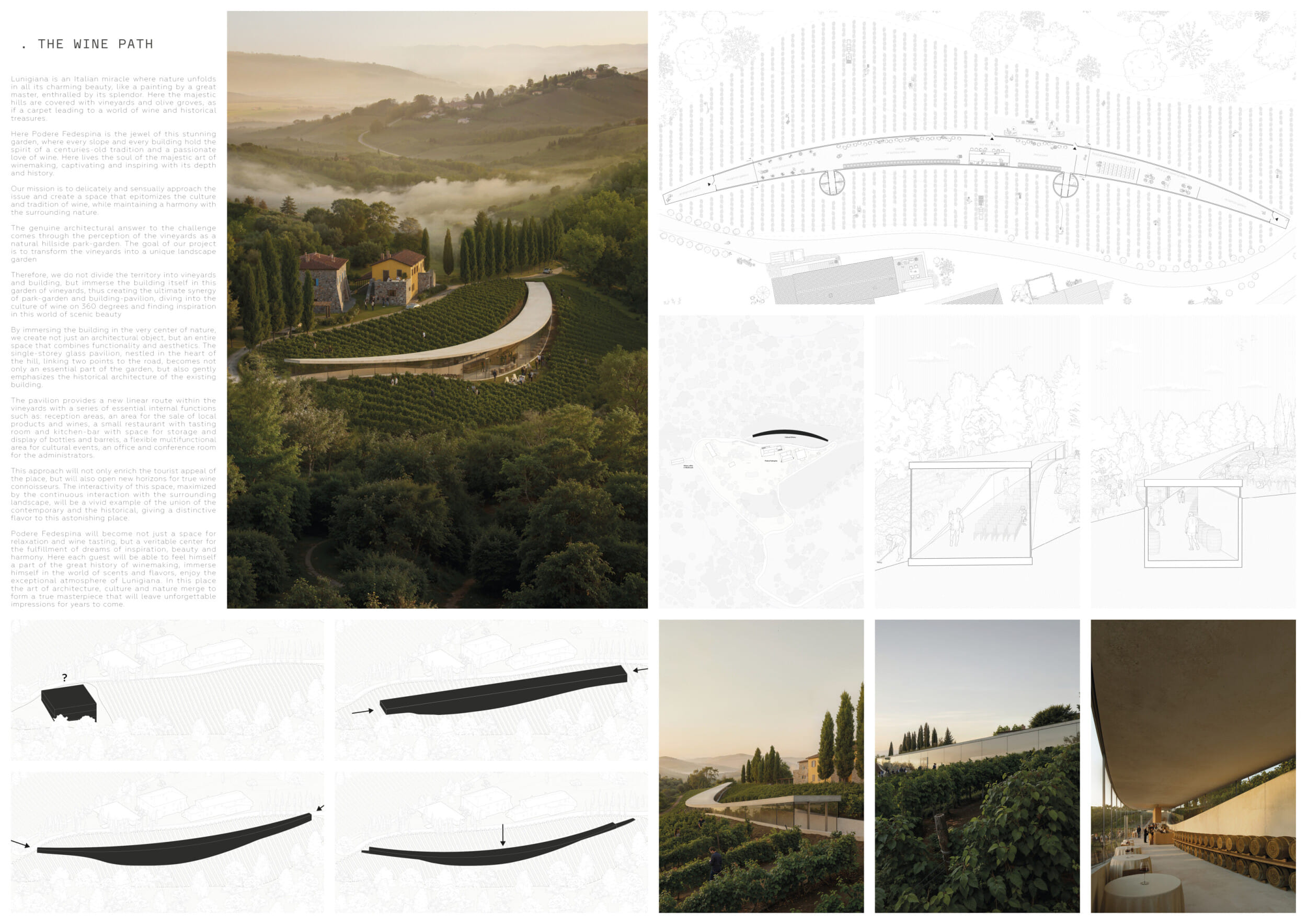
. the wine path by Tigran Danielian
Jury comment: “The presentation is anchored by compelling site photography that immediately conveys the spatial relationship between architecture and landscape. Diagrams clearly articulate the evolution of the form from context analysis to sectional studies, though annotation is minimal and could do more to unpack programmatic layers. The linework is precise, particularly in the plan and section cuts, with soft contrast maintaining focus on spatial flow rather than construction detail. The layout balances image and drawing, allowing the curved form to reappear across multiple media without redundancy. While the boards maintain a strong visual rhythm, text is dense in areas and typographically weaker than the visual content. Color use is minimal but effective, emphasizing natural tones. Diagrams would benefit from clearer labels or keys to guide non-expert viewers through the design logic.”
Large-scale category winner
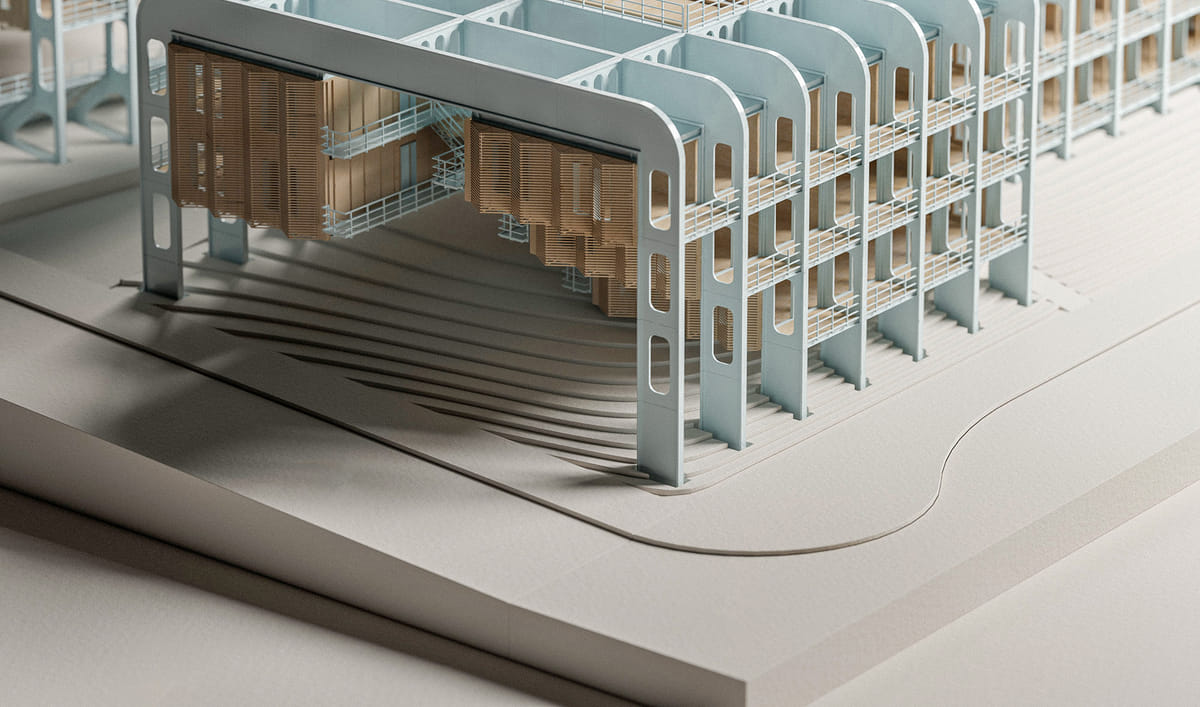
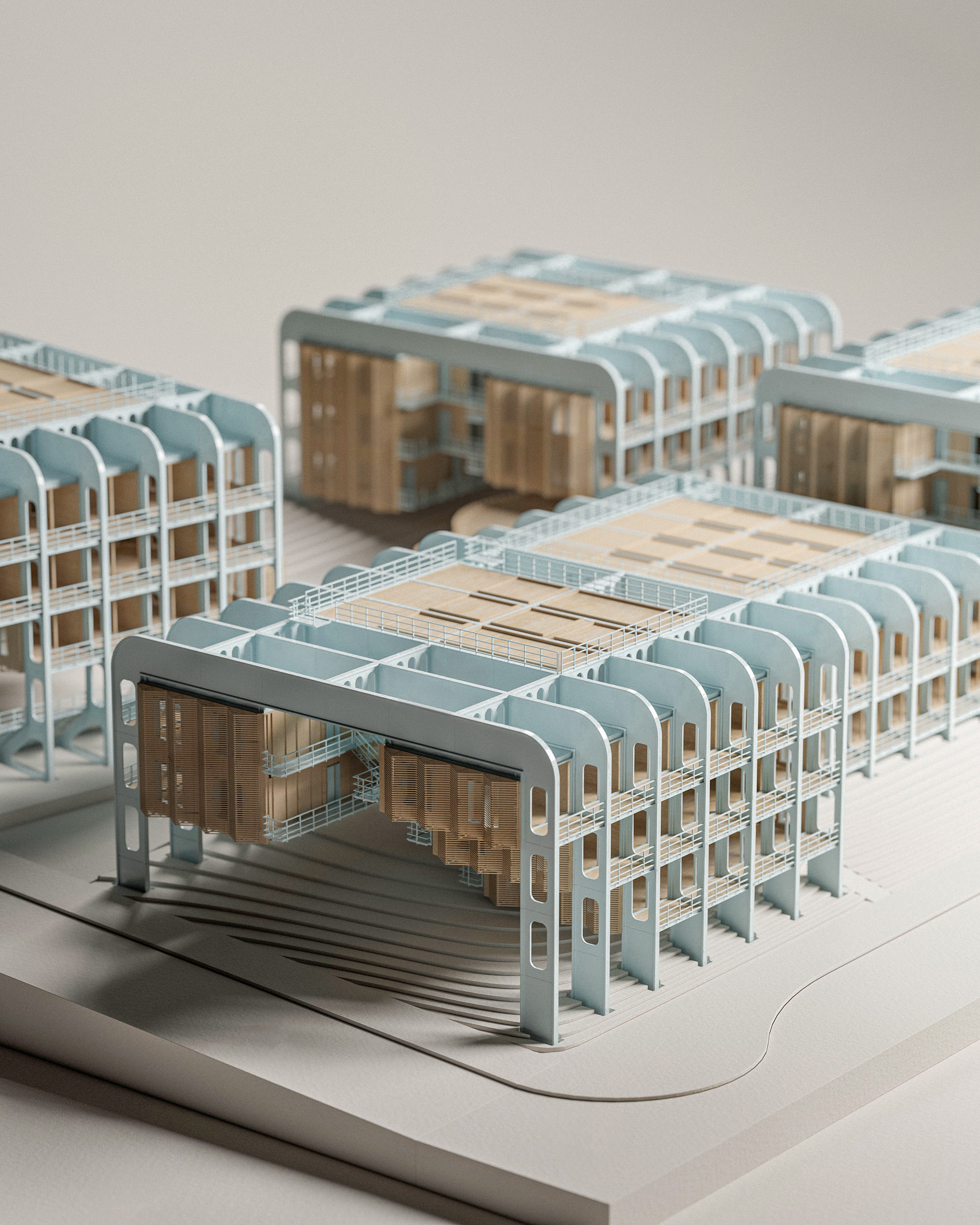
Theseus: A New Housing Typology by Emma Agnes Sheffer and Joe Robert Russell
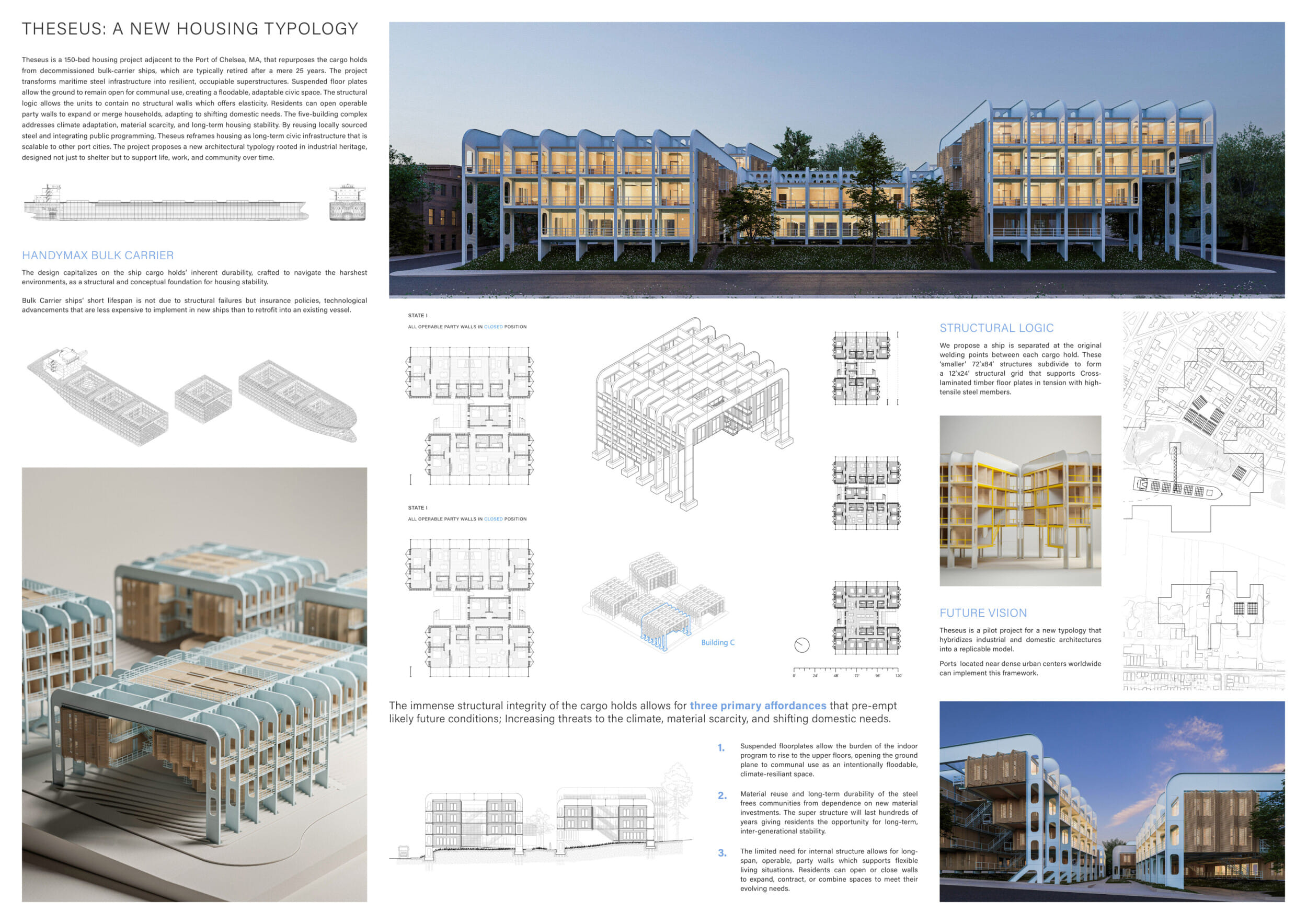
Theseus: A New Housing Typology by Emma Agnes Sheffer and Joe Robert Russell
Jury comment: “Theseus: A New Housing Typology proposes a 150-bed modular housing system adjacent to the Port of Chelsea, MA, utilizing the immense structural strength of decommissioned Handymax cargo ship holds. The project retrofits these steel structures into multi-story housing units elevated above the ground, forming adaptable living environments that address long-term urban resilience, material scarcity, and climate adaptation. The superstructure supports suspended floor plates, allowing the ground level to remain open and fostering flexibility in future use scenarios. By separating the steel shell from its original function and embedding new laminated timber floors within a tensile grid, the design celebrates industrial heritage while offering a replicable framework for dense, cost-effective infill. The proposal envisions scalable, ship-derived modules as part of a broader strategy for coastal cities grappling with housing shortages and post-industrial land reuse.”
The best presentation award 2025
Tranquillizing the Void by Xavier Arés, Koh Noguchi, and Juan Pablo Lopez Isabella
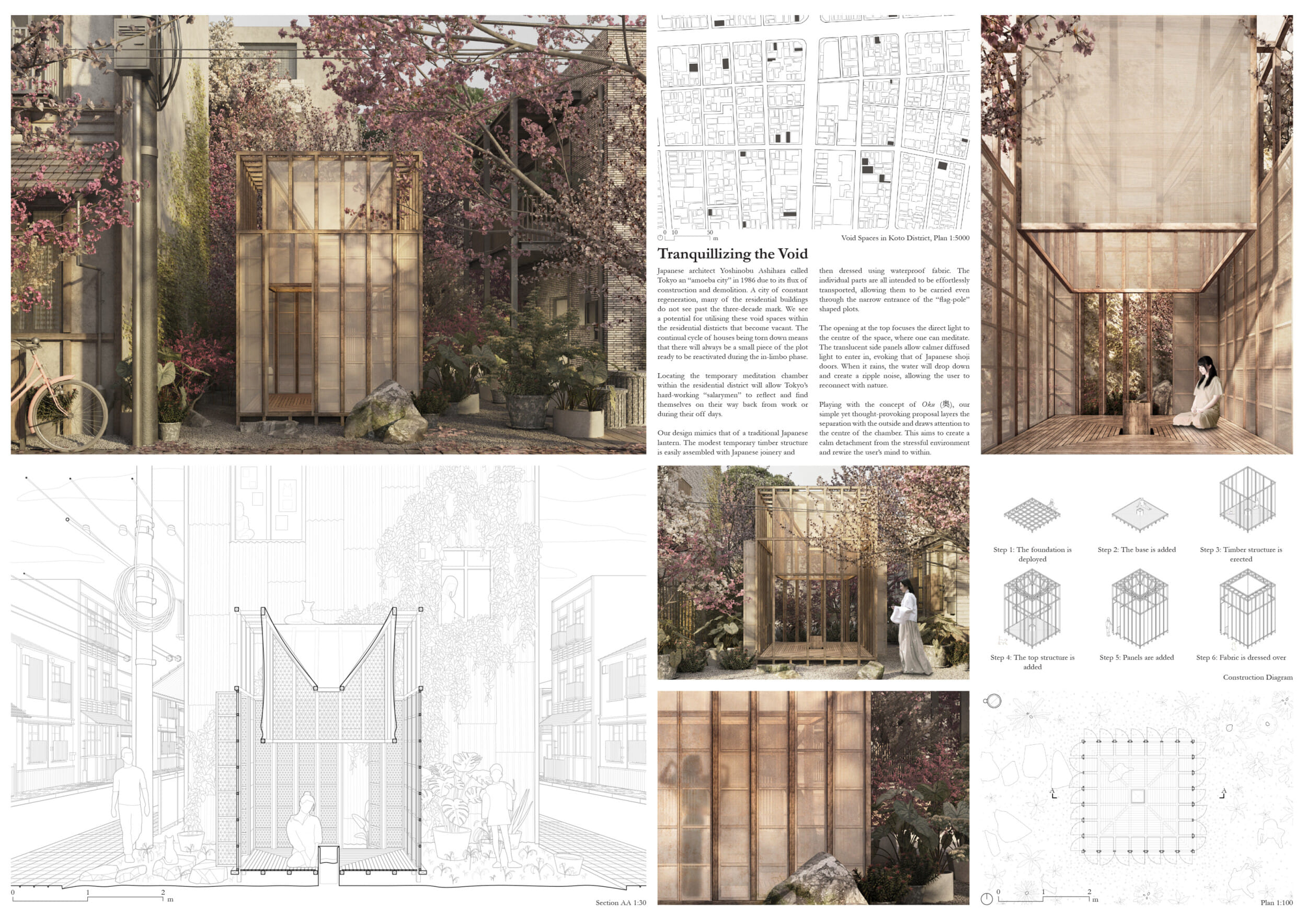
Tranquillizing the Void by Xavier Arés, Koh Noguchi, and Juan Pablo Lopez Isabella
Jury comment: “Tranquillizing the Void proposes a small-scale intervention in the underutilized residual spaces of Kyoto’s dense urban fabric. Taking inspiration from the Japanese concept of oku—the layered spatial experience of depth and retreat—the project introduces a light timber pavilion designed for reflection, solitude, and reconnection with nature. Its architectural language is minimalist yet refined, combining translucent polycarbonate panels, soft interior tatami, and open roof apertures that guide natural light inward. The drawings present a clear sequential logic, from context plan and elevation to an elegantly constructed sectional perspective and diagrammatic construction breakdown. The project balances simplicity with craft, proposing a replicable structure that can be adapted to the overlooked pockets of the city, offering moments of quiet amidst the urban rush.”
Some current competitions on Bustler that may interest you…
Architecture at Zero Competition 2026
Register/Submit by Mon, Jun 1, 2026

Call for the international architectural competition for the National Slavery Museum
Register/Submit by Wed, Apr 8, 2026
Design and Build: Soundscapes in Structure
Register/Submit by Sun, Apr 26, 2026
TIMBER IN THE CITY 6: Urban Habitats Competition
Register by Wed, Apr 8, 2026
Submit by Wed, Jun 3, 2026