
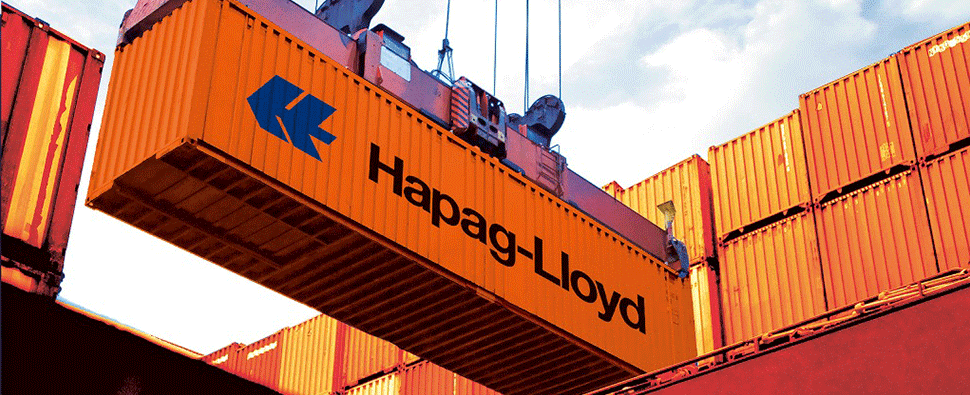
German container carrier Hapag-Lloyd has agreed to acquire Israel-based ZIM Integrated Shipping Services in an all-cash transaction valued at approximately $4.2 billion, marking one of the most significant consolidation moves in the container shipping sector since the pandemic-era boom.
The $35-per-share offer represents a 58% premium to ZIM’s February 13 closing price and a 126% premium to its unaffected share price in August 2025, before takeover speculation surfaced. Upon completion, Hapag-Lloyd’s global market share is projected to reach about 9.2%, cementing its ranking as the world’s fifth-largest liner operator behind Mediterranean Shipping Company, Maersk, CMA CGM, and COSCO Shipping, according to Alphaliner data.
The combined entity would command more than 4.8 million TEU of fleet capacity, including vessels on order, transport an estimated 17–18 million TEU annually, and operate a fleet exceeding 400 ships. The acquisition comes as carriers navigate softer freight markets, higher operating costs tied to prolonged Red Sea diversions, and ongoing alliance restructuring.
Network Expansion and Trade Lane Strength
Hapag-Lloyd CEO Rolf Habben Jansen described ZIM as a strong strategic fit, highlighting enhanced coverage across the Transpacific, Intra-Asia, Atlantic, Latin American, and East Mediterranean trades.
Geographic complementarity underpins the deal’s industrial logic. ZIM’s network significantly bolsters Hapag-Lloyd’s Transpacific footprint, potentially elevating the merged carrier into the top four on the trade lane through a projected three-to-four-point market share gain. The Atlantic corridor also benefits, with ZIM filling long-standing network gaps.
ZIM brings roughly 713,000 TEU of operated capacity across 117 containerships and 14 car carriers. Around 60% of its fleet consists of newer vessels, including approximately 40 LNG-powered ships—strengthening the combined group’s alternative fuel profile.
Management forecasts annual run-rate synergies of $300–$500 million, driven by network optimization, procurement savings, equipment pooling, IT integration, and rationalization of overlapping infrastructure. Hapag-Lloyd cited prior integrations—including UASC, CSAV, and NileDutch—as proof of execution capability.
The deal is also expected to reinforce Hapag-Lloyd’s role within the Gemini Cooperation, its strategic alliance with Maersk launched in February 2025, by channeling additional cargo volumes into the shared network.
Addressing Israeli National Security Interests
Given ZIM’s strategic importance, the transaction incorporates safeguards tied to Israel’s national security framework.
ZIM holds a non-transferable “Golden Share” controlled by the State of Israel. Under the proposed structure, that share will transfer to FIMI Opportunity Funds, the country’s largest private equity fund.
FIMI plans to establish a new domestic carrier, “New ZIM,” launching with 16 modern vessels serving trade lanes linking Israel with major ports in Europe, the United States, the Mediterranean, and the Black Sea. The company will operate under the ZIM brand and receive commercial and network support from Hapag-Lloyd, including access to Gemini alliance services.
FIMI founder and CEO Ishay Davidi emphasized the goal of maintaining a strong, independent Israeli shipping presence while partnering strategically with Hapag-Lloyd.
Shareholder Windfall Caps Volatile Cycle
The acquisition closes a remarkable value-creation chapter for ZIM investors.
Since its January 2021 IPO, ZIM has distributed $5.7 billion in dividends. Including the acquisition consideration, total capital returned to shareholders approaches $10 billion—roughly five times its initial market capitalization and 45 times IPO proceeds.
Under CEO Eli Glickman, ZIM transformed from negative equity in 2017 into one of the liner sector’s most profitable carriers during the pandemic freight surge, driven largely by Transpacific spot market exposure.
Deal Timed With Earnings Normalization
The takeover unfolds as liner profitability resets from pandemic highs.
Hapag-Lloyd reported 2025 revenue of $21.1 billion, with EBITDA of $3.6 billion and EBIT of $1.1 billion—down from $5.0 billion and $2.8 billion, respectively, in 2024. While transport volumes rose 8% to 13.5 million TEU, average freight rates declined 8% to $1,376 per TEU.
Operational costs linked to Cape of Good Hope diversions and Gemini alliance start-up expenses pressured margins, though management expects synergy benefits to accelerate through 2026.
ZIM’s board has unanimously approved the transaction. Closing is targeted for late 2026, pending shareholder and regulatory clearances. Until completion, both carriers will continue operating independently.