
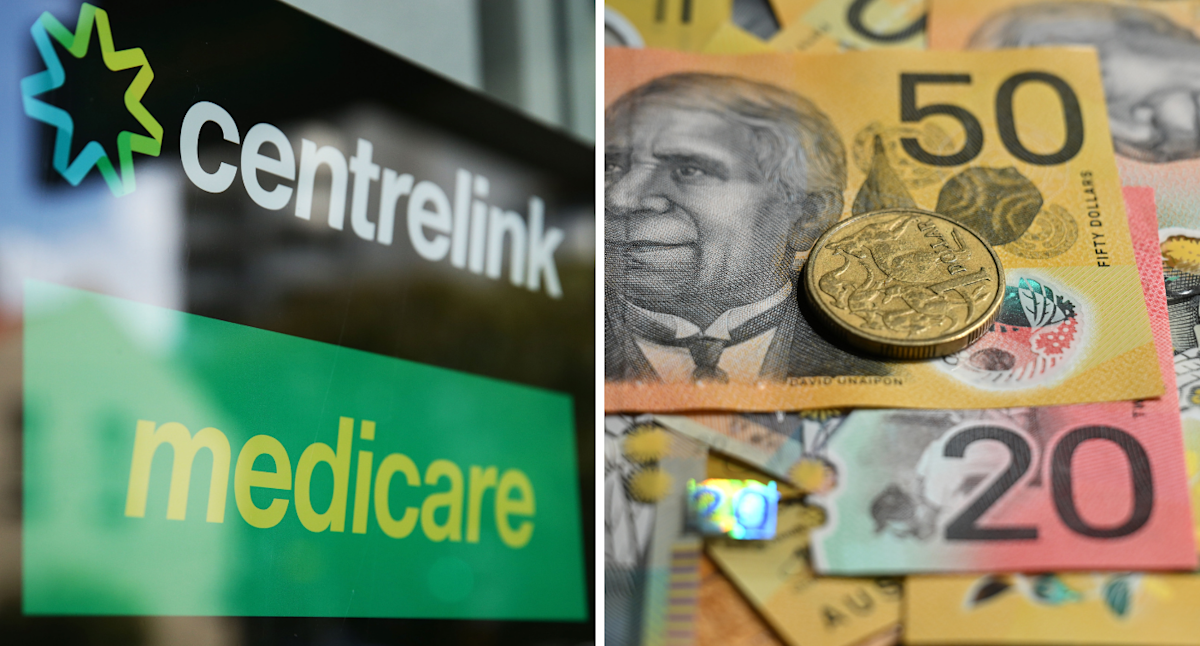
 Centrelink payments rates and deeming rates will increase on March 20. (Source: Getty)
Millions of Centrelink recipients will see a boost to their social security payments next month, while deeming rates will also increase again. Payments like the Age Pension and JobSeeker are indexed twice a year in March and September to keep up with inflation.
From March 20, more than five million people will see changes to their payments, rates and limits. That includes 2.6 million people on the Age Pension.
The government expects people getting the full single rate of Age Pension, Disability Support Pension or Carer Payment to likely see a $22.20 boost to their fortnightly payment.
RELATED
People receiving Commonwealth Rent Assistance, JobSeeker, ABSTUDY (aged 22 and over), and Parenting Payment will also see their payment increase.
“Thanks to indexation more than five million Aussies should expect to see a boost to their payments,” Social Services Minister Tanya Plibersek said.
These are just tentative indexation rates based on available data, with the government due to officially confirm new rates once final data is available in the coming weeks.
Deeming rates will also increase again in March, following an increase in September.
Deeming rates are the rates of return people are assumed to earn on financial assets and they impact calculations for Centrelink payments, including the Age Pension, JobSeeker and Disability Support Pension.
From March 20, the deeming rate of 1.25 per cent will apply for financial assets under $64,200 for singles and $106,200 for couples combined. Assets over this amount will be deemed at a rate of 3.25 per cent.
This is up from the previous rates of 0.75 per cent and 2.75 per cent, but are still below the official cash rate of 3.85 per cent.
The change follows a recommendation from the Australian Government Actuary, which has been accepted by the government. This is the first time deeming rates have been subject to the actuary’s assessment and advice.
“To make sure our social security system delivers value for taxpayers it must be grounded in fairness, which is why we have made responsible adjustments to deeming rates,” Plibersek said.
“We’ll continue to make sure the system is there to support those who need it most, ensuring that everyone can make ends meet and no one gets left behind.”
National Seniors Australia has labelled the increases as “modest” and noted it keeps the upper rate below the cash rate and well below returns on investments like superannuation and term deposits.
“While the increase will have some impact on pensioners, it could have been worse given interest rates remain stubbornly high,” National Seniors Australia CEO Chris Grice said.
“We have said consistently and still maintain – any upward change to deeming rates needs to be measured, incremental, and transparent to protect older people.
“If interest rates continue to rise and government reverts quickly to the old method to set deeming rates, there could be significant financial impacts, with lower pensions and higher aged care co-contributions.”
Deeming rates were previously frozen at lows since 2020 as an emergency pandemic measure, which had been extended until the recent September increase.
The government confirmed last year that it would be gradually increasing deeming rates to better reflect current rates of return.
Around 771,000 people who receive income support payments have their rate affected by deemed income, as of June 2025.
Those impacted include about 460,000 aged pensioners, 96,000 on JobSeeker payments, 62,000 disability support pension recipients, and 57,000 Parenting Payment single recipients.
National Australia expects the 0.5 per cent increase in deeming rates will be largely offset by the increase in the pension.
Get the latest Yahoo Finance news – follow us on Facebook, LinkedIn and Instagram.