
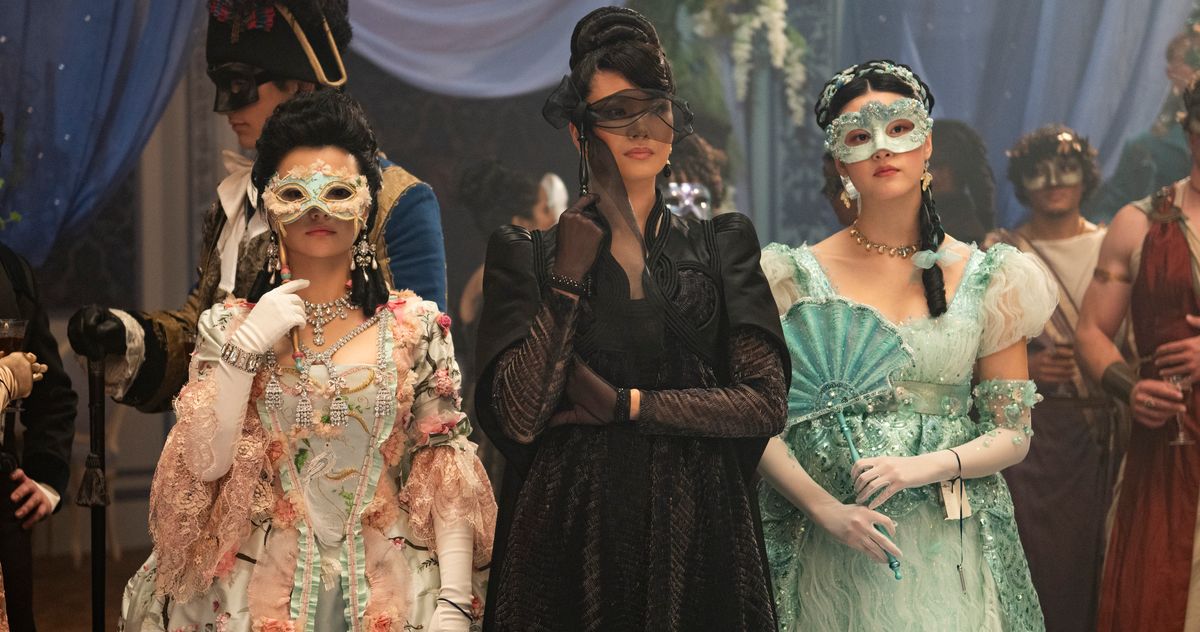
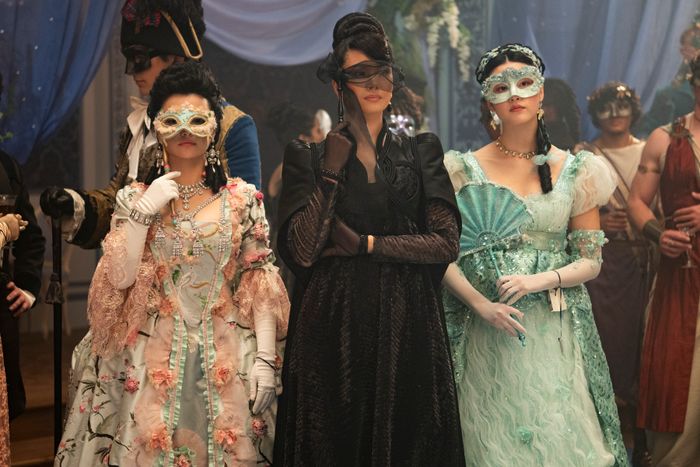
“No one talks about the Earl of Penwood being an asshole. It’s like, ‘God, Araminta is evil.’ But I’m like, ‘Hello?!’”
Photo: Liam Daniel/Netflix
Spoilers follow for the first part of Bridgerton’s fourth season, which premiered on Netflix on January 29.
Katie Leung knows what Bridgerton fans think of Lady Araminta Gun, Sophie Baek’s stepmother and season four’s chief antagonist. She’s heard the Disney-villain comparisons. She doesn’t really agree.
On the one hand, Lady Penwood has tormented Sophie since her father’s death, denying her parentage, forcing her into servitude, and working her to the bone. On the other hand, the Regency world of Bridgerton, for all of its post-racial politics, is still a classist hierarchy. Since she was born out of wedlock, Sophie’s existence could smear the Penwood name and diminish the marriage chances of her stepsisters, Rosamund (Michelle Mao) and Posy (Isabella Wei). For Araminta, a woman who has always lived within society’s strictures, Sophie is just another rule to follow — and Leung does so with sneering menace, extravagant goth gowns, and a purposefully maternal approach.
“Her motivation is motherhood,” says Leung, who broke out in the Harry Potter films as Cho Chang and has since worked steadily in British TV and theater. “As a mother myself, it’s an inexplicable need to ensure that your children live their best life. You’ll do anything so that they’re happy and content.”
“For Araminta, ‘happy’ is probably not her main thing,” she adds, laughing. “But it’s the same kind of drive.”
You’ve said of Araminta that she is “someone who has chosen to live with this scarcity mind-set, which has informed her decisions and the way she is, and it unfortunately does not bode well for her.” What did you mean by that?
I was speaking for her as a woman in that time period and everything that she’d been through up until then. She hasn’t lived a bad life by any means, but she’s had that scarcity mind-set. Once upon a time, I was somebody with a scarcity mind-set, and I would think that people were taking things away from me and the world was unfair. It really never served me, and it’s only now that I’ve come out of it that I see it.
For Araminta, she’s had a first husband who she had two children with, and she decided that he wasn’t the love of her life. It was something she had to do as a woman and something she accepted. He died and she was left as a widow and single mother to two daughters, without an heir. Then she found a second husband she adored and was in love with — to then lose him and have this ward she was unaware of. When things happen to you in succession like that, it can put you into a really dark place. But I don’t think all hope is lost in her case. There is perhaps a glimpse at the end of someone who might change.
There’s such an insistence on a male heir in this world. When I look at Araminta in those terms, more than any other character this season, she reflects how the patriarchy is still very real, and a lot of her choices are in reaction to that. A male heir could come along and be like, “I have the title now, get out,” right?
Yeah, exactly. And it’s funny, because no one talks about the Earl of Penwood being an asshole. [Laughs.] It’s like, “God, Araminta is evil.” But I’m like, “Hello?!”
You come home to your new husband, and he’s like, “Hey, by the way. I had a mistress, and here’s the child.”
People are like, “Why can’t she accept that?” She might not have married him if she had known about it. And once you lose that trust in a relationship, it’s really hard to go back to a place when it was all lovely.
You said of working with Yerin Ha, who plays Sophie, “You just want to match that, when you’re working with somebody that great. She made me want to try harder.” Was there a scene from part one where you were really challenging each other on set?
We didn’t have that many scenes together in the end, but I feel like we had way more scenes because, as Araminta, she’s always my focus. The sign of a good acting partner is someone who makes you feel like you can try different things and someone who’s always giving you something a bit different, so then you respond differently. We had time to rehearse the scene where I fire her. We were able to map out where we were going to be and the energies we’re going to give each other. We had a great director, Jaffar Mahmood, and Jess Brownell, the writer and showrunner, was in the room when we rehearsed. It wasn’t totally polished, but we had a sort of template. On the day, there was good humor and good banter in between takes. Yes, Sophie’s a maid, and yes, she’s inferior to Araminta, but I never felt that with Yerin as the actor. I constantly had to shift Araminta’s movement or her physicality, because you can’t just yell or do the normal things that you would think make you superior to somebody. It’s a dance — a constant dance — and we were dancing. There were enough different dynamics and energies happening throughout the scene that it didn’t feel stale.
You get the sense in that scene that Araminta has reached a breaking point. It’s more in her interest to keep Sophie around, but she’s over it.
It’s a big decision! As much as people might view it as she’s putting Sophie in her place, she was doing the opposite. Araminta actually showed her vulnerability by firing her, because it was a moment where her emotions got the better of her. She’s always been very good at keeping her emotions at bay and being practical and ambitious. She perhaps even regretted making that decision afterward. She’s constantly on edge, whether Sophie is in her life or not. Sophie gets fired and she’s not around, but that doesn’t mean that she doesn’t exist in the world anymore. If anything, Araminta becomes even more anxious because she’s not under her watch.
In your audition, you were encouraged to evoke Anna Wintour. What did that mean for you at the time, and did you keep up that Anna Wintour element through your performance?
It was something I let go of, because it wasn’t something that I was very aware of and I felt like it might restrict me. The costumes restrict me enough on a physical level. [Laughs.] But Anna has a very iconic look: She’s always got the shades on, so you never really get to look into her soul or see her eyes. That’s kind of imperative when you’re an actor. With Araminta, she does have something about her that is impenetrable. You don’t know what she’s thinking. In that sense, there’s a similarity. But Araminta does have eyes! Eyes that, like, could kill.
How did Araminta’s costumes affect your performance?
Funnily enough, they weren’t as constricting as I had imagined. Everyone in the costume department did everything they could to ensure that I was as comfortable as I could be. As someone who doesn’t wear dresses — I’m always in sweatpants and joggies — anything they put me in is always going to be a tad constricted. [Laughs.] But I felt like a million dollars. I have really bad posture, and these dresses did not allow for bad posture, especially once I’m in my heels and I have my fan and I’ve got the wig and the makeup on. The minute I was dressed fully, I was 80 percent there. Every time I went in for a fitting, I’d be like, “This is my favorite dress … No, this is my favorite.” I definitely had the best costumes out of everybody.
The diamond shoe clips Posy gives Sophie that Araminta then accuses Sophie of stealing — did you play it as Araminta knew they were fake?
I played it as though she wasn’t aware. I haven’t read the book, so I don’t know if there was more to that backstory.
Now I sympathize with Araminta, because she probably overpaid for these shoe clips.
She definitely got f’d over.
Part one ends on the cliffhanger that Araminta and her daughters are moving next door to the Bridgertons. They don’t know Sophie is working there, but Araminta is still looking for her. Does Araminta see herself as an investigator, someone who could use various detective skills to find Sophie?
I feel like it’s innate in Araminta — not that she’s particularly a good investigator, but she’s someone who is always on the lookout. She’s on edge. She’s got eyes at the back of her head. She will find any way to track down Sophie, regardless of the risks or the relationships she’s perhaps compromising, to get that job done. There’s her ambition and determination, but I think she’s really scared.
We also see that Varley left the Featheringtons to join Araminta’s household. Tell me about working with Lorraine Ashbourne.
Lorraine is a legend. She just has funny bones — she’s got it in her body, and it brings a certain energy into the room and into the performance that keeps you on your toes. Outside of our scenes, we chatted about motherhood. She looks at everything with curiosity and fascination. I learned a lot just from observing her. It would be easy for Lorraine as Varley to go into a really dark place as an actor, because you’re like, My boss is the worst person in the world. But she’s almost unfazed by it, and that’s what makes it funny. Araminta is trying to hold everything together, she’s really anxious, and Varley’s the opposite.
There’s a moment in part two, which comes out on February 26, where Araminta and her daughters speak Cantonese. You’ve said that suggestion came from showrunner Jess Brownell. How did that come about?
It was a really casual conversation. She called me one day with the idea, but we hadn’t decided where we were going to put it. At one point, I had my own version of what it would be, because within Cantonese, there’s phrases that I would and wouldn’t say and things that are more authentic to my upbringing. In the end, it was Jess who decided where it was going to be, and we had a student from Oxford or Cambridge give us the translation of that moment. I was a bit apprehensive because of the era; I wasn’t sure if my modern Cantonese would suffice. I looked at period dramas in Cantonese, which I used to watch growing up. I asked Isabella’s mum to help, because Isabella’s from Hong Kong. Her mum sent me some voice notes for several phrases for a different scene. In the end, we went for that particular one that we see now. It’s a very short phrase, so it was easy enough for me to repeat it, but it’s not something I have ever said in my life.