
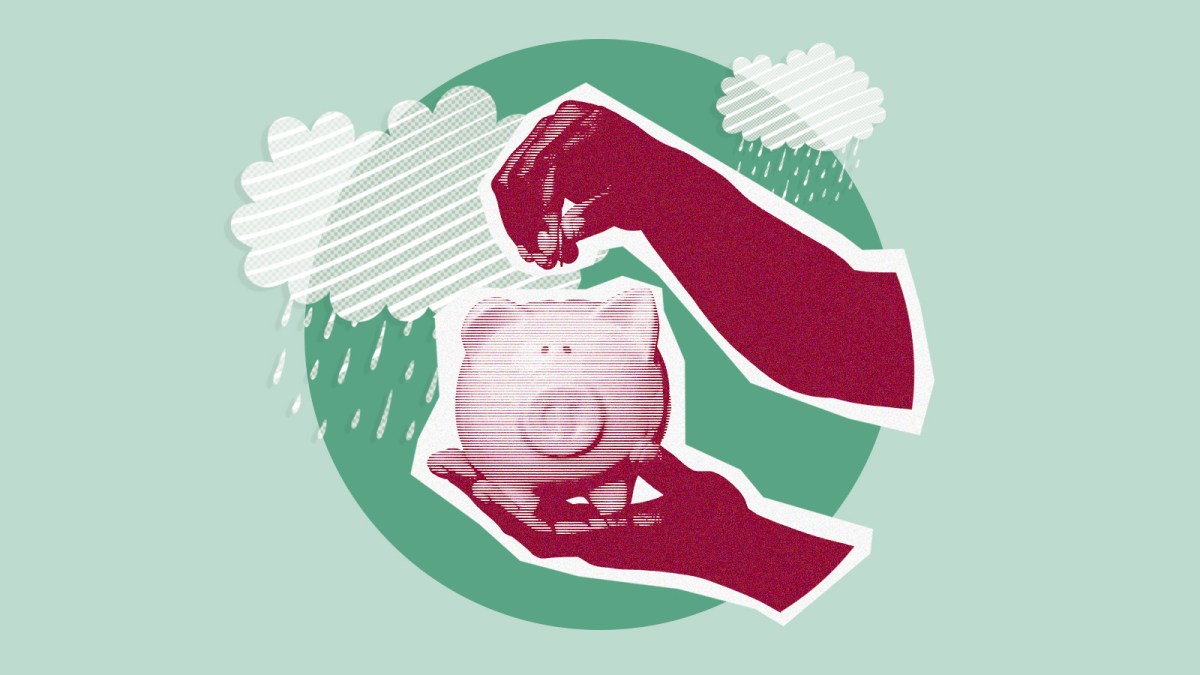
The start of this year has been one of the wettest on record. But Joseph Murray, who has linked his savings to the weather, is in a bright mood: 40 days of consecutive rain has boosted his pot by £800.
Until six years ago, the 33-year-old had struggled to save money. “I’d hit a bit of a brick wall. I had about £2,000 in my savings account and had been desperately trying to get beyond that, but I never could.”
In the hope of changing this, Murray, who works in administration in the NHS and lives in London, committed to turning bad weather into good habits and used wet days to save for a rainy day. Every day that rainfall was forecast in his area, he set aside £20. The result has been a complete overhaul of his saving strategy, and after six years his pot has grown to more than £16,000 thanks to the English weather.
“It’s about changing habits,” he said. “You kind of leave it in the background — I barely notice it half the time. But I was committed and consistent with it and continued to be really strict. [Reaching]£16,000 was a big milestone.
“I never thought I’d be in the position to own a home, but with this habit change I can actually save for a deposit and get closer to my long-term financial goals.”
He used the personal finance app Plum to help him. Its Rainy Days Rule allows users to save either £1, £2, £5, £10 or £20 each time it rains. Users set aside an average of £88 a month or £1,056 a year. Once the account holder adds their postcode, the app transfers the money into their savings account each time rain is forecast in their locality. Plum has seen a 36 per cent increase in people using the Rainy Days Rule since January 1.
Murray said: “Consistency matters way more than the amount you’re saving — just being consistent and really, really pushing to build that as a habit. And because of this rule I’ve been able to form those habits naturally rather than it being a stressful exercise.”
• What everyone in their twenties needs to know about money
Alexandra Rees also discovered that imposing new rules changed her relationship with money. “I was awful at saving; I was a case study of what not to do with your money,” said the 45-year-old.
Rees, who lives in Vauxhall, London, and works as a management consultant at a communications firm, decided to curb her spending and prioritise saving by putting a “tax” on herself. Any time she makes a purchase with a retailer that is a guilty pleasure, a percentage of the purchase is moved into her savings account. She has the rule set up for transactions with a number of online retailers as well as chain coffee shops such as Starbucks.
She said: “It’s a self-imposed tax, so it makes you think twice before you do something and it slows you from a hot emotional state of being drawn to something like Asos to thinking, hold on, I know if I spend money at this shop I’m going to tax myself for it.
“It’s about checking yourself so you can be more mindful with your spending.”
• Our five-point plan to make Britain better off
Alongside other saving habits, the tactic has helped Rees amass about £25,000. Although she is not saving for anything in particular, the pot has eased her mind about her financial future. “The current economic uncertainty makes me think I need to look out for myself more. Nothing feels very stable and we don’t know what pensions are going to look like then.”
Rajan Lakhani from Plum said: “There is a feedback loop from these types of saving challenges and rules that can nudge people towards other good money habits. Building up confidence around your savings can lead you towards taking the first steps in investing, and so on. It’s a virtuous circle that builds over time.”
Plum also has a “1p challenge” to help account holders to build a savings habit. On the first day of the challenge, 1p is taken from the saver’s current account and moved into savings. Each day, another penny is added to the amount taken until the saver has reached almost £668 by the end of the year.
• Visit Times Money for personal finance news, guides and expert columnists
Vicky Reynal, a financial psychotherapist, said these methods work because they trigger the brain’s reward system. “When the rules are a bit playful, it makes an activity that many people find daunting or simply boring into something more fun,” she said.
It also removes the effort of decision making. Reynal added: “Money decisions are demanding, both cognitively and emotionally, and the more choices we face, the more likely we are to avoid or postpone them. A simple, pre-set rule removes negotiation and willpower from the equation. These cues create a behavioural shortcut known as habit stacking, attaching a new behaviour to an existing routine.”