
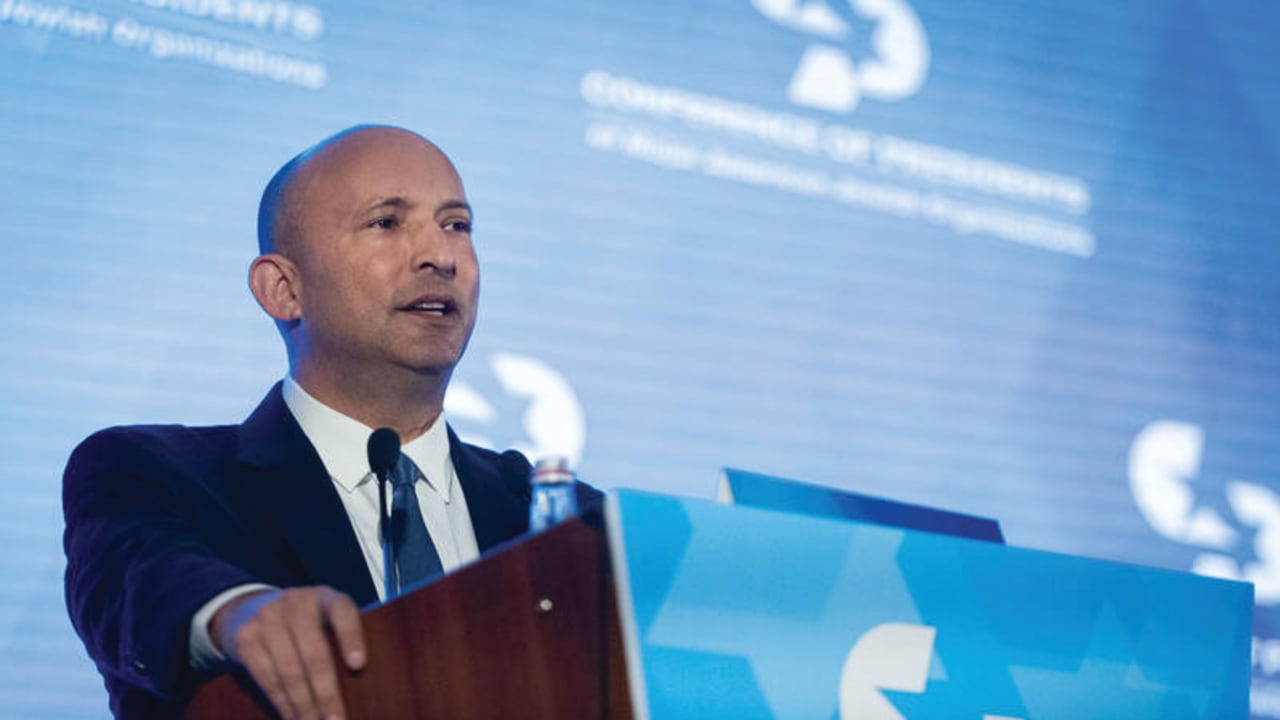
After two years away from political life, former prime minister Naftali Bennett has emerged as a leading candidate in the upcoming elections, presenting a strategy for Israel he says he carefully built during his time away.
Speaking to over 1,000 English-speakers and olim (immigrants) in Tel Aviv last week, Bennett outlined his plan to improve the country, saying he would implement it immediately if reelected.
“I’m not promising anyone the moon. What I am promising is a decent, competent, transparent, and just good government for the State of Israel that works for you,” he told the audience.
His party, Bennett 2026, positioned on the Right of the political spectrum, has been trailing Prime Minister Benjamin Netanyahu’s Likud in recent polls ahead of elections set to take place no later than the end of October.
The heart of Bennett’s proposal for repairing the country is to conduct a state commission of inquiry into the October 7, 2023, Hamas attacks, improve education, reduce the cost of living, and prioritize security above all else.

Bennett claimed to have spent time with over 100 experts across numerous fields to develop his plan while he was away from politics.
“What that means is on the first day of our new government, I’m not going to waste precious time on preparing plans or setting up committees. We’re going to hit the ground running,” he said.
“We built a plan to fix Israel’s biggest problems in all areas,” he added.
“I want to share with you what we’re actually going to do and then how we win,” he told the crowd.
The content of Bennett’s Olim event
Kicking off the event held entirely in English, Bennett remarked that as the child of parents who made aliyah from the US, he doesn’t take Israel for granted.
“Thank you not only for coming to the event but for making aliyah to Israel, and I guarantee you, it’s the single best decision you’ve made in your life,” he told the crowd of English-speakers hailing from around the world.
“Look, I could spend the evening talking about the current government’s failures. There are a lot of them, but everyone’s doing that. So, I choose to focus this evening on my vision for Israel, my plan for Israel, and how we’re going to fix Israel together,” he said.
“Something we all feel, especially Americans who make aliyah or folks from abroad – we feel that the government’s not working. Public service doesn’t work well. Incompetent,” he said.
“In my government, ministers are going to be accountable. Every minister will receive transparent, measurable goals.
“I’m going to put through a temporary executive order to go back and reexamine every political appointee of the past few years and replace anyone who doesn’t meet the professional standard.”
Bennett said that on his first day in office, his government would decide to establish a state commission of inquiry to probe government failings that took place during the October 7 Hamas attacks.
“We’re not going to let anyone cover up October 7,” he said.
The political echelon has repeatedly blocked a state inquiry into the events surrounding the attacks, despite polls showing huge public support for this type of investigation. Netanyahu is the only one among the major officials who has not resigned following the October 7 massacre.
“After such a colossal, systemic failure, the nation of Israel deserves real answers,” he asserted.
Another aspect Bennett said he would address as prime minister would be canceling the law that the current government is advancing that claims to draft haredim (ultra-Orthodox) to the IDF. Critics argue that the law is a political measure that will not enforce conscription.
Bennett spoke about the importance of haredim serving in the IDF, as the military warns it is suffering from a lack of manpower.
“With this government, right now, there are 100,000 young haredim, perfectly healthy, that could be trained…. And right now, they’re passing a law precisely so we don’t bring them in.
“The Torah states, time and again, that when there’s a war, everyone goes to fight. All our heroes were fighters. Joshua was a fighter. Abraham was a big fighter and a businessman. Gideon was a fighter. King David was a huge fighter. They all fought in the army.”
Bennett said he would also work to pass a law limiting the time a prime minister can be in power.
“I want to tell you that power corrupts, and absolute power for long periods absolutely corrupts. The people of Israel are greater than any individual leader,” he said.
Another core goal of Bennett’s government would be to lower the cost of living.
“Now, Israel is one of the most expensive places on earth. And it doesn’t have to be this way. This isn’t some force majeure. It’s not a force of nature. It’s about mismanagement.
“Essentially, what we’re going to do [is] break monopolies, break up cartels, open the market, open exports, imports, competition, competition. And the most immediate tool for doing this is also reducing regulations. Because regulations create bureaucracy. We need to cut those regulations with a chainsaw and lower prices for Israeli citizens and for businesses.”
Bennett also promised that his government would work to repair Israel’s international public standing.
He reflected that when he was prime minister, he put together a hasbara (public diplomacy) unit to advocate for Israel. “We called it the hasbara section, and it worked well,” he recalled.
Bennett’s past political experience
Bennett praised the accomplishments of the previous government and the work he had done as prime minister.
“In my government, in one year, we did what most governments don’t achieve in four,” he said.
“We reduced crime. We reduced the number of Israelis murdered in Israel from criminal murders by 30% from year to year.
“We granted tax credits to working parents. We brought quiet to the South for the first time in 20 years because I had a policy of not one single rocket, and we hunted Hamas day in, day out. We lowered the prices in dozens of areas by opening competition.
“And we did all of this while taking the country from a huge deficit to a nice surplus.”
Bennett became prime minister in June 2021, entering a rotation government with opposition leader Yair Lapid (Yesh Atid) after four elections were held between 2019 and 2021. His government was the first in Israel’s history to include an Arab party, adding the Ra’am Party to the coalition in a highly controversial move.
Bennett’s decision to partner with Lapid also drew criticism among his own voters. His government was dissolved one year after its formation, and Lapid took over as prime minister until Netanyahu returned to power in the 2022 election.
During Bennett’s time as prime minister, the party he led was Yamina. After his fragile coalition’s ultimate collapse, Bennett stayed on the sidelines and quietly left the political sphere.
Meanwhile, his Yamina Party ran under former justice minister Ayelet Shaked in the last elections but failed to pass the electoral threshold.
Other parties Bennett led were Bayit Yehudi in 2013 and 2015 and New Right in 2019. Bennett had served in various portfolios under Netanyahu throughout the years in roles that included defense, education, and economy minister. Before entering politics, he had built a career working in the country’s hi-tech sector as an entrepreneur.
Bennett’s return and his new direction
In a major move to return to political life ahead of the elections, Bennett officially registered his party, Bennett 2026, in April. It had been unclear what his vision was for the party and campaign at the time of the announcement.
Since registering the party, Bennett has remained relatively distant from the press, avoiding interviews and instead speaking mainly at conferences and events.
He has engaged in talks with party leaders within the opposition bloc. Bennett had been offered by former IDF chief of staff Gadi Eisenkot (Yashar!) to form a united list with Lapid in January.
Yet, the burning question surrounding Bennett is whether he will be willing to form a government with Netanyahu after the elections. With opposition parties pledging that Israel’s next government will be devoid of Netanyahu’s presence, Bennett has not directly stated his stance on the matter. However, in a seeming first this week, he indicated what his position would be.
He said on Tuesday that Israel needs “new leadership” following the October attacks, suggesting that he would not be willing to form a government with Netanyahu after the elections.
“I will not allow failed leadership to continue. I intend to lead Israel into its next chapter, stronger,” he told the Conference of Presidents of Major American Jewish Organizations in Jerusalem.
“After three decades since coming to power, and after the greatest disaster in Israel’s history occurred on his watch, a leader must know when to step aside with dignity,” he added, without mentioning Netanyahu by name.
Bennett’s recent moves to strengthen his campaign team have also been viewed as an effort to apply pressure on rival candidate Netanyahu, political sources say.
The former prime minister added two senior American political consultants and pollsters, Anthony Fabrizio and George Birnbaum, to his team at the start of February.
Fabrizio currently serves as a central adviser and pollster to US President Donald Trump. He also served as Trump’s pollster during both the 2016 and 2024 presidential campaigns
Birnbaum has taken part in every general election campaign in Israel since 1996, as well as in more than 20 national election campaigns around the world, Bennett’s office said.
The move has been viewed as a way for Bennett to get closer to key figures and demonstrate that he can work with Trump. Fabrizio and Birnbaum both advised Netanyahu in the past.
Birnbaum was also Bennett’s strategist ahead of his 2021 election win. Bennett’s political career had hit a low point in the 2019 elections, when his New Right Party failed to cross the electoral threshold.
At the time, Bennett appeared defeated. Yet within two years, he succeeded in his goal of becoming prime minister.
“I was always the one to say you have to stay independent and keep your options open,” said Birnbaum in 2021 after Bennett’s election win. “I fought tooth and nail to make sure Naftali wouldn’t commit to one camp or another.”
“I told him that you always have to run to win,” Birnbaum had added. “Anything can happen. The hand of God plays a role.”
In 2019, it seemed that Bennett’s political career was over, but two years later, he emerged as prime minister. Now, as Israel heads toward another election, Bennett is back in the race and aiming for what could be his biggest comeback yet.