
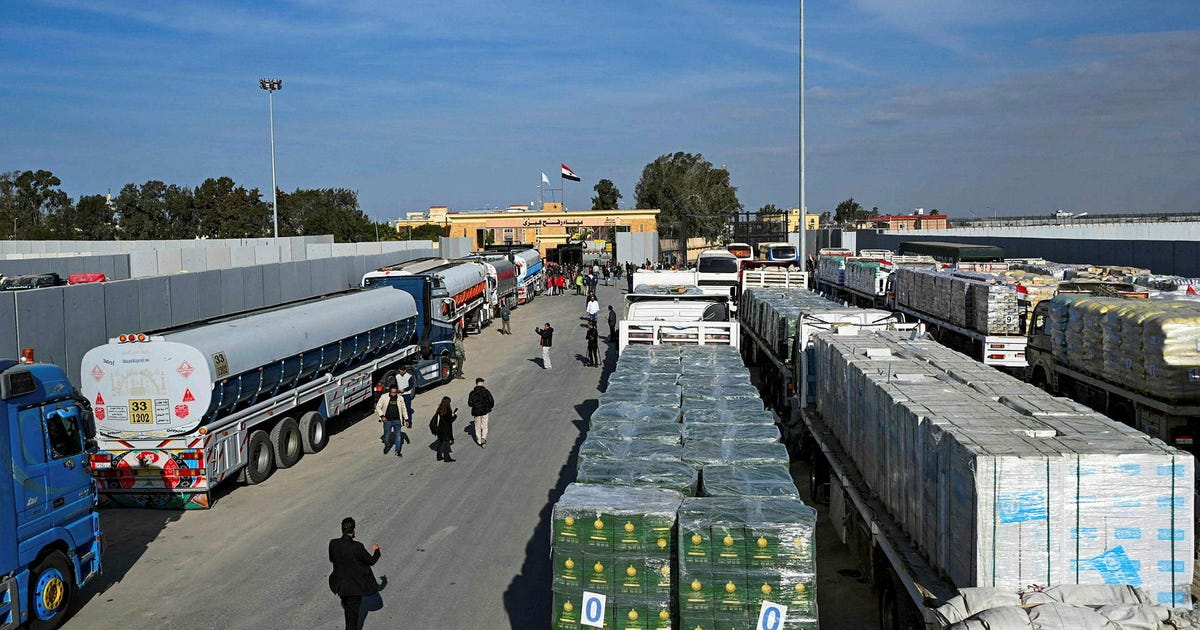
Israel’s Diaspora Affairs Ministry announced this week that the British-based NGO Oxfam will cease operations in Gaza after its Israeli registration lapses, part of a broader move affecting 37 international aid groups that refused to comply with new government data-sharing requirements.
The announcement came as the ministry also highlighted a recent interview on Britain’s Channel 4 in which Oxfam’s former CEO, Halima Begum, alleged the organization had disproportionately focused on the Israel-Gaza war and faced internal pressure to label it a genocide before sufficient legal review – claims Oxfam strongly denies.
Oxfam, which is comprised of 21 affiliates operating all over the world, was included on a list released in late December of organizations whose Israeli registration was set to lapse, meaning that they would have to halt their work in Gaza, the West Bank and East Jerusalem.
 Close
Close
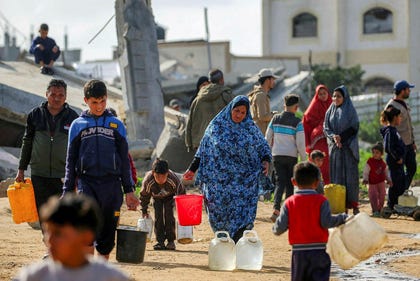
People fill up water containers from a mobile cistern in the Maghazi camp for Palestinian refugees in the central Gaza Strip on February 11, 2026. Credit: Eyad Baba/AFP
People fill up water containers from a mobile cistern in the Maghazi camp for Palestinian refugees in the central Gaza Strip on February 11, 2026. Credit: Eyad Baba/AFP
The organizations listed, 37 in all, refused to comply with new registration requirements that went into effect on January 1, including providing the Israeli government with the personal information of their employees working in the Palestinian territories, many of whom are Palestinians themselves.
“INGOs cannot transfer sensitive personal data to a party to the conflict since this would breach humanitarian principles, duty of care and data protection obligations,” a statement from Oxfam released in January read. “This is not a technical or administrative matter, but a deliberate policy choice with foreseeable consequences. If registrations are allowed to lapse, the Israeli government will obstruct humanitarian assistance at scale.”
Bushra Khalidi, Oxfam’s policy lead in the Palestinian territories, explains that in Gaza, the organization does a lot of work on water and wastewater infrastructure. They “work with the local municipalities to deliver water, to provide technical support,” she told Haaretz. They also work with the private sector and groups like the Palestinian Farmers Union.
Haaretz Podcast’It’s a disgrace. Israelis have had enough’: Amid ultra-Orthodox riots, fury over IDF draft-dodging peaks
play
Haaretz Podcast
‘It’s a disgrace. Israelis have had enough’: Amid ultra-Orthodox riots, fury over IDF draft-dodging peaks
Volume: 0.5
X1
total– : –time0:00
fast forward15
play
rewind15
The deregistration will not significantly upend their operations, she said. “We’ve known about this coming for the last year, so from our perspective, we’ve been kind of preparing for the last 12 months for how we’re going to handle this.”
Oxfam’s method of having local partners lead in executing projects will help them survive. “But a lot of our peers do direct implementation and rely on direct implementation, and their activities will certainly cease if they have not already,” she said of organizations that execute the projects by themselves.
“When journalists ask me, ‘What are the implications of your organization’s closure in Gaza?’ I say, ‘Well, okay, I guess people will be swimming in more sewage.’ The bar is so low right now. The implications are terrible already,” she said.
Related Articles
The question, Khalidi said, should not be what will happen to organizations that are deregistered, but what could happen if they were to be allowed to work unhindered. “I’d love to imagine a world where actually we could operate in Gaza without our operations getting attacked by Israel, our convoys not getting bombed, our colleagues not getting killed, our items not rejected and just blocked at the crossing … What would that do to the population of Gaza?”
The Diaspora Ministry, in the same statement, pivoted to highlight another controversy regarding Oxfam. “On a separate but related note,” it read, before discussing a recent interview given by the organization’s former CEO, Dr. Halima Begum.
The interview was given by the organization’s former CEO, Halima Begum, to the United Kingdom’s Channel 4. Begum alleged that Oxfam paid disproportionate attention to the Israel-Gaza war and pushed to brand it a genocide before receiving evidence or proper legal counsel.
Begum told Channel 4 that “It’s important to obviously work around the rule of law and maintain that the international rule of law must not be compromised, but we have to show consistency with other crises that are taking place in the world, and it always felt as though we were disproportionately working around the crisis in Gaza.”
“But other examples include quite strong push back when we were not ready yet to use the word ‘genocide'” in relation to Gaza, “because to use the word genocide, it has to be something that we arrive at with consultation and evidence and good legal advice. To try and use that term before we’re ready as an organization feels quite risky to me.”
The statement quoted Diaspora Affairs Minister Amichai Chikli as stating, “Dr. Begum herself, who is Muslim, has been a vocal critic of the State of Israel. Therefore, when she testifies about the level of antisemitism within the organization and levels these accusations herself, her remarks should resonate around the world all the more.”
Oxfam denied Begum’s accusations. In response to the interview, Oxfam said: “The claims made in the broadcast represent one individual’s perspective and are strongly disputed by Oxfam Great Britain as unsubstantiated and inaccurate,” it read. “We have a zero-tolerance approach to discrimination, harassment and abuse of power in all areas of our work – including racism, antisemitism, sexism and homophobia. These standards apply across the delivery of our programs worldwide.”
It added that its institutional position on Israel and the Palestinian territories “has been clear and consistent for decades,” and that the decision to use the word “genocide” was made “only after a thorough legal review and following widespread research and consideration of credible analysis by organizations and experts mandated to make such legal verdicts such as the International Court of Justice, the UN Commission of Inquiry and Amnesty International.”