
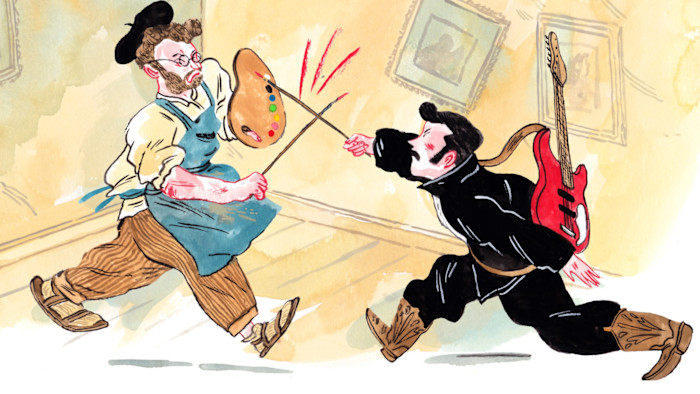
“It’s very hard for a famous person or a powerful person to become a successful artist,” says Marc Glimcher, president and chief executive of the international Pace Gallery. “There’s no real history of that.”
Such is the plight of every Hollywood or pop A-lister who also yearns to become an art star. From the brushy landscapes of the legendary crooner Tony Bennett to the warped figurative sculptures of Brad Pitt, almost every celebrity’s studio practice is met with scepticism by the art establishment. But a closer look reveals that viable paths to approval do exist. The devil is in the detail.
One factor is which type of celebrity wants to cross over. Movie and pop stars turned artists have typically fared poorly among the art world’s elites. In 2025, for instance, the street art-inspired canvases by Oscar-winning leading man Adrien Brody and the Jackson Pollock-indebted drip paintings by chart-topping troubadour Ed Sheeran received a scornful response from critics, as did a London solo show by singer Robbie Williams. Although the obviousness of their influences contributed to the backlash, their station in the entertainment ecosystem likely mattered, too.
“There’s a very clear progression from filmmaking, which is a feast for the visual senses, to a fine art practice,” says the art adviser Meredith Darrow. “The translation from music and acting to the visual arts, while valid, is more convoluted and therefore not as easy or clear for galleries and institutions to understand.”
American collector Jeff Magid suggests a particular power dynamic may be at play. He wonders if the “legacy art world” may be “more willing to accept filmmakers as artists because they seem to them more like the boss in a film’s hierarchy, whereas actors may seem to them more like paid employees in the service of someone else’s creative vision”.
A double standard is at work: mainstream stars often get VIP treatment as art buyers but quick dismissals as art makers
Indeed, a sizable and growing list of filmmakers has been embraced by galleries and museums with industry-wide credibility. David Lynch, whose movie career grew out of his early education as a painter, is currently the subject of his second cross-disciplinary solo exhibition at Pace, this time at its Berlin outpost (until March 29). Photographs, sculptures and multimedia works by John Waters — whose boundary-testing films earned him the nickname the “Pope of Trash” — featured in a travelling survey organised by the Baltimore Museum of Art in 2018-19, as well as several gallery shows at Sprüth Magers.
The decorated indie writer-director Jim Jarmusch has exhibited collages at James Fuentes Gallery in New York and LA. Fuentes sees little separation between Jarmusch’s lauded work in cinema and his collages: “It’s the same hand, the same mind, a similar approach, just a different medium.” What’s more, unlike the stars who unveil their artwork as a third-act plot twist, Jarmusch had been making his collages for more than 20 years before publicly exhibiting them.
Still, decades of dedication are not always enough to guarantee a celebrity’s artwork will transcend their star power. Take Sylvester Stallone, whose painting practice began in the 1960s, and tends to centre expressionistically rendered figures (often strapping, shirtless men), bold colours and scrawled messages like “Our little lives are big deals”.
“The biggest barrier to entry is that people don’t realise he was an artist long before he was an actor, writer or producer,” says Shawn David, a partner and director at the Palm Beach gallery Provident Fine Art, which became the exclusive representative of Stallone’s artwork in March 2025. “He always says, ‘I’m an artist who found celebrity through acting and writing, but I’m an artist first’.”
Magid sees a double standard at work when mainstream stars intersect with the art establishment: they often get VIP treatment as art buyers but quick dismissals as art makers, both of which, he suggests, “perpetuate the exclusionary class system that has kept the art world so small”.
The kicker is that many of the celebrity artists locked out of the upper-echelon galleries, museums and art fairs are doing just fine in terms of sales. History shows that fame all but guarantees the cooperation of a dealer at some level of the market. A few even stock their inventory with works by multiple mainstream stars; C Parker Gallery, with locations in Manhattan and Greenwich, Connecticut, offers surprisingly whimsical lithographs by Muhammad Ali, pastel-hued abstractions by Sharon Stone and painterly still lifes by Bob Dylan, among others.
A steady stream of buyers and regional institutions justify dealers’ interest in celebrity-made art. David, of Provident Fine Art, said in late January that he had sold 25 of Stallone’s paintings in the eight months prior, for prices up to $850,000. The Rocky multi-hyphenate has also been the subject of solo exhibitions at the Russian State Museum, France’s Nice Museum of Contemporary Art and the Osthaus Museum in Hagen, Germany.
Sheeran wrote in an August 2025 Instagram post that sales of his artwork had raised more than $1.25mn for charity. In 2023, Johnny Depp sold more than $3.6mn worth of prints struck from portraits he’d painted of celebrity friends and role models.
Whether they have resale value is murkier. Late-in-life paintings by Frank Sinatra have found buyers at auction 23 times since 2018 and soared as high as $137,500 (with fees), per Arthur Analytics. On the other hand, Stallone and Depp have only had three auction sales each over this time period, all for less than $16,500. To date, one Brody lot has sold under the hammer, for $1,548 (with fees) — which is one more than Sheeran or Stone has had.
So is this work pop culture kitsch — or a golden opportunity to expand art’s appeal? The answer, it seems, is in the eye of the beholder. “At the end of the day, it’s about democratising our field a bit — which I’m all for,” Fuentes says. “But I don’t think everyone is.”
Find out about our latest stories first — follow FT Weekend on Instagram, Bluesky and X, and sign up to receive the FT Weekend newsletter every Saturday morning