
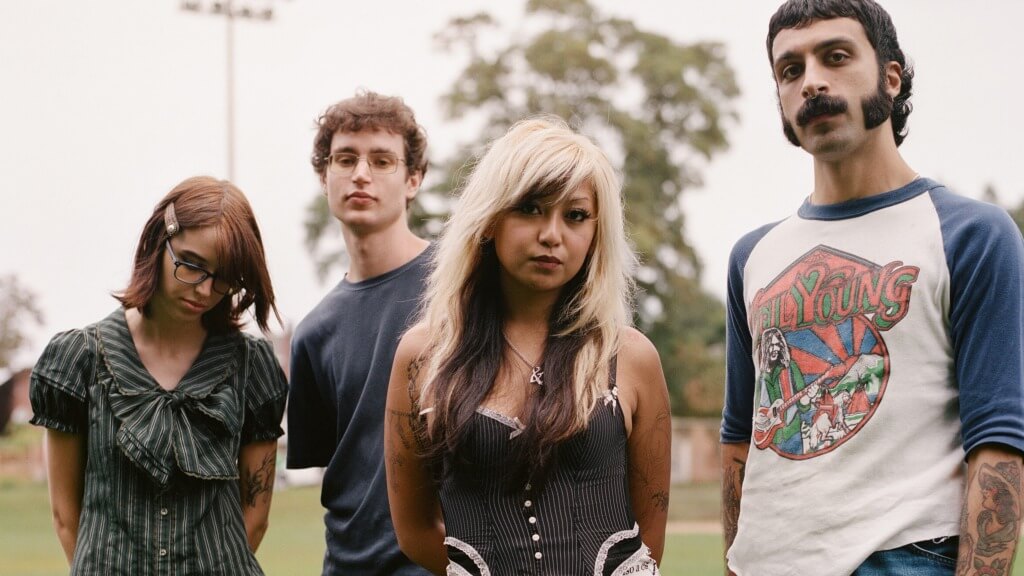
When cootie catcher’s video call fills my laptop screen, the Toronto four-piece are lounging on a couch at their practice space, framed by a massive, regal Lady and the Unicorn tapestry on one wall.
“Oh! Wow. Big tapestry,” I say, dumbly. “That’s the, like, famous one, right?”
“Oh, uh, I have no idea what this is,” guitarist/vocalist Nolan Jakupovski replies, completely caught off guard.
Giggling, bassist‑vocalist Anita Fowl then offers to “show the Gibby” instead, an ostensibly baffling suggestion Jakupovski immediately turns down—but it’s fine, because somehow, I know exactly what Fowl means. Given that the band and I are roughly the same age, there’s really only one thing they could be referring to. I, like a surprising number of people I know, had a friend in college who had a tapestry of shirtless Gibby from iCarly on his wall too—we called it the Gibby flag—and I spent far too many nights freshman year downing bad drinks in solo cups beneath the Gibby to not instantly put the pieces together. I say as much and against Jakupovski’s initial sheepish hesitation, the band dutifully pans the camera to the flag, and there he is: Gibby, arms out, nipples blazing, staring angrily down at them like a deeply stupid patron saint.
“We’re just at our practice space,” Sophia Chavez (DJ, vocals, synth) says by way of explanation: they didn’t choose either decoration, they just came with the room. Neither should be taken, then, as some sort of statement; it’s not like the band picked them out themselves. But even so, a part of me can’t help but find the juxtaposition between the medieval unicorn and the Jesus-figure of late 2000s television (this is a joke, but I stand by it) oddly fitting. This is a band, after all, whose music smashes past and present together, treating history and established genre not as something to fetishize but as raw material for something twitchy, bright, young, and pointedly present‑tense.
cootie catcher—Jakupovski, Fowl, Chavez, and drummer Joseph Shemoun—have become a minor obsession in Toronto’s DIY circuit by doing exactly that. They write jangly, heart‑on‑their-sleeve indie pop that could pass for classic twee if you only heard the guitars. Except it’s not just guitars: the band weaves tinny drum machines, chopped‑up vocal snippets, and live‑triggered glitches into each measure, making the songs feel less like a scene revival and more like someone snuck a laptop into a basement band.
They’ve been called “laptop twee,” and while the band acknowledges it’s an accurate description (their music is, definitionally, rather twee, and they certainly use laptops in the process of making it) something in Jakupovski still rankles at the categorization: “Like, technically, that is correct,” he admits. “But we’re writing such different songs from other bands that sound like that. I don’t know.” The discrepancy perhaps comes from the role the laptop itself plays in their sound: it’s an instrument in the band like any other instead of the outfit’s raison d’etre. Where some laptop‑twee peers foreground DAW chaos as the main event, cootie catcher keep the songs themselves stubbornly, almost old‑fashionedly, band‑shaped. The computer isn’t there to dissolve verse‑chorus‑bridge into internet paste; it’s there to jab at the songs from the sidelines, add a whistle here, a wrong‑sounding hi‑hat there, an uncanny clatter in the corners.
cootie catcher’s upcoming third album, Something We All Got—an acronym for SWAG, which serves as the band’s personal “be yourself” mantra—is the first time that approach has been rendered at full, studio‑level resolution. Where 2025’s Shy at first sounded like a brilliant mess of bedroom pop and indietronica effortlessly stitched together on the fly, Something We All Got retains that unpredictability but smoothes out the edges, blending the live instrumentals with their computer-created counterparts so fully they’re often indistinguishable. The album is all bright, chiming guitars pushed forward, Shemoun’s live drums and Jakupovski’s drum machines playing chicken with each other, and three lyricists orbiting the same half‑block of late‑capitalist bus rides, half‑formed relationships, and the specific anxiety of trying to be a person in a world that keeps lapping you.
Three‑quarters of cootie catcher—Jakupovski, Fowl, Chavez—have known each other since high school (Catholic high school, in fact) in Mississauga. The band started as what Fowl describes as a pandeming recording project more than anything like a career move: they wanted to learn how to play an instrument “better, or at all,” so they roped their boyfriend, Jakupovski, into making songs with them as an excuse to practice. Live shows weren’t on the vision board quite yet, considering live anything was a long way off for everyone back in 2020. The pair put out a couple of tracks that were, by their own telling, “pretty dumb” and “a little silly,” the sound of two people figuring out how to write together without worrying about how any of it would work on a stage.
When I ask them when cootie catcher stopped being “just” a fun pandemic duo and became an actual group in their minds, Fowl doesn’t even have to think about it. It happened, they say, “pretty much as soon as we were gonna start playing live,” when Chavez joined on synth and DJ controller and a childhood friend came in on drums, although the latter ended up bowing out when touring was on the table (it’s a lifestyle that’s not for everyone, that’s for certain). Once Shemoun—a drummer who earned his stripes in a high-school church band and just so happened to also love touring—stepped in permanently, “we really found our formula,” Fowl says. “The band solidified when Joseph joined and we all got comfortable with each other.”
From there, the “formula” is less about genre than logistics. On the recording side, most songs still begin with Jakupovski alone, writing on guitar and building a beat around whatever he’s come up with. He’ll obsess over tiny choices—making sure the electronic kit sounds “tinnier” (Fowl mistakenly says “tingier” at one point, and he teases them mercilessly), keeping kicks at a level a real drummer can actually play with—precisely so they won’t box Shemoun out later. Some older tracks, he admits, are impossible to pull off live because the original beats weren’t built with a human in mind; on Something We All Got, you can hear the adjustment in real time, in the way those drum‑machine clacks leave pockets for fills and cymbals, in how often the laptop seems to be playing with Shemoun rather than over him.
Vocals and lyrics, meanwhile, work like a loose‑rules auction. Whoever ends up singing a song writes their own melody and words, but that decision rarely comes down to “this sounds like a Sophia song” or “this feels like Anita.” More often, it’s pure practicality: if Jakupovski’s guitar part is too gnarly to play and sing at once, someone else has to front it; if Chavez is already juggling complex DJ controllers and synth, piling lead vocals on top can be a bridge too far. On Something We All Got, that division of labor means all three songwriters get fast songs and slow ones, moody tracks and giddy ones, verses they trade back and forth and songs they completely own—it’s less three lanes than a roundabout, with everyone merging and peeling off as needed.
You can hear all three approaches ricocheting off each other on Something We All Got. In “Straight drop,” Fowl struggles to choke down emotion—“I’d rather cry in public / than in front of you”—then tries to convince themselves to take “what I can get / even if it’s not all that I ever wanted.” In “Gingham dress,” Chavez describes being eight months into a limbo relationship and realizing only then that the other person won’t commit; she plays “pseudo wife,” cleans the bottles off their desk, wrestles with the lack of closure. Jakupovski’s “Puzzle pop,” meanwhile, zooms out to a more ambient frustration—trying to get home from somewhere that suddenly feels too far, trying to know someone who refuses to try to know you. (Although Jakupovski and Fowl have been a couple for years, their relationship is rarely the subject of their songs, for fairly obvious reasons. Their relationship is part of cootie catcher’s origin story more than its lyrical engine; the songs stay zoomed in on city streets, bad days, and lopsided crushes, not intra‑band drama.)
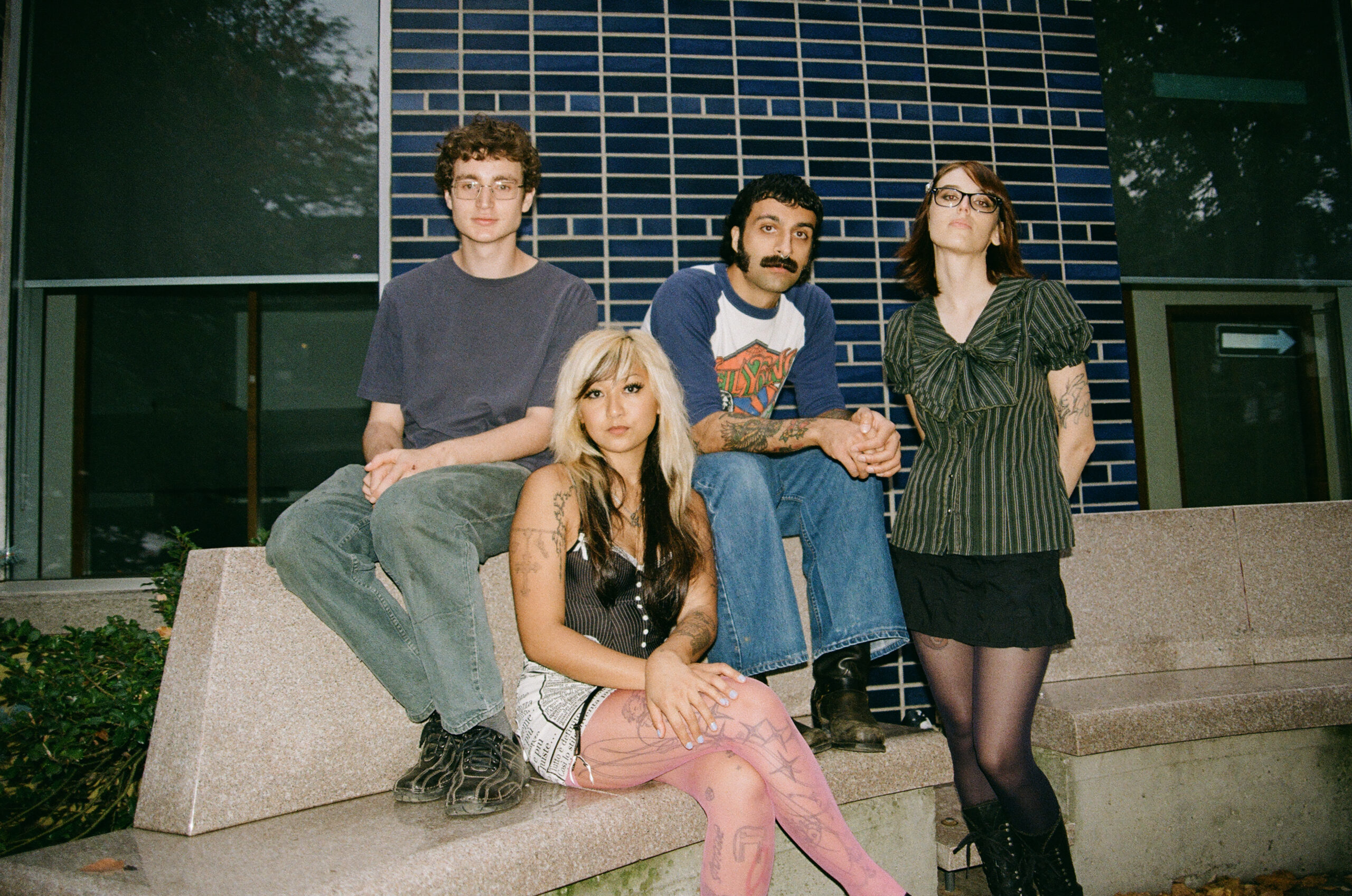
One of the surprises of cootie catcher is how rarely any of that individualism gets them into a fight. On paper, they’re a recipe for permanent deadlock: three singers, three lyricists, four people with wildly different record collections, zero shared “desert island band” picks. “It’s like a four‑way Venn diagram,” Jakupowski says of their collective music taste. “I don’t know if there’s one band that we all agree on.” Chavez concurs: “Between all four of us? No.” Fowl tries to think of even just a single song they’d have the same opinion on, but quickly calls it quits: “It’d take too long.” When they try to imagine making a covers set, everyone simply groans. “Everyone would just be like, this sucks,” Shemoun laughs.
But even so—“We never, like, argue over this stuff,” Jakupovski says. “We all do agree about what we’re making.” Each member is, as Chavez puts it, “in charge of [their] own part”: Shemoun sneaks in kraut‑rock‑ish patterns when he can; Chavez leans toward DIY looseness and “kid aesthetic” in her melodies; Fowl thinks in comic book‑like narratives; and Jakupovski makes sure the whole thing doesn’t tip over into either pure laptop mush or straight rock bandness. Vision, for cootie catcher, is apparently the easy part. Taste, on the other hand, is chaos—and that’s how they like it.
If there’s one place cootie catcher actually do agree, it’s on what the band is and isn’t trying to be. They’re happy to wear the twee tag, if need be—”Although we’re definitely going more the Ivy route,” Jakupovski insists, “We’re not doing, like, a Dean Blunt style thing”—but Fowl is quick to clarify that they “did not start out with the intention of being twee,” and that the label stuck after the fact rather than being a mission statement. They prefer to think of themselves as a strange, present‑day branch off an older tree—an older twee, if you will. In Jakupovski’s head, cootie catcher is what would happen “if a Beat Happening‑type band were in this age”: simple, emotionally direct songs put through a laptop without letting the computer become the whole point. The band name‑checks Disco Inferno’s late‑’80s collision of samples and guitars, the German micro‑scenes around Lali Puna and Guther, the way Everything But the Girl and Saint Etienne made dance music feel like full bands. The common thread between these acts, to cootie catcher, is their ability to “mold the acoustic and electric at the same time and do it actually live.” In that sense, the twee is just the vehicle. The cootie catcher effect, then, feels less like a scene revival and more like a Trojan horse: familiar indie‑rock shells smuggling in lofi beats and chopped‑up samples.
That’s where their allergy to capital‑N Nostalgia comes in. They’re suspicious of anything that feels like costume play, especially in the lo‑fi realm. “I’m not a huge fan of throwback stuff,” Jakupovski admits. “I feel like being lo‑fi on purpose really places a song in a specific time. I would like to make something timeless.” Shemoun is even more blunt about his preferences—“I would definitely always want to go to a studio. I’d rather everything sound hi‑fi and crisp and clear.” The closest they come to a self‑applied genre tag is a bit Jakupovski tosses off about their beats: they’re aiming for something that sounds like the MIDI music in a Greek restaurant, plasticky drum machines clacking away under very human guitars and voices. “That’s what our beats kind of sound like,” he laughs. “The genre is Greek restaurant.”
For Fowl and Chavez, both visual artists who graduated from OCAD and still juggle art and teaching alongside the band, the aversion to retro is less about fidelity than about feel. Chavez talks about embracing a naivete in both her drawings and her lyrics—DIY, messy, unembarrassed by childlike framing. Fowl compares their songs to their comics: smaller, conversational story panels strung together, not some big oil painting of a concept. Both grew up on bedroom pop and lo‑fi records, and Fowl (like yours truly) will still ride for the scrappier versions of bands like Car Seat Headrest, but what really matters is a song having “a good recording,” not an era signifier.
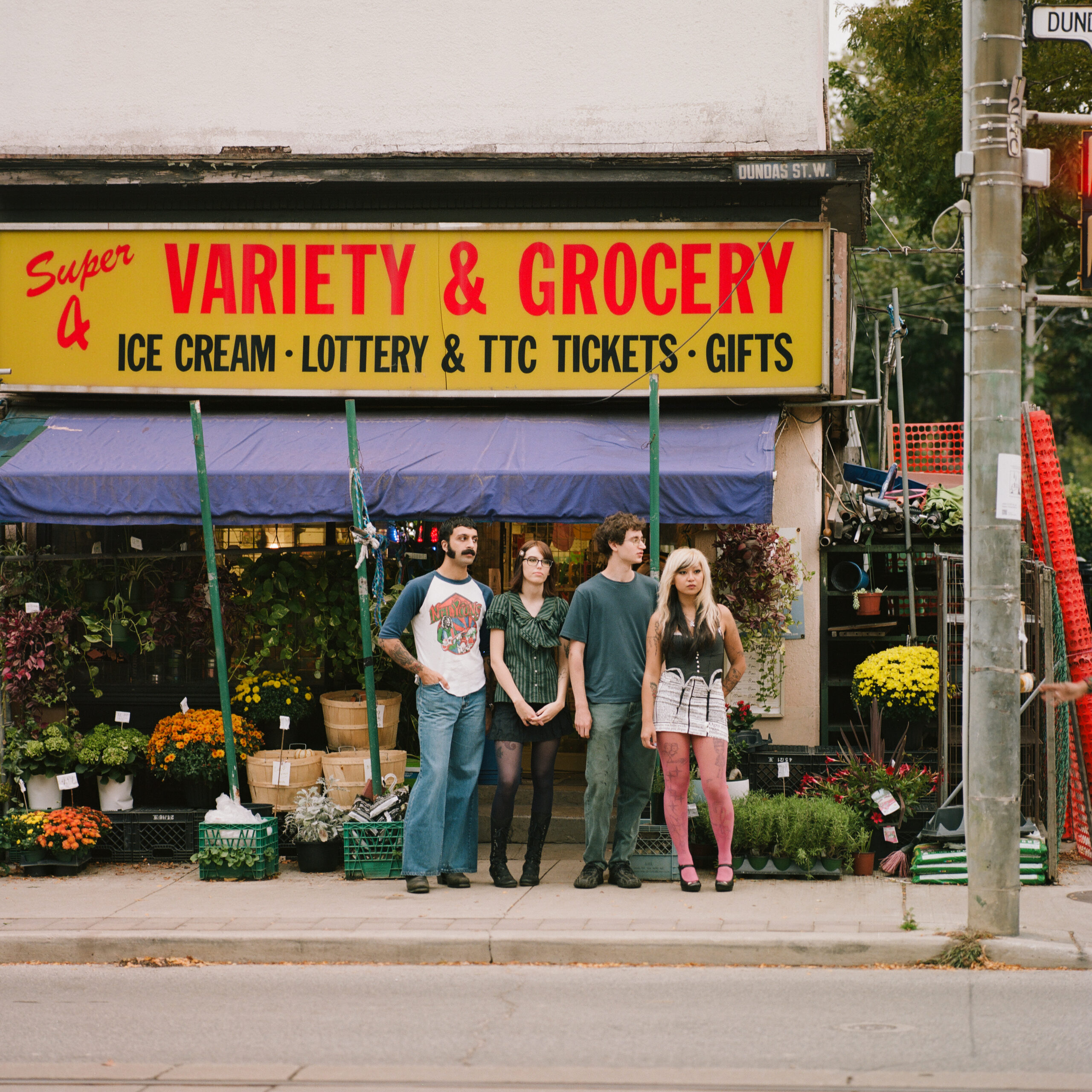
Between the split‑up process and the lack of a common musical taste, there are a lot of reasons why Something We All Got could easily feel like three mini‑albums stapled together, but it never does. Part of that cohesion is sonic—those bright guitars and Greek restaurant MIDI textures glue everything together—but a lot of it comes down to scale. They all keep gravitating to the same size of story: extremely small. “We pretty much just write about what we know,” Fowl says. “So it’s a lot of mundane, day‑to‑day life stuff, but that probably also keeps the songwriting unified.”
That shared mundanity is important enough that they joke about what would happen if someone broke the spell. “It would be crazy if, like, two of us were like that and one of us was, like, a super fantastical storyteller,” Fowl laughs. “God, imagine if one of us tried to write an Edgar Allen Poe thing.” Jakupovski quickly lays down the law: “We would have to have a conversation about it.” Shemoun, who hasn’t written a cootie catcher song yet, sees his opening: “Just wait until I write a song,” he deadpans. Everyone cracks up. “Okay, yeah, when Joseph starts singing, we’re gonna have to sit down and have a serious talk about it,” Jakupovski grins.
As bright and joyous as their sound often is, their subject matter is about as down-to-earth as it could get: work, money, faltering relationships, the way adult life quietly colonizes whatever romance you thought you were writing about. “Everyone writes what they know,” Jakupovski shrugs. And what he knows is the city he sees on his trek across Toronto as a guitar teacher: kids in school programs who will only play if he bribes them with candy, a student who lives next door to Glenn Gould’s childhood home, men on the subway eating newspapers and chicken wings out of backpacks. “Toronto is a funny city,” he says. “I see lots of funny things every day.” (I point out that most of them seem to be people eating weird things, or occasionally, normal things in weird ways. He just shrugs again, laughing: “It’s a funny city!”) There’s something grim in it, too, though: a man eating a magazine on public transit is funny, a man eating a magazine on public transit because he’s gone for weeks without food is less so. “I feel like I’m in that movie Parasite sometimes,” Jakupovski says at one point, in reference to his cross-city journeys to teach bored rich kids how to play instruments at their parents’ behest. You can’t try for adulthood in 2026 without gaining a bone-deep awareness of the impacts of late-stage capitalism, and the members of cootie catcher are certainly no exception.
That’s the tension Something We All Got keeps playing with: how do you make a life for yourself in a world that doesn’t always want you to have one? The songs keep that question small on purpose—glitchy, tinny samples stitched to clean, bright guitars; electronic hi‑hats that sound ripped from a cheap kids’ keyboard chattering against Shemoun’s very human, sometimes kraut‑rock‑ish patterns; three writers dealing with the same anxieties from slightly different angles. It’s not an Album About Late-Stage Capitalism, so to speak, but it keeps circling the same handful of daily knots: how to stay hopeful without lying to yourself, how to live without losing yourself, how to move through a city that’s always one step ahead of you, how to stop mistaking comfort for genuine care.
At the same time, though, Jakupovski is upfront “that we’re not trying to be so serious.” Take the album title, for instance. When I finally ask the obvious question—how intentional was the SWAG acronym?—Chavez doesn’t hesitate. “Oh, super intentional.” It’s the real album title; the phrase “something we all got” doesn’t actually mean anything, and they just thought it was funny because, in Jakupovski’s words, “it sounds like some bullshit indie album title a band would actually use.” He remembers someone recently asking if Something We All Got was “this, like, interconnecting personal thing,” then having to awkwardly admit it was just an acronym for the word “swag.”
At the same time, the joke keeps accidentally turning into a thesis. “I think sometimes we do things because we like being kind of satirical with it,” Chavez says, referencing both the title and the hyper-serious album cover, which sees all four band members staring blankly into the camera, positioned like an awkwardly official family photo. “But it also is kind of the point.” Something We All Got was originally only intended as a vehicle to get “swag” in there, but Fowl says it slots into place weirdly perfectly in retrospect. “We feel like outsiders,” Chavez says. “We’re all different. But we’re not, really, at the same time.” When I ask what swag even is in 2026, I realize I’ve walked right into the answer. Shemoun lets a perfect beat pass, then deadpans once more: “It’s just something we all got.”
Something We All Got is out February 27 on Carpark Records.
Casey Epstein-Gross is Associate Editor at Paste and is based in New York City. Follow her on X (@epsteingross) or email her at [email protected].