
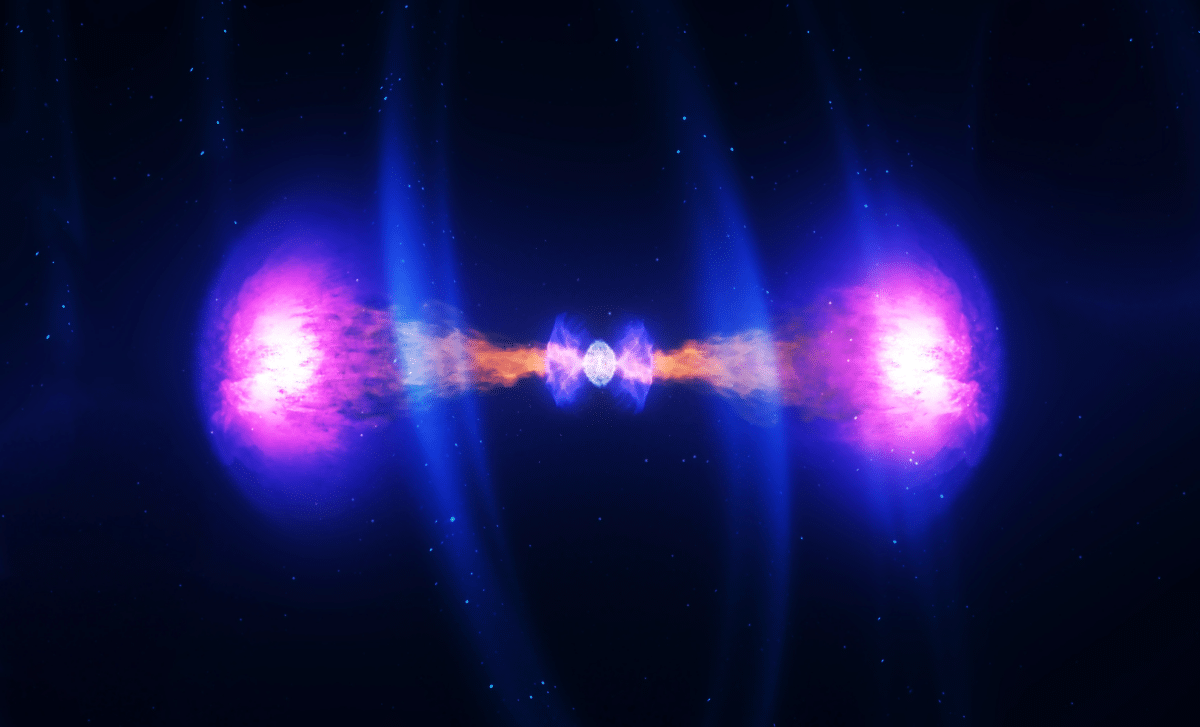
Physicists have made a monumental discovery that sheds light on the early moments of the universe. By recreating conditions resembling the first milliseconds after the Big Bang, researchers at the Large Hadron Collider (LHC) have uncovered evidence of the behavior of quark-gluon plasma. Published in Physics Letters B, this study delves into how the universe’s primordial soup behaved before cooling into the atoms that make up everything we see today. Through this work, the team has discovered that the quark-gluon plasma acted more like a liquid than a gas, challenging previous assumptions about this mysterious state of matter.
The Quark-Gluon Plasma: A Liquid-Like Soup
Quark-gluon plasma is an exotic state of matter that existed shortly after the Big Bang, where quarks and gluons, the fundamental particles that make up protons and neutrons, moved freely within a hot, dense medium. The conditions were so extreme that atomic structures as we know them could not exist.
“The density and temperature is so high that the regular atom structure is no longer maintained,” says Yi Chen, assistant professor of physics at Vanderbilt University and a member of the CMS team. Instead, “all the nuclei are overlapping together and forming the so-called quark-gluon plasma, where quarks and gluons can move beyond the confines of the nuclei. They behave more like a liquid.”
This behavior was not only unexpected but also critical in understanding the universe’s early stages. In this plasma, quarks and gluons do not behave like isolated particles but interact collectively, flowing in a manner similar to a liquid. This finding is significant because it challenges the traditional view of quark-gluon plasma as a gas-like state and opens up new avenues of research into the dynamics of the early universe.
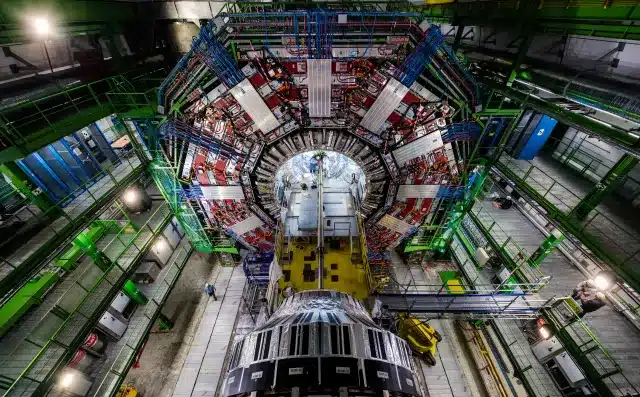 A photo of the Compact Muon Solenoid (CMS) detector at the Large Hadron Collider, which conducted the new experiments.
Image credit: Hertzog, Samuel Joseph: CERN)
Recreating the Big Bang Conditions in the Lab
To simulate the conditions of the early universe, scientists at the LHC collided heavy atomic nuclei at nearly the speed of light. This experiment temporarily created a droplet of quark-gluon plasma, lasting only for fractions of a second but providing valuable insights.
“In our studies, we want to study how different things interact with the small droplet of liquid that is created in the collisions,” Chen explains.
The LHC’s experiments allow scientists to observe how energetic particles, like high-energy quarks, interact with this hot, dense medium.
In particular, the researchers focused on how these quarks travel through the plasma. Their interactions were tracked using Z bosons, particles that interact minimally with the plasma. This allowed researchers to isolate the effect of the quark on the surrounding medium, offering a clearer view of the early universe’s conditions. The results revealed that the quarks leave behind a detectable “wake,” akin to how a boat creates ripples in water.
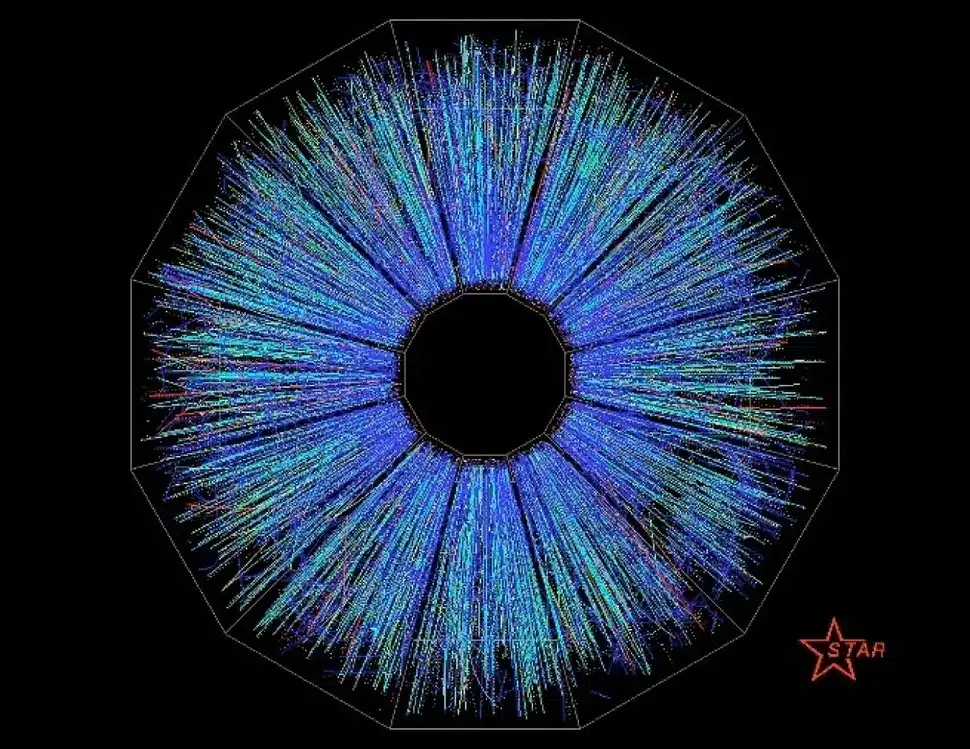 An illustration of the aftermath of a high-energy collision that created a quark-gluon plasma at Brookhaven Lab’s Relativistic Heavy Ion Collider.
Image credit: Brookhaven National Laboratory)
A Subtle but Crucial Discovery
The team’s discovery, published in Physics Letters B, was subtle but significant. They observed a small dip in particle production behind the quark as it moved through the plasma. This “wake” is a critical signature that suggests the quarks were transferring energy to the surrounding plasma. Chen elaborates:
“For now, the observed dip is just the start. The exciting implication of this work is that it opens up a new venue to gain more insight on the property of the plasma. With more data accumulated, we will be able to study this effect more precisely and learn more about the plasma in the near future.”
Although the dip in particle production is less than 1%, it represents the first clear detection of such a wake in a Z-boson-tagged event. The discovery provides new insights into how quarks interact with the quark-gluon plasma, potentially revealing much more as the data continue to accumulate.