
Researchers have drilled deeper than ever before beneath the West Antarctic Ice Sheet, uncovering evidence that the region was once part of an open ocean. The research team hopes that analyzing the past conditions of Antarctica will provide crucial data to predict sea level rise in the coming decades.
The international team of 29 scientists embarked on this ambitious drilling project to study the behavior of the West Antarctic Ice Sheet, which is a critical area due to its potential to raise global sea levels by as much as 4 to 5 meters. By retrieving sediment cores, the team aims to understand how the ice sheet retreated in the past.
Unprecedented Depths of Discovery
According to Nature, the drill reached depths of 523 meters of ice and228 meters of ancient rock and sediment, providing a historical record of environmental conditions in the region. While many of the sediments were typical ofice-covered regions, researchers were stunned to find marine organisms and shell fragments that are typically associated with open oceans.
These discoveries strongly suggest that at least part of Antarctica’s West Ice Sheet was once covered by open water rather than a solid ice shelf. The presence of marine life is particularly significant, as these organisms require sunlight to thrive, an indication of a much warmer and different climate in this area millions of years ago.
“Some of the sediment was typical of deposits that occur under an ice sheet like we have at Crary Ice Rise today,” explained co-chief scientist Molly Patterson from Binghamton University. “But we also saw material that’s more typical of an open ocean, an ice shelf floating over ocean, or an ice-shelf margin with icebergs calving off.”
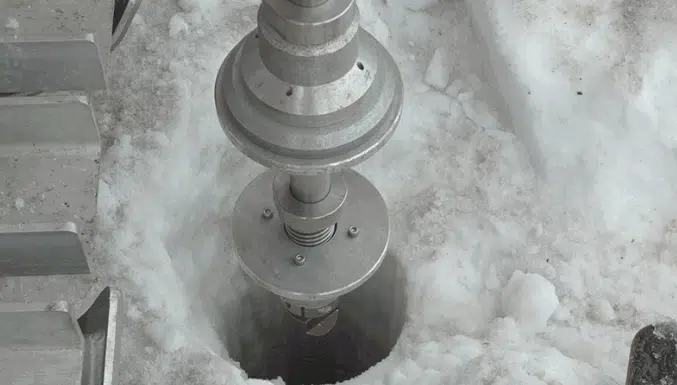 A close-up of the drilling process beneath Antarctica’s ice. Credit: Ana Tovey/SWAIS2C
Unfreezing the Ice Sheet’s Ancient Secrets
The core samples from the drilling site provide crucial insights into the past 23 million years, including periods when Earth’s temperatures were significantly warmer than today. As stated by Huw Horgan, a fellow co-chief of the project from Victoria University of Wellington, the samples show evidence of times when global temperatures were more than 2°C higher than pre-industrial levels.
“It was a great feeling when that first core came up, but then you start worrying about the next core and the next core after that. So, it’s stressful right up until the end. We’re thrilled to have learnt from our previous challenges and to have successfully retrieved this geological record that will help the world prepare for the impacts of climate change,”
By examining the layers of sediment, scientists can trace the cycles of ice sheet retreat and advance, offering a clearer picture of how the West Antarctic Ice Sheet responded to climate shifts in the past.