
From the day it premiered, Twin Peaks had a problem. Audiences wanted to know who killed Laura Palmer; David Lynch and Mark Frost weren’t interested in telling them who killed Laura Palmer. When they agreed to reveal the killer, the network was apparently vindicated. Some 17 million viewers tuned in — the highest ratings the show had achieved since the season-two premiere.
But now that the murder mystery had been resolved, the show had a new, even more vexing problem: If it wasn’t about solving the murder of Laura Palmer, what was Twin Peaks about? Even Bob Iger concedes he may have been too hasty. “Looking back on it now, I’m not convinced I was right,” he said. “Deep down, I felt David was frustrating the audience, but it may well be that my demands for an answer to the question of who killed Laura Palmer threw the show into another kind of narrative disarray.” Mark Frost agrees. “We paid a big price for it. You know, that was something that contributed as much as anything to the momentum falling apart.” David Lynch was even blunter. “That killed Twin Peaks,” he said. “Totally dead. Over. Finished.”
The problem, of course, was that Twin Peaks wasn’t finished. It was in the middle of its second season, and the story would continue, one way or another, for at least 13 more episodes. “Especially network television— when you’re dealing with 22 episodes, and the production monster’s chasing you, you don’t really have any other choice,” says Mark Frost. “I don’t think it had been fully figured out,” says Scott Frost. “Production is like jumping out of a plane. And you have a parachute, but it’s actually not attached to you yet.”
The resolution of Laura Palmer’s murder isn’t so much a period at the end of a sentence as it is an ellipsis: Leland may be dead, but BOB is still out there, hunting for another host. Or, to put it another way: With the central mystery resolved, the show’s writers had unprecedented freedom to redefine what Twin Peaks could be. “I don’t know if there was a master plan there at all. We got so good at resolving things we thought up that we were kind of fearless about what we put in,” says writer Robert Engels. “That was one of the things that was fun about the show — that we had the sense that we could pretty much do or try anything,” says writer Harley Peyton. “There were times when that took us down weird avenues, but there were times when it took us in absolutely the right direction. I think we took some wrong turns along the way, but that, to me, is part of the process, and part of making something under sort of insane circumstances.”
There’s a palpable sense of desperation as Twin Peaks — just one episode removed from Leland’s death — manufactures another, flimsier reason for Cooper to stick around town. Targeted (correctly) by the FBI’s internal affairs division for his extralegal undercover mission at One Eyed Jack’s and (incorrectly) for stealing a large amount of cocaine, Cooper is suspended from the FBI and forced to hand over his badge and gun. Twin Peaks had already flirted with turning Cooper, a consummate outsider, into a Twin Peaks insider. (At the very least, it was hard to imagine him saying good-bye, forever, to the Double R’s coffee and cherry pie.) But Cooper’s dismissal from the FBI, even temporarily, altered the show’s fundamental building blocks in a way that proved challenging to reverse. So much care had been put into crafting the show’s look and feel: What happened when you upended it? “We were doomed the day that Agent Cooper turned in his black suit for lumberjack flannel,” says editor-director Duwayne Dunham.
Twin Peaks had always managed to juggle its darkest moments with its silliest, but the show’s unique tone was becoming harder and harder to balance. “If we made mistakes along the way, one of them was maybe falling in love with comedy a little too much,” says Peyton. “This is the thing you always have to be careful of as a writer: Are you entertaining yourself, or are you entertaining the audience? We were certainly entertaining ourselves, and the hope was that we would entertain the audience as well.”
No sustained analysis of season two would be complete without a brief survey of some of the show’s wackier story lines. Nadine Hurley waking from a coma with the strength of a superhero and the mind of a teenager? “I was a big comic book fan, so I brought in Nadine’s superpowers, which I thought was hilarious. That’s on me,” says Peyton. The emergence of Lana Milford (Robyn Lively), a black widow who seduces both of the elderly Milford brothers while turning every other man in Twin Peaks — even, uncharacteristically, Cooper — into a drooling idiot? “That was meant to have a supernatural aspect, but that supernatural aspect never actually comes in, so it’s just unresolved,” says Peyton. Ben Horne, trying to reverse the Civil War while delusionally believing himself to be Robert E. Lee? “That idea came about at the same time Ken Burns’s [The] Civil War miniseries happened. Had that miniseries not come out, I doubt that story ever would have gone into the series,” says writer Scott Frost.
And then there’s what Peyton acknowledges as “the most grievous thing I ever did in the Twin Peaks universe”: James Hurley’s brief, stand-alone detour into a film noir after he crosses paths with a femme fatale named Evelyn Marsh. “James is just such a wonderful actor, and he had this wonderful vibe that sort of made him a perfect fit for that kind of story, which is why we wanted to do it in the first place,” says Peyton.
At this point in the story, James’s love life has gone full Peyton Place. “The only thing I really, really wish they would have done is kept James with Donna,” says actor James Marshall. “When Laura died, the reality of their attraction came around. And when they got together, they should’ve stayed together. They could help each other through their grief, and you actually see two people heal while everything else is going crazy. Instead: Evelyn Marsh.”
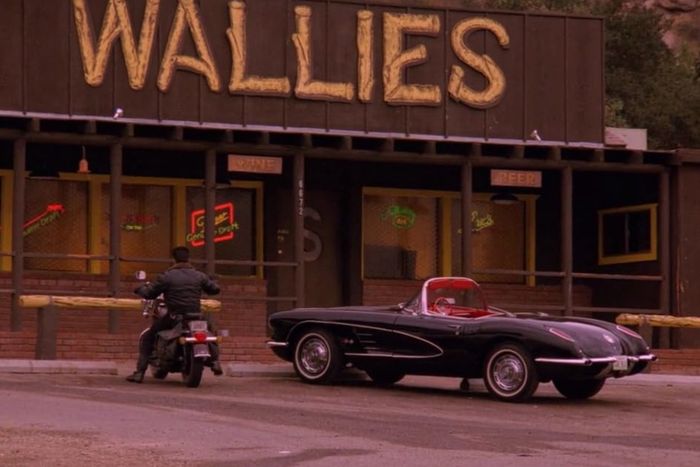
“The most grievous thing I ever did in the Twin Peaks universe.”
Photo: ABC
In a rare subplot that takes place entirely outside Twin Peaks, James — on a sullen solo motorcycle trip after Maddy is murdered — suddenly wanders into a James M. Cain novel. Twin Peaks had nodded at classic noir tropes before; Neff, the insurance agent who alerted Catherine Martell to a shady policy in the show’s first season, was named in tribute to the protagonist of Cain’s 1943 crime classic Double Indemnity. This particular subplot owes Cain an obvious debt and stretches across five episodes, as the married Marsh picks up James at a bar, hires him as a mechanic, sleeps with him, and frames him for killing her husband before having a change of heart and letting him go.
It is as paint-by-numbers as a noir story can get, and those responsible for translating it to the small screen were just as dubious of the story line as the audience. “You hadn’t seen a character like Evelyn in Twin Peaks. She felt like she came from, I don’t know, Dynasty or something,” says Dunham, who directed one of the episodes in which the Evelyn Marsh subplot unfolds. “I regret that I didn’t do a better job with it. But it just didn’t fit. It was completely wrong, and it was wrong for James. James — that character — would not be attracted to that. James was one of the Bookhouse Boys.” Marshall agrees. “I think there were a lot of actors on the show who were reputable, seasoned actors — who’ve been around a long time — doing exactly what I was scared to do: going to production and fighting for their parts,” he says.
“So much happened on the show where I didn’t know if my character was coming or going,” said Lara Flynn Boyle. “I called [David Lynch] every day, like, ‘Oh my God, they’re ruining the show.’ He got sick of hearing from me,” says Sherilyn Fenn. “This costumer, in the second season, said, ‘Oh, I’ve got 20 hula skirts.’ And I was like … ‘Do you think Twin Peaks is just this random, let’s-be-weird-to-be-weird? Because it isn’t. It never was.’”
“It just was getting weird for weird’s sake,” agrees Dunham. “My thing is: That’s not an accurate understanding of David’s work. It’s not just weird for weird’s sake. There’s a purpose and a reason. That’s why, in David’s hands, he can make that stuff work.”
The problem reached its nadir in “Episode 21,” the first (and only) episode directed by Uli Edel. As the director of the acclaimed, noirish drama Last Exit to Brooklyn, Edel had earned a reputation as a talent to watch. But his abrasive style clashed with the cast, who were justifiably confident, by then, that they knew what they were doing. During the filming of one scene, “Uli said, ‘You’re just furniture to me, man. Just go where I tell you,’” says Michael Horse. “So I go to the crew and said, ‘This guy, Uli, is he good?’ And they said, ‘Yeah, he’s really good.’ And I went to Uli and said, ‘Hey, man, you can say that to me. But if this isn’t Emmy-quality shit, I’ll come to your house and kick your ass.’”
It just was getting weird for weird’s sake. That’s not an accurate understanding of David’s work.
— Duwayne Dunham, editor-director
Horse’s conflict with Edel was a representative example of the cast’s larger sense that Twin Peaks had been handed to some unfit caretakers while Frost and Lynch were busy elsewhere. “I hope I’m not making anybody mad, but they claimed David and Mark were totally on top of the Twin Peaks stuff — that they were giving yeses and noes and overseeing everything in every detail. But I know that, working with David, it was a way different show. So I just don’t believe that,” says Marshall. “I do think that it had an effect on the show. How could it not? You could be the most talented person on earth. You’re not going to be able to imitate David Lynch.”
It’s true that the Leland reveal in “Episode 14” was Lynch’s last directing credit until the season-two finale. But while there are Twin Peaks fans who believe season two’s missteps were due to Lynch’s absence, it was Mark Frost who spent some time away from the show during its perceived dip in quality. Just as Lynch spent a chunk of Twin Peaks’s first season directing Wild at Heart, Frost took a leave of absence from season two to direct Storyville, a moody, James Spader–starring political thriller. “His absence made things complicated. Certainly for my relationship with David,” says Peyton.
By this point, Peyton and Engels — long established as two of Twin Peaks’s most reliable writers — had been given producer credits and taken on some duties that, today, would fall under the umbrella of “showrunning.” When Frost went to New Orleans to shoot Storyville, he left Peyton in charge. “It’s not like I had to somehow convene a writers’ room and figure out what we’re going to do next. We know what every episode is going to be, and Mark was talking to me every day,” says Peyton. “But one night — at, like, almost midnight — my phone rings, and it’s Todd Holland. And Todd is freaking out because he just got off the phone with David Lynch, who gave him a raft of script notes that were going to impact his shooting the following morning. Now, I’m already a little irritated, so I say, ‘Look. Ignore David’s notes. He has no business calling you up at 11 o’clock at night with script notes. Just shoot your day and let it be.’ He’s very thankful, and I feel I’ve done my job.”
“My phone rings the next day. And David yelled at me for ten minutes. And I’m telling you: Ten minutes is a long time to have someone yell at you. His temper … you didn’t see it very often, but I saw it, and he was fucking furious, yelling at the top of his lungs: How dare I? What the fuck am I doing? Who the fuck do I think I am? The phone call, obviously, did not end well. And my relationship with David — whatever relationship I had — that was the end of our relationship.”
The disagreements among creatives at the top of the show were further complicated by the actors, who continued to use their own power to try to shape the stories written for their characters. “There were some political things that were starting to happen, and I just got out of the way for the whole thing,” says Marshall. “There were several other actors on the show who were vying for different things, and it was like … I didn’t want to be involved in that.”
Most significant was the scrapping of a plotline that had been simmering since the beginning of season one: the flirtation between Cooper and Audrey Horne. “As far as I remember, we all believed that they were a couple or going to be a couple,” said Tina Rathborne, who directed one of season one’s many sexually charged scenes between Audrey and Cooper. “Audrey’s seduction of Coop seems part of the dual lesson that Coop is learning. He’s learning about his more innocent side, and he’s learning about his darker side, that he’s willing to be seduced by this young girl. This young, somewhat raunchy girl. But he’s also willing to defend his higher side.”
In season one, Cooper’s so-called “higher side” seemed to win out. When he found Audrey waiting for him, naked, in his bed at the Great Northern, he let her down by gently explaining that what she really needed was a friend. But owing to Kyle MacLachlan and Fenn’s undeniable onscreen chemistry, the writers kept looping Cooper and Audrey back together. Audrey goes undercover at One Eyed Jack’s to help the man she calls “my special agent”; Cooper risks his career to rescue her. When Audrey meets Denise Bryson and feels threatened by the presence of Cooper’s female FBI peer, she marks her territory by planting a kiss on his lips.
If the writers didn’t want the audience to be invested in a romance between Cooper and Audrey, they were doing a very, very bad job backing away from the story. That’s because they had every intention of doubling down on what had obviously emerged as the show’s most potent will they/won’t they. “David took me to dinner and basically asked me if I was in love with Kyle,” says Fenn. “And I burst out laughing. Not even slightly! He’s a great guy, he’s a nice person, but that’s it. I didn’t have any feelings that way. At all. The truth is that as human beings, he and I didn’t have that kind of chemistry. But those characters, for some really weird reason, did.” Peyton adds, “We were going to do a — ‘romance’ may be the wrong word, but certainly an exploration of the relationship between Audrey and Cooper. That didn’t happen, and it didn’t happen because Kyle refused.”
For years, the official story has been that MacLachlan rejected the plotline because he didn’t believe Cooper would get involved with a high-schooler. There’s a solid plot justification for that argument; Cooper did, after all, gently reject Audrey for the same reason back in season one. But whatever the merits of that argument, there’s no question that offscreen dynamics were also in play. At the time, MacLachlan was dating Lara Flynn Boyle, whose push for Donna’s unconvincing bad-girl makeover in season two was judged, by some, to have been a response to Fenn getting more attention for her coquettish performance.
“I still remember talking with Mark [Frost],” says Peyton. “Mark was saying, ‘No, we’re going to draw a line in the sand. We can’t do this. We planned this pretty carefully, and it’s going to upend our second season.’ Then Kyle went into Mark’s office with David. I remember waiting and waiting and waiting. And then he came out and said, ‘No, we’re not doing it.’ And that was because David was the one who was basically saying, ‘We’re going to go with what the actors prefer.’ The thing about David that I learned over time is that he will sort of do anything for the actors. And because he’ll do anything for them, they will do anything for him.”
Whatever the underlying reasons for it, even those who were frustrated by MacLachlan’s justification now concede it was better that the Cooper-Audrey plotline didn’t move forward. “It’s hard to say, because nowadays, I would say, ‘No, we can’t do that, because he’s in a position of power and she’s much younger.’ All the things Kyle was saying. It’s easy to say he did it because of Lara Flynn Boyle. But who knows why?” says Peyton. “I mean … he did end up with a love interest who was the same age [as Audrey]. And she was from a convent, for crying out loud.”
Cooper’s formerly cloistered paramour was Annie Blackburn (Heather Graham), a half-sister of Norma Jennings whose sudden arrival in Twin Peaks was written to fill in the gap where the Cooper-Audrey romance would have been, and actor Heather Graham knew what she was walking into. Prior to being cast, Graham had already made her way into the outskirts of Lynchland by co-starring, opposite Benicio del Toro, in a Calvin Klein commercial Lynch directed. But playing a woman capable of instantly bewitching Dale Cooper would be an entirely different challenge, and Graham met Lynch at his home to discuss the character — after he showed off another ongoing project. “He was doing some kind of experiment where he was putting meat into this kind of art piece and letting ants crawl on it,” says Graham.
Graham recalls Lynch describing Annie as “a finely tuned machine. Like a Ferrari or a sports car that’s very amazing — but that it can be easily thrown off-balance, if something goes wrong.” Peyton had a blunter appraisal: “Sad to say, Annie was — at least when the character was initially conceived — a damsel in distress. And not a great deal more than that,” he says.
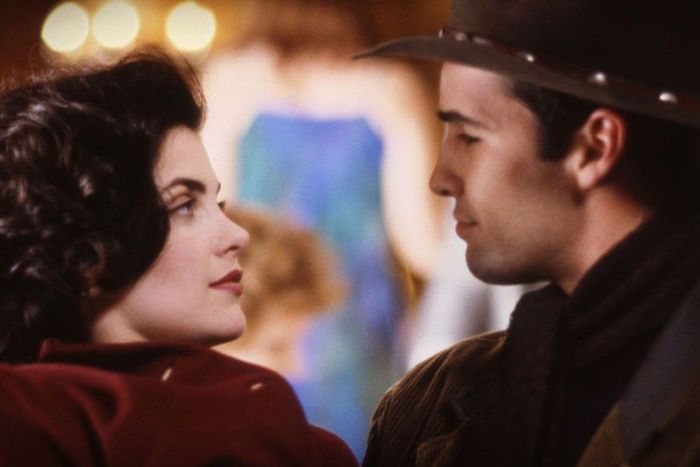
“When we said, ‘Okay, well, who’s going to sweep Audrey off her feet?’ [Harley Peyton] said, ‘Well, it should be a singing cowboy.’”
Photo: ABC
Audrey, for her part, got a new love interest of her own — though not before the show teased a flirtation between Audrey and Bobby, who was briefly positioned as Ben Horne’s new right-hand man. “I don’t know if they were definitely going to go with it. I thought they were definitely going to go with it, and we had those moments,” said Dana Ashbrook. “I think it was either a MacGuffin, or a change of someone’s mind, or I don’t know. It was so on the fly, always, the story.” In the end, Bobby stayed true to Shelly — though not before Gordon Cole planted a kiss on her — and Audrey got her own new love interest in John Justice Wheeler, a dashing young businessman-pilot played by Billy Zane. “It was Harley who came up with [John Justice Wheeler],” says Mark Frost. “When we said, ‘Okay, well, who’s going to sweep Audrey off her feet?’ he said, ‘Well, it should be a singing cowboy.’”
Wheeler does, in fact, throw on a cowboy hat, take Audrey on a picnic, and serenade her with a rendition of the cowboy folk standard “Bury Me Not on the Lone Prairie.” Fenn herself was unconvinced. “He’s a really nice guy. But the first time I met him was at 6 in the morning. And he goes, ‘What would you do if I leaned over the table and kissed you?’ And I go, ‘I’d have a problem with that.’” Still, Wheeler’s routine is enough, apparently, to knock Audrey’s crush on Cooper out of her brain entirely; the episode’s script describes her as “warm and certain” as she reassures Wheeler that she doesn’t have feelings for anyone else.
With Cooper and Audrey splintering off into their own separate love stories — and much of the other main cast engaged in their own semi-stand-alone arcs — Twin Peaks needed both a villain and an event to justify weaving everything back together. If there was anything that bound Twin Peaks’s many threads in the back half of the second season, it was the simmering threat of Cooper’s insane former partner Windom Earle, revealed early in season two as having escaped custody hell-bent on revenge. Though it wasn’t clear at the time, Earle’s clash with Cooper would become Twin Peaks’s most significant arc following the resolution of Laura’s murder. “That was supposed to be short-lived,” says Engels. “I talked those guys into hiring [Kenneth Welsh]. He was a friend of mine, and they just loved him, so that character became bigger.”
After escaping a mental institution and stalking Cooper to Twin Peaks, Earle engages Cooper in a grotesque version of the daily chess game they played when they were partners. Whenever Earle takes a piece, he commits an equivalent murder; the loss of a pawn, for example, leads to the murder of a drifter with no direct connection to the larger narrative.
Once Cooper realizes the game Earle is playing, he’s savvy enough to build a strategy not aimed at winning the game, but at protecting the pieces remaining on his side of the board. Still: You’d think he’d be smart enough to realize that protecting his queen is paramount — especially since he’s simultaneously falling in love with Annie, whose innocence and lack of worldliness makes her an especially ripe target. And you’d definitely think he’d be smart enough to recognize the danger when the Giant literally appears in front of him, waving his arms and mouthing the word no, after Annie suggests she’ll enter the Miss Twin Peaks pageant. But when Cooper falls in love, it seems, his deductive powers vanish; just a few episodes earlier, he flirts with Annie at the Double R, then walks right by the not-especially-well-disguised Windom Earle.
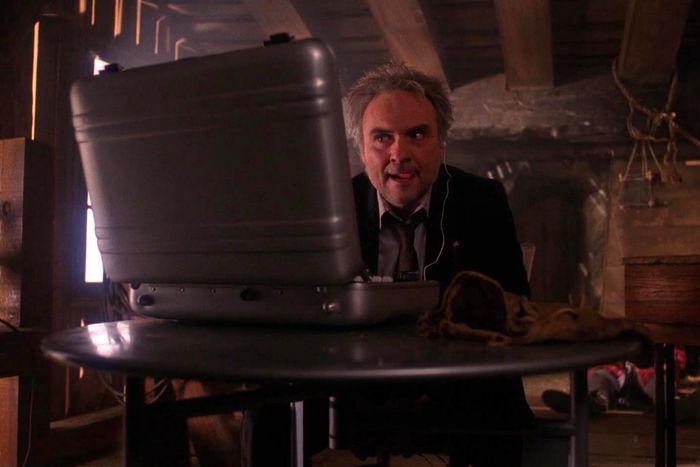
If there was anything that bound Twin Peaks’s many threads in the back half of the second season, it was the simmering threat of Cooper’s insane former partner Windom Earle, played by Kenneth Welsh.
Photo: ABC
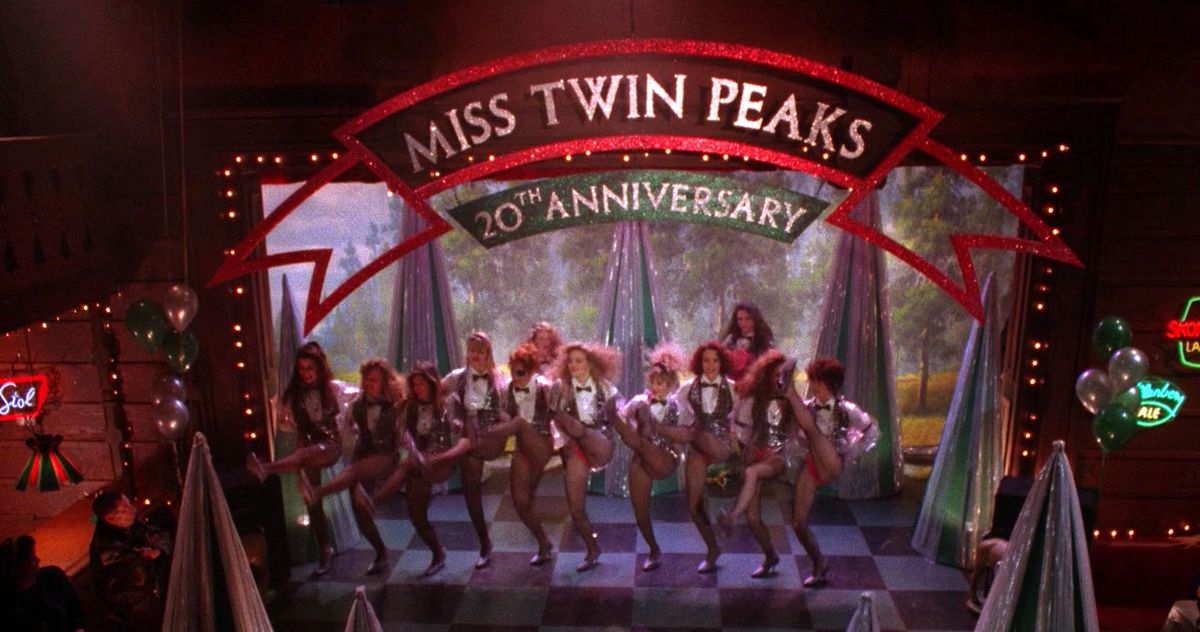
All these plotlines converge in the penultimate episode of Twin Peaks, which also turns out to be the last gasp of the comedy-focused storytelling that had come to the forefront of the first season. The Miss Twin Peaks pageant was designed, among other things, to bring the increasingly scattered group of characters back together: Donna Hayward, Shelly Johnson, Lucy Moran, Nadine Hurley, Lana Milford, and Annie Blackburn all compete, and Norma Jennings, Doc Hayward, Pete Martell, and Dick Tremayne all play a role in judging the pageant. Though she had been targeted by Windom Earle alongside Donna and Shelly just a few episodes earlier, Audrey is noticeably absent for much of the competition. “I called David right away and said, ‘I’m not doing it,’” says Fenn. “No fucking way. Audrey was there, but I didn’t, like, parade up and down a fucking catwalk in a bathing suit.”
Goofy as it is, the levity feels welcome before Twin Peaks takes its final plunge into the darkness. Lana Milford does something called “contortionistic jazz exotica,” and Lucy Moran does a dance that ends in the splits, which led to actress Kimmy Robertson needing to reassure people that there was no damage to the baby. (Robertson, for the record, was not actually pregnant.) But when Annie Blackburn is crowned Miss Twin Peaks — after a speech that leans heavily on the words of Chief Seattle, a leader of Washington’s Suquamish and Duwamish tribes — Earle, who has infiltrated the Miss Twin Peaks pageant disguised as the Log Lady, makes his move. A queen has been crowned; he’s ready to claim her.
It’s a strong cliffhanger for the season finale, but that’s not how it originally aired. By this point, ABC’s scheduling of Twin Peaks had become erratic, with lengthy hiatuses in December and January — a problem further exacerbated when the show was preempted by coverage of the Gulf War. After the memorably bizarre cliffhanger of “Episode 23” — which concluded with Josie Packard, revealed as the mysterious shooter who shot Cooper in the season-one finale, somehow trapped in a drawer pull in a Great Northern Hotel room — ABC put the show on hiatus. That troubling sign prompted a fan campaign called COOP, or Citizens Opposed to the Offing of Peaks, to place hundreds of phone calls and send thousands of letters and packages, some containing logs or doughnuts, to ABC. David Lynch goosed the campaign further in a February appearance on Late Night With David Letterman, where the host gamely posted Bob Iger’s mailing address. (“I love annoying these network weasels,” said Letterman.)
ABC relented, and Twin Peaks returned on Thursday, March 28 — an escape, at last, from the wasteland of Saturday night. But the reprieve was short-lived. Less than a month later, on April 18, 1991, “Episode 27” aired — a return to form that ended, promisingly, with BOB reemerging from the Black Lodge. But anyone intrigued by that cliffhanger was forced to wait nearly two months, to June 10, when the network unceremoniously dumped the final two episodes as a double feature. Though Twin Peaks hadn’t been formally canceled, everyone involved knew the writing was on the wall. “As a phenomenon,” Mark Frost conceded a month before the season-two finale aired, “the show is over.”