
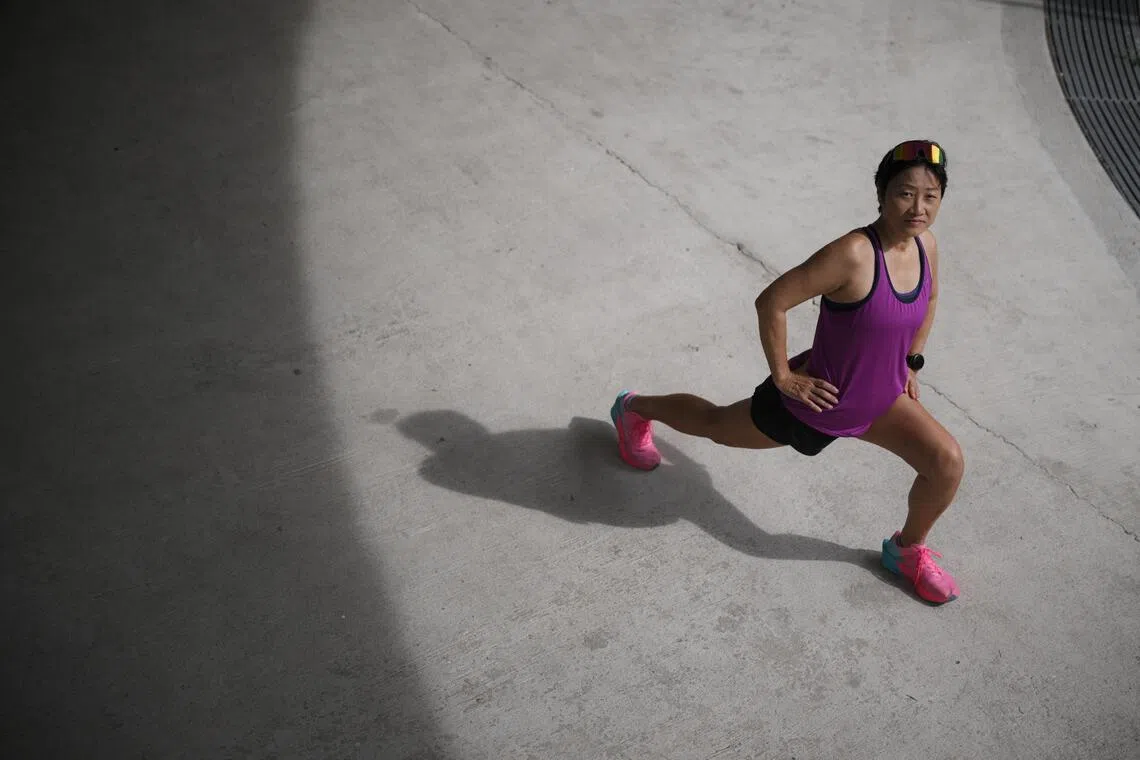
SINGAPORE – Ms Vivian Chee started 2026 by clocking 22km in a nature run in Melaka in early January.
She had ended 2025 by completing her first Hyrox fitness race here in the women’s singles category in November, as well as a couple of other endurance races.
These are commendable feats for any 57-year-old, but what makes her story extraordinary is that she achieved them with only half her lung capacity, after battling colon cancer and undergoing three lung operations since 2020.
The mother of four children, aged 16 to 29, was never sporty as a child. She took her first fitness walk at age 39 when a friend invited her to Bukit Timah Hill. That invigorating session in the outdoors in 2008 kindled a lifelong passion for movement.
At her very first race that same year, she lay on the ground, exhausted after 1.6km. When she tried learning to swim in open water for a race, she panicked and grabbed her coach.
Undaunted by the setbacks, she kept on training. She was five weeks pregnant with Joel, her youngest child, when she completed a 40km cycling event.
Six months following Joel’s birth in October 2010 – all her four kids were delivered naturally as she was intimidated by the epidural needle – she resumed running.
She then set her sights higher, joining longer distance races of 21km as well as swim events.
Just over a year later, in March 2012, she took on the Aviva Ironman 70.3 Singapore Triathlon, which is considered a half-Ironman race. She was 43.
She completed the gruelling 1.9km swim, 90km bike and 21.1km run in seven hours and 50 minutes, just 10 minutes before the eight-hour cut-off. It was her 30th race since 2008.
“I didn’t know if I could do it, so I took it as a challenge,” says the bubbly Ms Chee, who works in customer service for a manufacturing multinational.
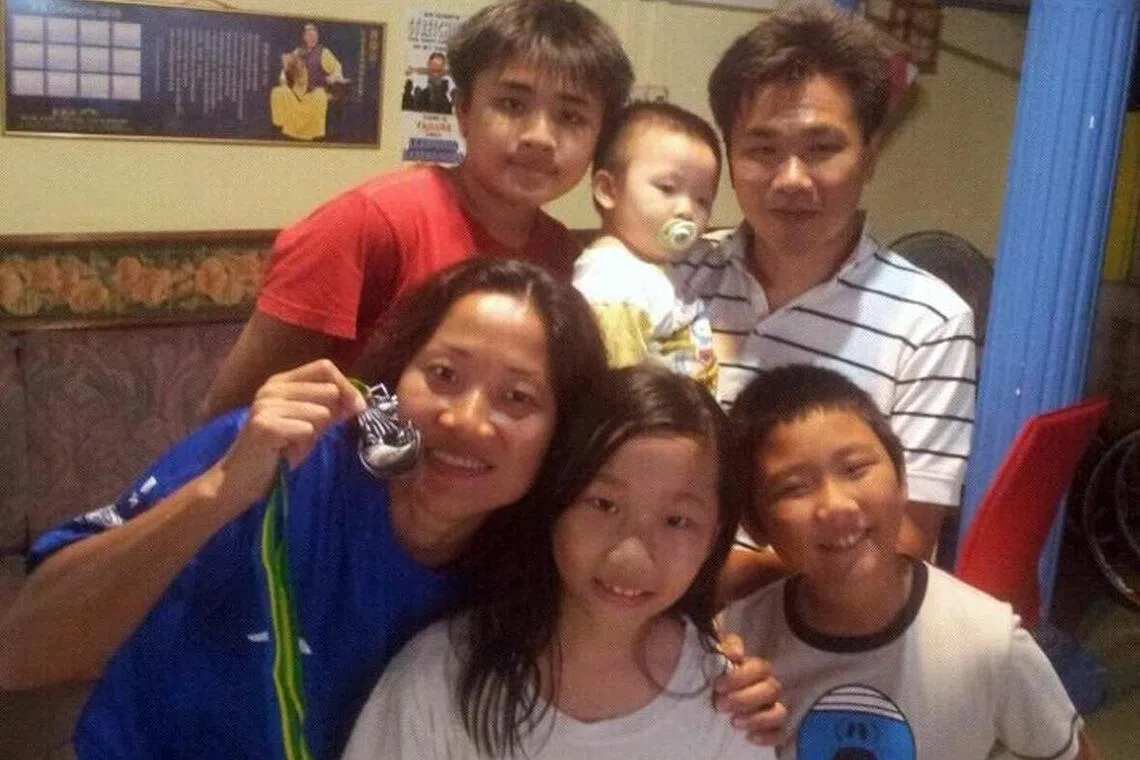
Ms Vivian Chee (bottom left), then 43, showing off her finisher’s medal after the Aviva Ironman 70.3 Singapore Triathlon on March 18, 2012.
PHOTO: COURTESY OF VIVIAN CHEE
The Straits Times, which dubbed her “Ironmum” in an article back then, said the event attracted 1,562 participants, of which 71 were local women.
A year later, she travelled to Busselton in Western Australia for the full Ironman race comprising a 3.8km swim, 180km bike and 42.2km run. She finished in 16 hours and 30 minutes, within the 17-hour cut-off.
She says she was able to race so frequently because of her then helper and a supportive husband in Mr Vincent Tay, 59, who is self-employed. Discipline also played a part, as she had to wake up at 5am to exercise before sending her children to school by car.
Her passion has also rubbed off on all her kids, who are involved in various sports.
In 2018, Ms Chee began experiencing pain in her bowels frequently enough to distress her. She describes it as feeling the urgency to move her bowels, but not being able to even after 15 minutes, leaving her in a cold sweat.
After seeing polyclinic and family doctors on and off, one suggested she do a colonoscopy.
That procedure at Jurong Medical Centre in May 2019 revealed she had stage 2 colon cancer. A month later, she underwent surgery to remove the tumour at the National University Hospital (NUH).
Colorectal cancer is the second most common cancer in women after breast cancer. Ms Chee has no family history or risk factors for it.
She took chemotherapy tablets for six months afterwards to reduce the chance of the cancer returning, but still found the strength to participate in a three-hour, 100-lap swimathon in Singapore and a 6km open-water swim race in the Philippines during that period, among other events.
“I had already registered for the events,” she says. “It was keyhole surgery and my recovery was okay.”
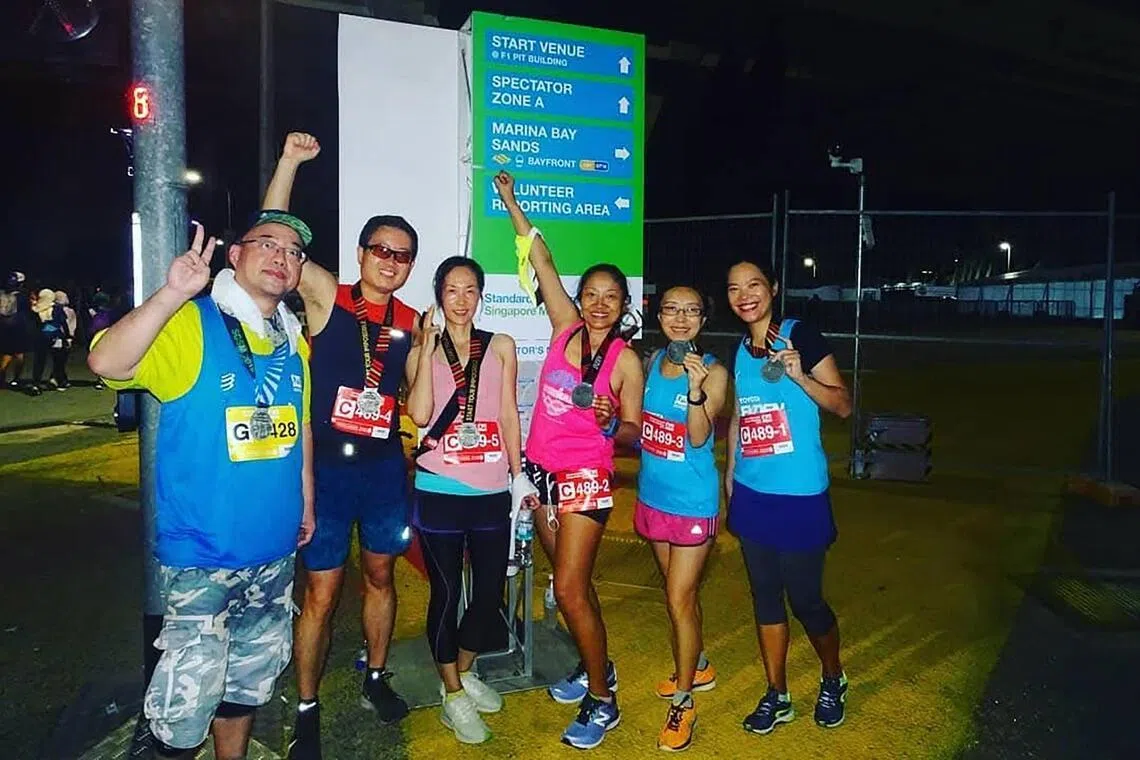
Ms Chee did a 42km relay in Singapore with four other friends in December 2019, six months after her colon cancer operation.
PHOTO: COURTESY OF VIVIAN CHEE
Just when she thought she was on the mend, a scan in September 2020 revealed that the cancer had spread to her left lung.
She underwent uniportal video-assisted thoracoscopic surgery (UVATS), a keyhole chest surgery involving a single incision.
“Her original colorectal cancer had recurred and spread to her lung. This type of spread, known as metastasis, can occur with colorectal cancer. When lung metastases are detected early and are suitable for surgical removal, surgery may be considered as a potentially curative treatment option,” says her oncologist, adjunct associate professor Chee Cheng Ean. She is a senior consultant in the Department of Haematology-Oncology at the National University Cancer Institute, Singapore.
Ms Chee says: “I felt helpless that I had to go through another procedure. But how I react affects how my family reacts. If I picture myself very positively and tell them, ‘Mummy is going for another operation, you do your own thing and I’ll update you’, they will not be so worried. I think everyone in the family managed it quite well.”
In fact, she was so upbeat that she took along two laptops to the hospital – “one for entertainment, one for work”, she quips. As soon as she found the energy during her week-long stay, she switched them on.
“It helps to distract me from the pain, but I also love my job because I feel I am helping my colleagues solve problems,” she says.
Her cancer reappeared just 11 months later, in August 2021. This time, both lungs were affected.
After chemotherapy failed, she went under the knife again and had UVATS for her left lung and an open middle lobectomy (open-chest surgery) for her right one.
She disliked the hospital food, so Mr Tay dutifully delivered her favourite dishes, such as fishball noodles and lor mee, to her every day.
Once again, Ms Chee clawed her way back to endurance racing, one step at a time.
“I cut down on a lot of races, but I didn’t stop training and I still went to the gym,” she says. “I did an Ironman 70.3 race in Langkawi in October 2024, but the bike part was so hard, I told myself, it’s okay to DNF (race lingo for ‘did not finish’).”
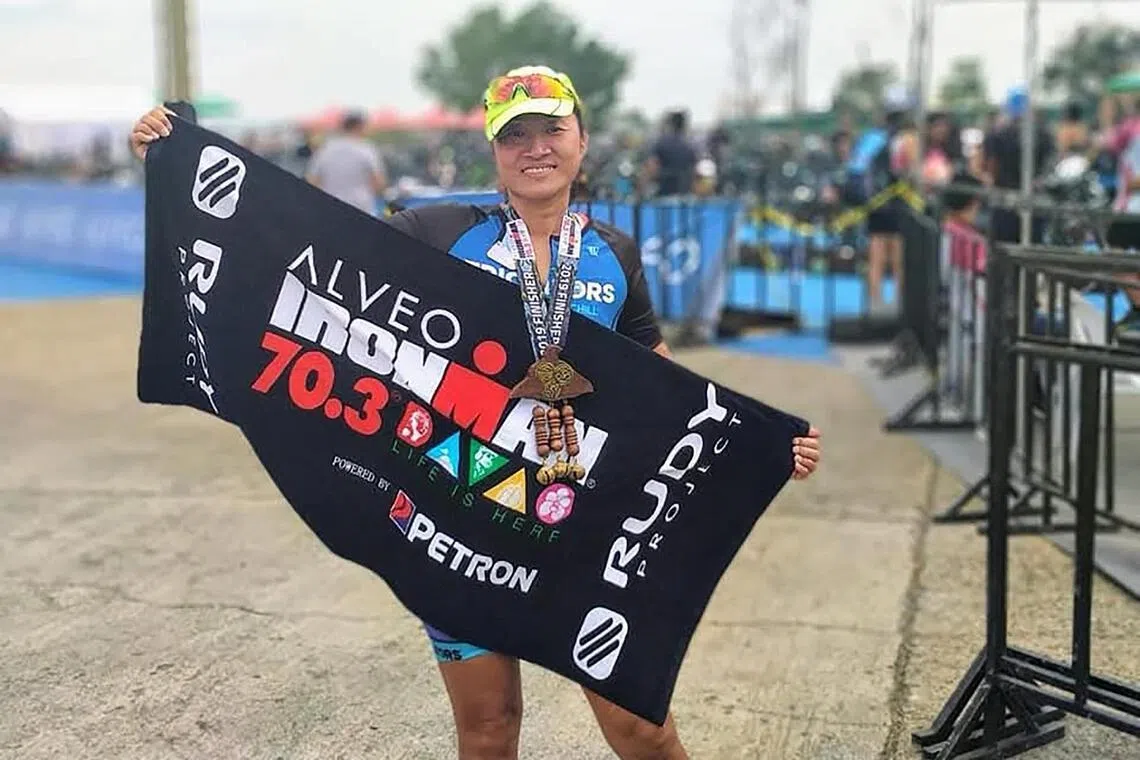
Ms Chee at the half Ironman race in Davao, the Philippines, in March 2019, before she was diagnosed with colon cancer.
PHOTO: COURTESY OF VIVIAN CHEE
In December 2024, she received more bad news – another nodule deep in her left lung.
She had a coveted spot in the Tokyo marathon in early March 2025, as well as two triathlons in Europe in May that year, so she negotiated for a later surgery date.
But the nodule had grown after her Tokyo race, which necessitated immediate surgery, and a challenging one at that.
The scar tissue from her previous two operations increased the risk of bleeding and tearing, and the bigger nodule meant that more of her lung had to be cut out during the UVATS, says her surgeon, Dr Lowell Leow, a consultant at the National University Heart Centre Singapore’s Department of Cardiac, Thoracic and Vascular Surgery.
“Increasing lifespans also mean we encounter more patients with cancers that recur or appear in other parts of the lung, requiring repeat surgery. But with improved and earlier detection, we are able to cure more patients who have smaller, resectable lung lesions,” he adds.
The cumulative operations left Ms Chee with half her lung capacity, although the organ can compensate and capacity can improve with training, Dr Leow says.
Complications set in two weeks after her surgery when fluid accumulated in her chest.
Ms Chee says it hurt to breathe and move all night, but she still prepared her youngest for school before rushing to NUH’s accident and emergency department. She was warded for two weeks.
It was one of the most frightening times of her life.
“There were a lot of X-rays and blood tests done. It was quite scary when you see the negative results. There were some nights when I lay there crying because I didn’t know what to expect,” she says, her voice choked with emotion.
After she was discharged, “even climbing the stairs to my room was so chuan”, she says, using the Hokkien term for exhausted. She stayed in bed in her two-storey executive maisonette in western Singapore for five days before she found the strength to go downstairs.
Her recovery took longer than she anticipated. She remembers taking 45 minutes to walk 200m because she was still breathless a few weeks later. When she returned to work a couple of months later, climbing the overhead bridge was so difficult that she had to stop several times.
Dr Leow, though, says Ms Chee surpassed the projected recovery timeline of eight to 12 months, thanks to her baseline fitness and her determination to train.
“The lung is like a muscle, and regular, disciplined training will help improve its function despite the insults of surgery. She is definitely the exception rather than the norm, but an inspiration to all of us that we can do amazing things if we set our minds to it.”
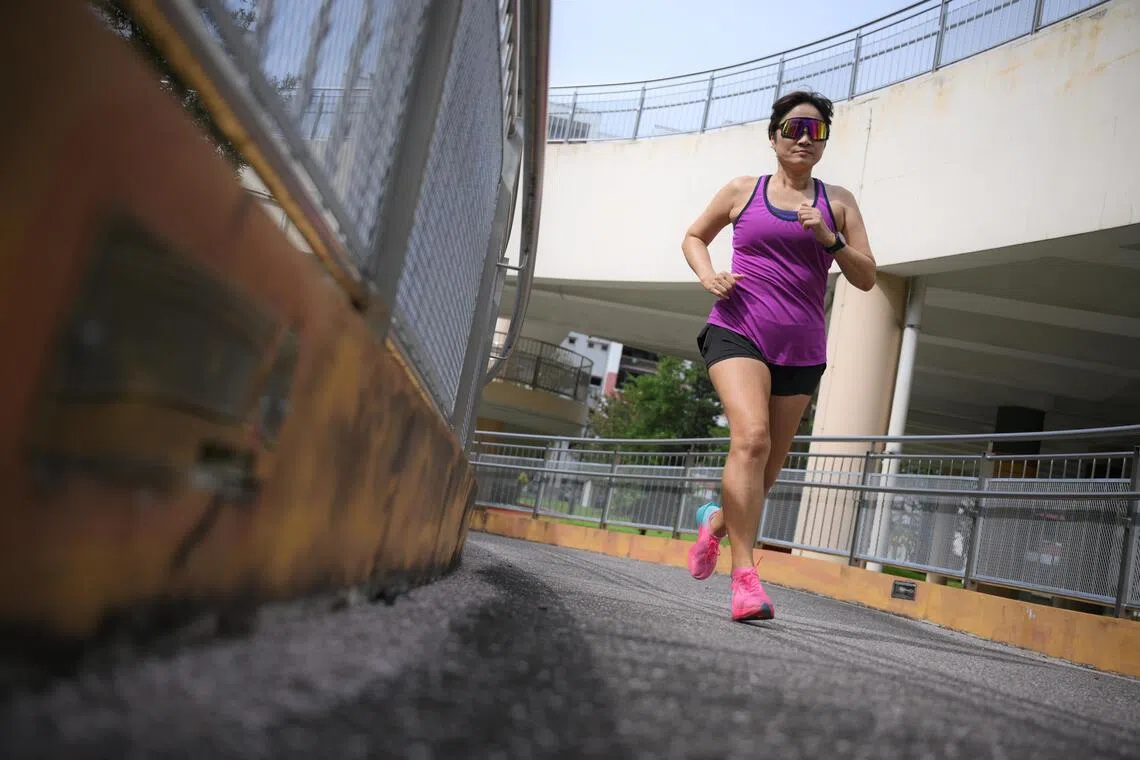
Ms Chee plans to do an Ironman race in Western Australia in December 2026.
ST PHOTO: MARK CHEONG
Ms Chee resumed fitness training in May 2025 doing light gym training, did more cardio exercises in preparation for Hyrox in September and completed a triathlon in Bintan a month later.
She managed to swim 1.9km within the cut-off time of 70 minutes at the Ironman 70.3 Phu Quoc in Vietnam in mid-November as a test of her swimming skills, which had deteriorated since her last operation due to breathlessness. She did not complete the rest of the race.
She took on Hyrox in late November after consulting Dr Leow. Her family members had participated in the June race as a relay and she was eager to have a go.
Hyrox is a high-intensity fitness race comprising an 8km run broken up by eight fitness stations. She trained regularly for it, including taking Hyrox preparation classes, and completed the route in two hours and 48 minutes. There is no cut-off time for Hyrox.
“Every station was hard. I had to walk 500m and then run another 500m,” she says. In the wall ball station, she had to pace herself across the 100 reps as she became tired after every five.
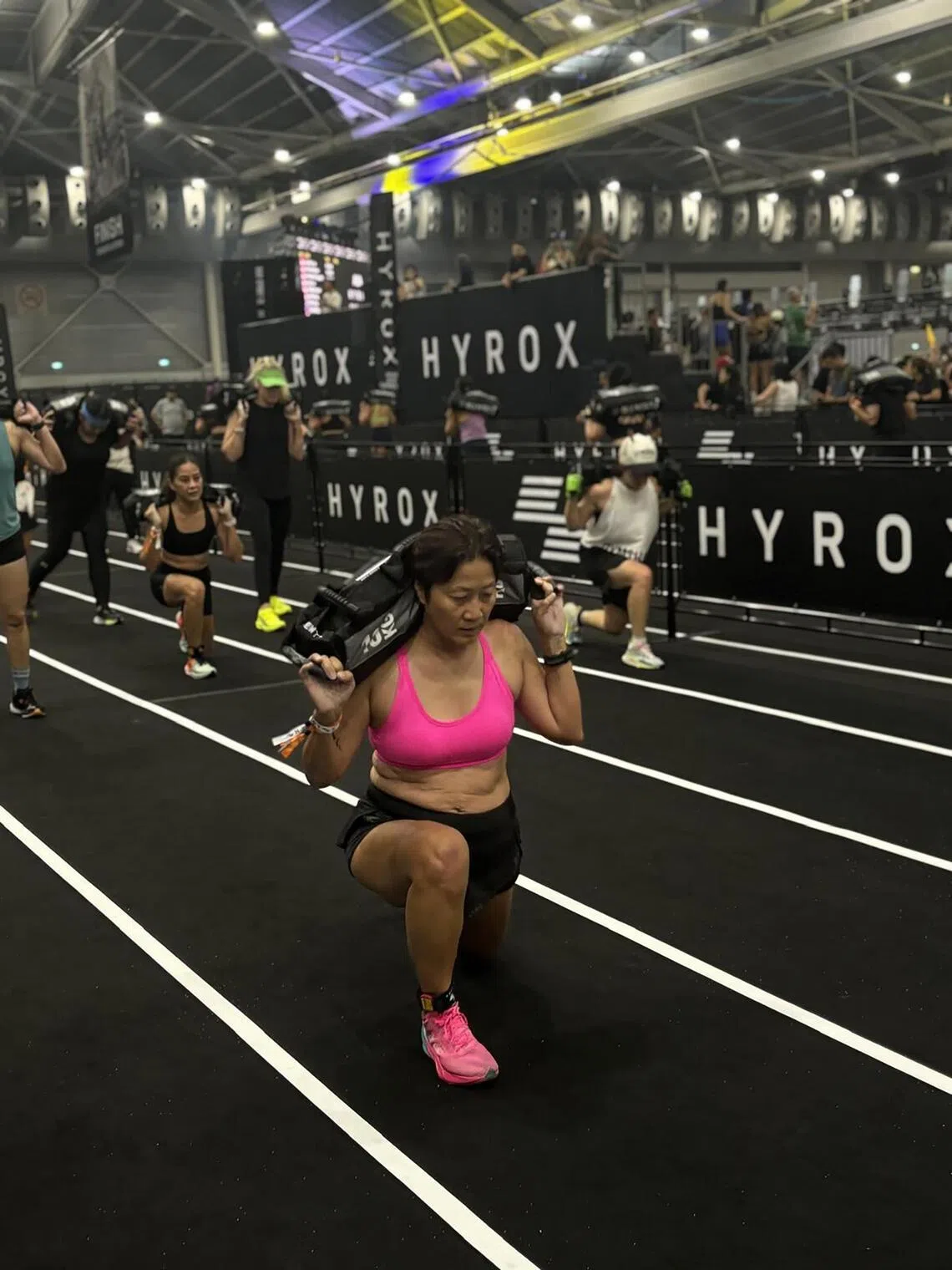
Ms Chee completed her first Hyrox race in November 2025, eight months after her third lung surgery.
PHOTO: COURTESY OF VIVIAN CHEE
Crossing the finish line, she teared up at the achievement as her family members erupted in cheers.
“It also made the kids proud. If I can do this, it tells them that I’m okay,” she says.
“When I race, I don’t go to extremes because I have a family. It’s always good to be safe and race consciously because if anything happens to me, it’s a burden to the family.”
Ms Chee already has a long list of races planned for the rest of 2026, including a regional Hyrox race and a trip back to do the half Ironman in Busselton, a full-circle moment for her.
“With a positive mindset and a brave heart, you can face whatever challenge comes at you.”