
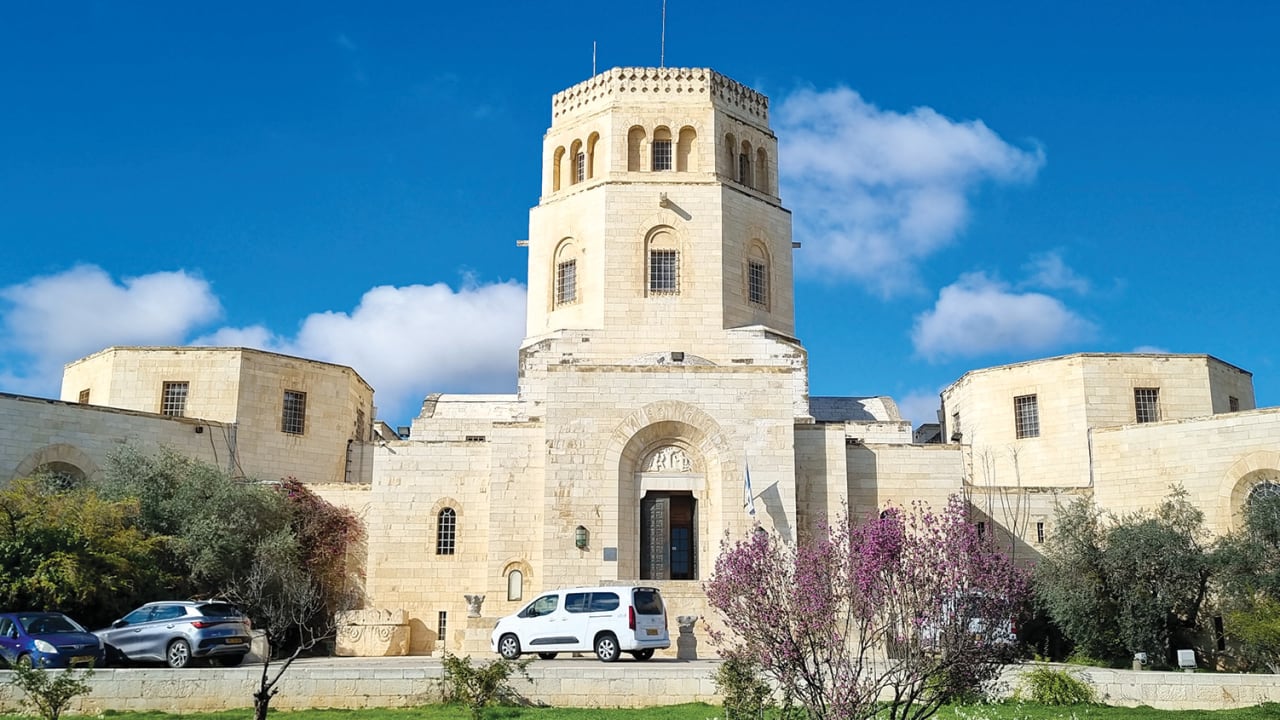
The Rockefeller Archaeological Museum in Jerusalem is a singular historic gem that more people are getting the opportunity to visit thanks to the guided tours, which were begun this year.
Shut down during the coronavirus pandemic and then after Oct. 7 and the subsequent war, the museum is now welcoming visitors once more, thanks to an initiative by the Tower of David Jerusalem Museum.
Eilat Lieber, director and chief curator of the Tower of David Museum, remembers visiting the majestic Rockefeller Museum with its sparkling backyard pool when she was an 18-year-old student at the Society for the Protection of Nature in Israel.
She spoke to In Jerusalem about the new tours which are now making the museum accessible.
“At first, the tour guides came,” she explained, since they were out of work due to the war. But as things opened up, the general public came for tours in both Hebrew and in English.

She sees the building as an important milestone in the history of museology. In the 1930s, the British were in control of the Land of Israel, and their archaeologists had the novel idea of opening a museum in the country from where the artifacts came, as opposed to shipping them off to Europe for display. Thus the mosaics from ancient synagogues, oil lamps, jewelry, and other artifacts discovered in excavations in the Holy Land are still here.
John D. Rockefeller Jr., son of the wealthy American businessman, donated $2 million for the construction.
“It’s interesting to know that he never visited this building,” Lieber said.
The building was opened in 1938.
Treasures from Israel’s past
Among the treasures in the museum is a life-size statue of Pharaoh Ramesses III found in Beit She’an dating back to the 11th century BCE. Next to it is a large stone stela with Egyptian hieroglyphics telling of the defeat of the Canaanites by the Egyptians at the battle of Megiddo.
Finds from Jewish history include a large mosaic from the synagogue at Yafia, near Nazareth, from the 4th century, and a stone lintel with a seven-branched menorah from the Eshtemoa synagogue near Hebron from the 3rd century, with a representation of the Temple Mount.
Inspirational architecture
The building itself is a work of art, designed by British architect Austen St. Barbe Harrison.

“I always thought that this building was one of the most beautiful buildings I ever saw,” Lieber said. “The architect tried to combine many inspirations from different gorgeous cities and palaces all over the world,” she explained.
“For example, in the inner courtyard, there’s a beautiful pool that he took as inspiration from the Alhambra Palace in Granada [Spain]. The Oriental arches are inspiration from what he learned about the Jewish Temple.”
An Amazon sarcophagus from the early Roman period sits in the sun near a Greek ossuary from 3rd-century Tel Turmus in the museum courtyard. Above, on the wall, is a carved depiction of Moses with the Ten Commandments as a stone lion watches over the pool. It could use a little cleaning, but considering the past few years, the public is lucky to see it at all.

Another gem is a room full of artifacts from Hisham’s Palace in Jericho with statues dating back to the Umayyad era.
This includes a statue from 9,000 years ago, which Lieber noted is one of the oldest examples of a depiction of a human face ever discovered. The inner dome of the palace, rescued after an earthquake, now sits on the floor. Its white stucco carved faces surrounded with intricately designed plants, which once stared down, now look up at the visitor.
Today, the museum is in need of an upgrade. Visitors are advised to wear a coat because the high ceilings and stone walls can make it drafty in the winter, and there is no central heating or air conditioning.

In addition to the building’s structure, the lettering inside the museum is also a work of art.
Lieber is a graduate of the Bezalel Academy of Arts and Design, where she studied industrial design with the intent of designing museum exhibitions. She later shifted to being a curator.

As part of her studies, Bezalel took its students to the Rockefeller. “I learned that the Hebrew letters written on the wall in the Rockefeller Museum are a very unique type of Hebrew letters that you cannot see anywhere else,” she explained. “So, from many aspects – architectural, design, and archaeology – it’s one of the jewels of Jerusalem that we must preserve for the next generations.”
Caroline Shapiro, director of external affairs at the Tower of David Museum, commented on the preparations for the Rockefeller tours.
“It was no easy feat, as the team of guides needed to have extensive training and knowledge to be able to [discuss] the treasures of the Rockefeller,” she said.
The Dead Sea Scrolls were once stored and studied in the museum. Visitors will see the vast library now with bare and dusty bookshelves. The long wooden tables once were used to stretch out the scrolls and study them, before they were eventually installed in the Israel Museum.

The British wanted the museum to represent the coming together of different cultures, as evidenced by the front lintel, which depicts Africa and Asia uniting, with the Mediterranean region in the middle. They made sure to have all the carved lettering inside the museum be in three languages: English, Hebrew, and Arabic.
When the Jordanians took over in 1948 and Jerusalem was divided, the new Arab administrators of the museum taped over the Hebrew lettering. The outline of the tape can still be seen, after it was removed following the city’s reunification in 1967.
Due to the museum’s strategic location on a hill overlooking the Old City walls, IDF soldiers were stationed there during the Six Day War.

The museum is located near Herod’s Gate beside a bustling outdoor market.
“It’s a very unique area,” Lieber noted. “People feel that they took a plane and are now somewhere abroad. When they pass through the door, they are inside a different place. But this is Jerusalem, where every gate will lead you to a different world.”

What is her favorite part of the museum? Lieber is fascinated by the jewelry collection. Enclosed in glass display cases are brightly colored bracelets, necklaces, and earrings, some of which look like something you could find in a shopping mall today.
“For those who love jewelry, they will see an amazing collection of the most beautiful gold jewelry from Jerusalem and other cities from the First Temple period,” she enthused.

“We always see stones and walls and remains of houses,” she said, “but to see the jewelry is almost as if you can meet the people of ancient Jerusalem.”
For more information on touring
the Rockefeller Museum, visit:
www.tod.org.il/en/