
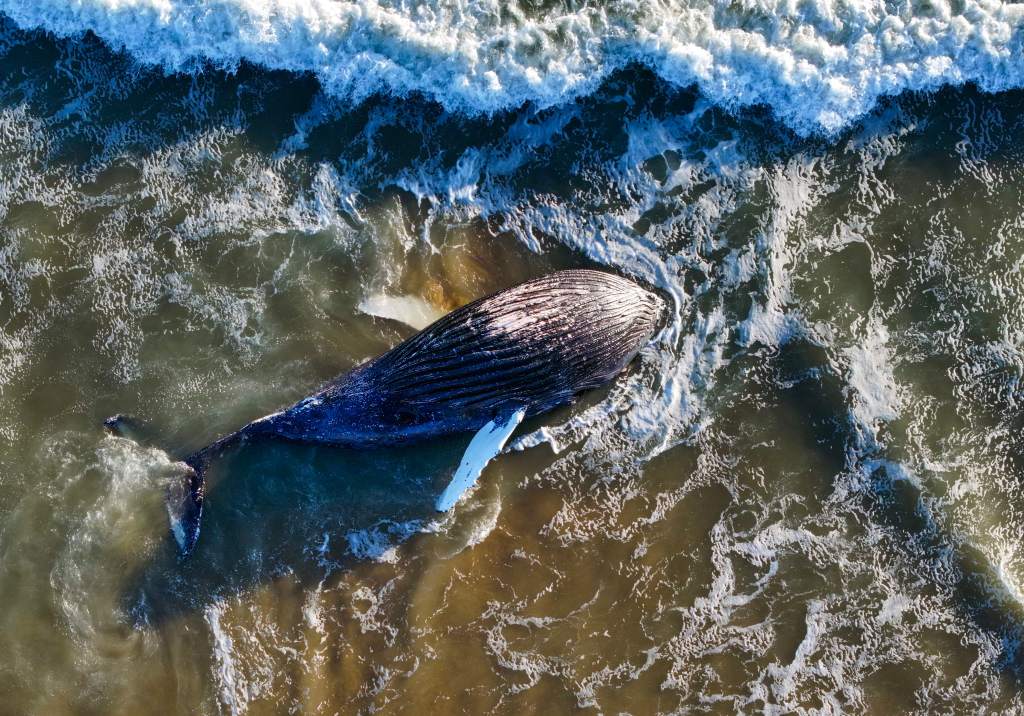
A nearly 30-foot deceased whale that washed up in Newport Beach this week disappeared overnight, likely carried back out to sea by strong surf, but was later found wedged on rocks further south in Corona del Mar.
The subadult humpback whale showed up on the shore near 11th Street, between the Balboa and Newport piers on Wednesday, Feb. 18.
Authorities were figuring out whether to tow it back out to sea or chop it up and take it to a landfill to dispose of the carcass. Taking it back to sea had its challenges with a storm that showed up on Thursday, with strong swells and winds that would make it difficult for the salvage tow boat to get near the shoreline.
“When we showed up this morning, there was no whale there,” said Marine Safety Battalion Chief Mike Ure. “We were looking around up and down the beach, toward the Wedge. We got a call from a citizen saying, ‘I think there’s a whale down here,’ in Corona del Mar.”
The whale was wedged in rocks between Big Corona and Little Corona, behind a big row of rocks sticking out in the ocean.
The boat initially scheduled to tow the whale out was still on standby. When it arrived, a lifeguard jumped in the water to hook a harness up to the whale, which was pulled out to sea.
The whale was being pulled 20 miles offshore.
“It will sink naturally in the weather and waves out there,” Ure said. “It’s starting to lose its gases that help it inflate and float. They usually just sink offshore; that’s what you want.”
The Whale Response Team from Pacific Marine Mammal Center, alongside Newport Beach lifeguards and public works, dispatched before it was gone to take samples and measurements to gather “important life history data and biological samples,” said a release from the mammal center.
The whale measured approximately 29.5 feet in length and is estimated to have weighed around 23,000 pounds, or more than 11 tons.
A subadult humpback is comparable to a teenager in human years, PMMC said.
“Humpback whales are a sentinel species,” said Dr. Alissa Deming, veterinarian and vice president of Conservation Medicine and Science at PMMC. “Every stranding represents both a loss and an opportunity — a unique chance to better understand the threats these animals face and how we can protect the population as a whole.”
Thursday evening, necropsy teams from the PMMC and the Ocean Animal Response and Research Alliance collected additional samples, including skin, blubber baleen, and bodily fluids for laboratory analysis, also confirming the whale was a female.
The Pacific Marine Mammal Center also deployed a thermography drone to document the whale and assess for visible injuries.
However, a rough surf and a rising tide made it unsafe to conduct a full necropsy at that time, the release said.
“While marine mammal strandings are always difficult to witness, they offer rare and valuable opportunities for scientific investigation. A thorough examination can help determine the cause of death and provide insight into the overall health of whale populations along the Southern California coast,” the PMMC announcement said. “The region has experienced an increase in whale strandings in recent years, coinciding with intensified human activity and changing ocean conditions.”
The Ocean Animal Response and Research Alliance had also planned to attach a satellite tag to the whale, allowing researchers to track its movement offshore and gather additional data on post-stranding drift patterns and ocean currents.
“This is a powerful example of what collaboration within the ocean community can accomplish. The samples and documentation collected will provide greater insight into this whale’s untimely death and contribute valuable scientific data to ongoing regional research,” Keith A. Matassa, chief executive of OARRA, said.