
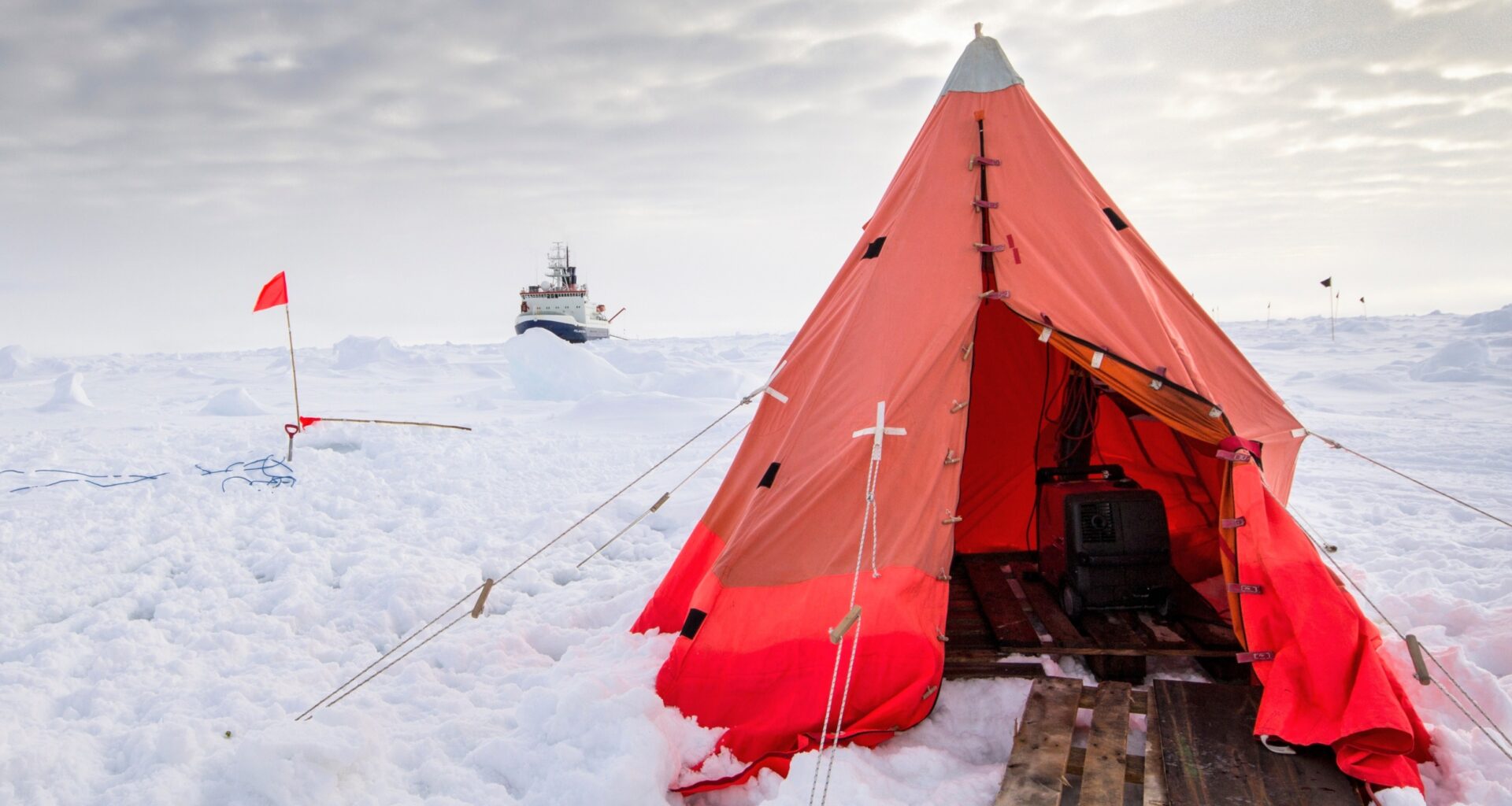
Out on the edge of the West Antarctic Ice Sheet, a group of scientists spent weeks living in tents on wind-packed snow, working shifts day and night.
They weren’t searching for wildlife or claiming territory – they were drilling deep beneath the ice to recover ancient mud.

Under more than a quarter-mile of ice, that mud can tell a story the ice itself can’t fully tell.
The mud preserves clues from past warm periods, revealing how the oceans shifted and how Antarctica’s ice sheet responded when the climate was hotter and less stable than it appears today.
Why drill under an ice sheet?
Ice sheets don’t just sit there. They creep, crack, and sometimes retreat fast.
The West Antarctic Ice Sheet is a big concern because it holds enough ice to raise global sea level by about 13 to 16 feet if it melted completely.
Satellites over recent decades show it’s losing mass faster and faster, but scientists still don’t know the exact amount of warming that could flip it into rapid loss.
For years, researchers have had to piece together the ice sheet’s past using clues gathered nearby, like sediments drilled next to the ice, under floating ice shelves, or out in the open Ross Sea and Southern Ocean.
While those sediment records are valuable, they cannot match the insight gained from drilling directly beneath the ice sheet itself.
That’s what makes this new drilling effort so unusual. An international team drilled a 748-foot-long sediment core made of ancient mud and rock from beneath 1,716 feet of ice.
Critical insights for future warming
The work happened at a deep-field camp at Crary Ice Rise, more than 435 miles from the nearest Antarctic stations, New Zealand’s Scott Base and the United States’ McMurdo Station.
The project is called SWAIS2C – Sensitivity of the West Antarctic Ice Sheet to 2°C. The project was led by co-chief scientists Dr. Huw Horgan and Dr. Molly Patterson.
“This record will give us critical insights about how the West Antarctic Ice Sheet and Ross Ice Shelf is likely to respond to temperatures above 2°C,” said Dr. Horgan, a geophysical glaciologist the Victoria University of Wellington.
“Initial indications are that the layers of sediment in the core span the past 23 million years, including time periods when Earth’s global average temperatures were significantly higher than 2°C above pre-industrial.”
If that early estimate holds up, this core doesn’t just cover a few ice ages. It reaches back into a huge stretch of time when carbon dioxide levels, ocean heat, and coastlines looked very different from today.
That matters because climate scientists use the past as a reality check. Computer models can simulate ice loss, but real evidence from real warm periods helps test whether those models behave like Earth actually did.
Variability across the sediments
As the researchers brought the core up in sections as long as about 10 feet, they noted that the sediments weren’t all the same. Some layers looked like what you’d expect under an ice sheet. Others didn’t.
“We saw a lot of variability. Some of the sediment was typical of deposits that occur under an ice sheet like we have at Crary Ice Rise today,” said Dr. Patterson.
“But we also saw material that’s more typical of an open ocean, an ice shelf floating over ocean, or an ice-shelf margin with icebergs calving off.”
Some of the strongest hints of open water came from shell fragments and the remains of marine organisms that need light to survive.
Light can’t reach them through hundreds of feet of ice, which suggests that at certain times in the past, this spot wasn’t buried under ice the way it is now.
Scientists have already suspected that parts of this region were once open ocean, which would mean the Ross Ice Shelf retreated, and the West Antarctic Ice Sheet may have pulled back a lot too.
Environmental conditions through time
The problem has been timing. Which warm periods did that happen in? How warm was the planet when it happened? And what was the ocean doing?
“This new record provides sequences of environmental conditions through time, and ground truths the presence of open ocean in this region,” said Dr. Patterson.
“In addition to pinning down the time when this occurred and the corresponding global temperature, analysis will help us quantify the environmental factors that drove the ice sheet retreat, such as determining what the ocean temperatures were at that time.”
Ocean temperature matters because warm water can eat away at ice from below. Even if the air is freezing, a slightly warmer ocean can thin ice shelves, weaken their grip, and allow glaciers behind them to speed up.
Science at the edge of the map
This wasn’t a quick drilling job with a warm building nearby and spare parts on a shelf. The team had 29 scientists, drillers, engineers, and polar specialists camping on the ice.
“To our knowledge, the longest sediment cores previously drilled under an ice sheet are less than 10 m. We exceeded our target of 200 m, and undertook this 700 km from the nearest base – this is Antarctic frontier science,” said Dr Patterson.
Just getting to the sediment meant melting a hole through 1,716 feet of ice with hot water. Then they lowered more than 4,265 feet of pipe down the hole.
Once each section of core reached the surface, the pace shifted to focused precision.
Scientists logged its features, photographed the layers, X-rayed the tube, and collected samples. Then they sent the drill back down for the next segment, racing the clock in a place where every hour in the field counts.
“It was a great feeling when that first core came up, but then you start worrying about the next core and the next core after that. So, it’s stressful right up until the end,” said Dr. Horgan.
“But we’re thrilled to have learnt from our previous challenges and to have successfully retrieved this geological record that will help the world prepare for the impacts of climate change.”
The future of Antarctic ice retreat
Preliminary dating in the field relied on tiny fossils from marine organisms found in some layers. That’s a classic way to estimate age, because certain microfossils show up in known time windows.
Next comes the slower, more exact work. A broader team across the 10 participating countries will use multiple methods to confirm and refine the timeline.
The core has been transported back to Scott Base and will soon head to New Zealand, with samples then distributed to scientists around the world for deeper analysis.
“Our multi-disciplinary international team is already collaborating to unravel the climate secrets hidden in the core,” said Dr. Horgan.
“With our drilling system having been put to the test under these tough Antarctic conditions and passing with flying colors, we’re looking ahead to plan future drilling to continue our mission to learn more about the sensitivity of the West Antarctic Ice Sheet to global warming.”
The big goal is simple to say and hard to answer: how fast will Antarctic ice retreat when the planet heats up?
This muddy archive, pulled from beneath a place most humans will never see, may end up shaping how the rest of us plan for sea level rise in the decades ahead.
—–
Like what you read? Subscribe to our newsletter for engaging articles, exclusive content, and the latest updates.
Check us out on EarthSnap, a free app brought to you by Eric Ralls and Earth.com.
—–