
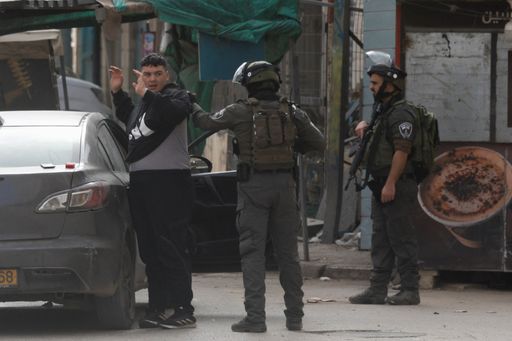
In the latest flashpoint of a deepening crime crisis gripping Palestinian communities inside Israel, police say they arrested 34 suspects overnight during raids in the northern town of Kafr Kanna, following a violent clash linked to a long-running family feud.
The arrests came after a grenade explosion and sustained gunfire late Saturday injured four people, including a young woman and her mother, both in moderate condition, and a man in his 30s who was seriously wounded. Local authorities say the violence erupted between rival clans, underscoring how internal disputes are increasingly spiraling into deadly confrontations.
Eyewitnesses described a dramatic scene, claiming a grenade was dropped from a drone before gunfire erupted — a detail that highlights the growing sophistication and lethality of weapons now circulating in Palestinian towns.
The violence in Kafr Kanna is part of a broader and alarming surge in crime within Israel’s Palestinian communities. According to local tallies, at least 57 Palestinian citizens of Israel have been killed so far in 2026, including four shot dead by police — nearly double the figure recorded at the same point last year. The spike follows 2025, the deadliest year on record, when 252 people were killed in Arab communities nationwide.
Israel’s police commissioner has described the situation as a national emergency. But Palestinian citizens say the state’s response remains largely rhetorical.
Attorney Hassan Jabareen, founder of the human rights organisation Adalah, argues the violence cannot be viewed in isolation.
“There is a lack of police enforcement, a lack of the rule of law,” Jabareen said. “What we see is a pattern: in Gaza, mass killing; in the West Bank, settlers killing Palestinians with impunity; and inside Israel, Palestinians left to kill Palestinians while the state looks away.”
Jabareen pointed to stark disparities in crime statistics to underscore what he described as structural neglect.
“In the West Bank, the rate of killings linked to internal crime is about one per 100,000 people. In Jewish Israeli society, it’s roughly the same. Jordan is similar. Globally, the average is five to six per 100,000. But among Palestinian citizens of Israel, the rate is nearly 13 per 100,000 — one of the highest in the world, rivaled only by some Latin American countries.”
Many Palestinian citizens cite a glaring gap in law enforcement outcomes, noting that homicide cases in Jewish communities are solved at far higher rates than those in Arab towns — a disparity that fuels anger, mistrust, and accusations of institutional discrimination.
Community activists say the crisis is rooted in years of inadequate policing, unchecked organised crime, easy access to illegal weapons, and widespread impunity. Family feuds often escalate into cycles of revenge, while criminal networks tied to extortion, loan-sharking, and racketeering have taken hold in towns and villages.
Frustration has spilled into the streets. Palestinian cities and towns across Israel have recently seen protests under the banner of “Disruption Day,” aimed at drawing attention to organised crime and what demonstrators describe as police inaction or complicity. A large rally was held in Tel Aviv. Protesters wore black, symbolising mourning and protest against what they see as state abandonment.
Demanding equal protection