
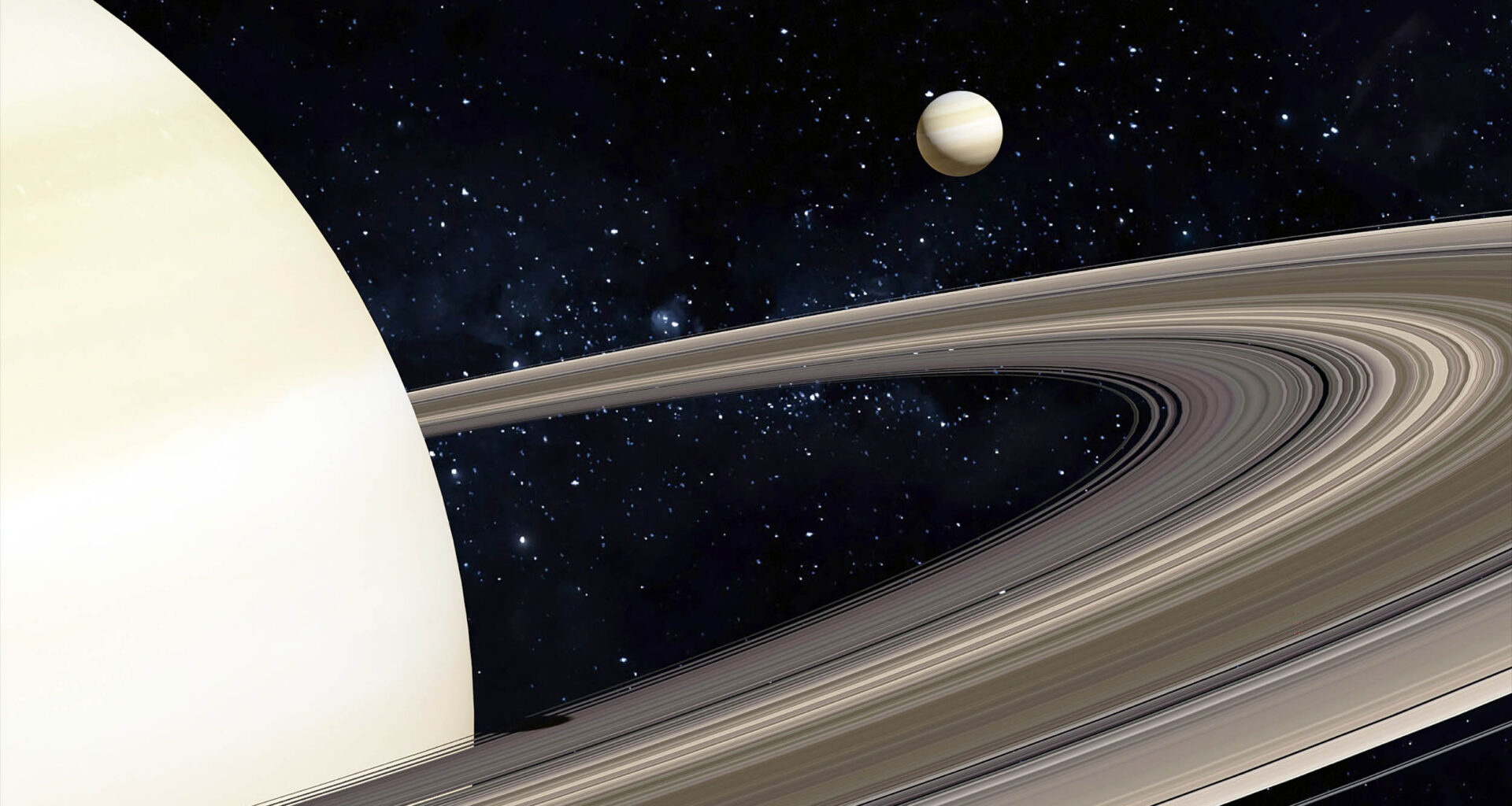
New observations show a small Saturn moon has generated electromagnetic waves that extend more than 313,000 miles behind it inside Saturn’s magnetic field.
That newly measured reach reveals a tiny icy world acting as a planetary-scale engine, reshaping how scientists understand the power of small moons.
Cassini mapped the wake

Cassini’s instruments repeatedly encountered the same magnetic disturbance far downstream from Enceladus, tracing a vast electrical wake through Saturn’s space environment.
At the Laboratoire de Physique des Plasmas (LPP), Thomas Chust documented 36 distinct wave events in the spacecraft’s record that aligned precisely with the moon’s magnetic footprint.
Thirteen of those signals appeared when Cassini was nowhere near the moon itself, confirming that the disturbance persisted long after any close pass.
Together, those detections establish that Enceladus does not simply disturb its immediate surroundings but sustains a long-range electromagnetic structure that demands closer explanation.
Geysers charge the flow
Jets of water vapor and ice shoot from south-pole fractures on Enceladus, constantly adding fresh material to nearby space.
Radiation strips electrons from part of that spray, turning neutral atoms into charged particles that start behaving differently.
Those charged bits mix with nearby gas to form plasma, a gas made of electrons and charged atoms, around the moon.
Once that plasma meets Saturn’s magnetic field, it can carry energy outward, even when the moon itself stays distant.
Waves run along fields
In Saturn’s magnetic field, the new plasma does not drift quietly, and it can set off traveling disturbances.
Scientists call those disturbances Alfvén waves, ripples in plasma that travel along magnetic field lines.
As they move, they push and pull on charged particles, transferring energy without needing the particles to stream the whole distance.
That delivery lets activity near Enceladus show up far downstream, in places Cassini reached long after the geysers erupted.
A wake with echoes
Behind Enceladus, the team found not one wave trail but several, created when signals bounced and crossed paths.
Reflections sent part of the energy back toward the moon’s orbit, while the rest kept streaming away in the wake.
Measured against a radius of about 155 miles, the disturbances stretched at least 2,000 times farther than Enceladus itself.
Such long-range structure also means a brief outburst in the geysers can leave a signature well after the source calms.
Hunting signals in orbits
From 2004 to 2017, Cassini circled Saturn for 13 years, leaving a deep record to sift.
Scanning that record, the LPP team identified 36 clear cases where Alfvén waves matched Enceladus’ position along the field.
13 of those events occurred when Cassini did not fly near the moon, which made the reach hard to dismiss.
“This is the first time such a large electromagnetic range has been observed for Enceladus, proving that this small moon acts as a giant Alfvén wave generator on a planetary scale,” said Chust.
Particles ride the wake
Far from the moon, Cassini sometimes found energetic electrons missing, showing the plume-driven interaction affected particles far downstream.
Absorbing those electrons matters because high-energy particles drive radiation damage, and spacecraft electronics feel that exposure first.
Water-rich material from the plumes can also grab charges, changing how currents flow and where the waves deposit energy.
That interaction stays patchy, so one pass can look calm while another nearby pass shows a strong pulse.
An ocean world clue
Interest in Enceladus started with chemistry, because its spray carries pieces of a salty ocean into space.
Sampling that material let scientists spot key ingredients for life, including organic molecules and signs of seafloor reactions.
A newly mapped electromagnetic reach changes the backdrop for those samples, since charged particles can alter molecules before instruments measure them.
Mission planners therefore need to treat the space around Enceladus as an active region, not a quiet corridor between flybys.
Small moons steer planets
Other worlds have shown moon-driven effects before, and Jupiter’s moon Io stands as the classic example.
Enceladus now joins that club in a quieter way, proving that even weak interactions can spread far.
Finding long-distance coupling at Saturn also helps researchers read faint radio and auroral signals in other planetary systems.
That perspective matters when scientists hunt for active moons around exoplanets, where direct images remain rare.
Magnetic waves from Enceladus
Cassini rarely cruised through the middle of the wake at medium distances, so the wave reflections still hide steps.
Limited coverage makes it hard to pin down where the bouncing happens, or how long each pulse survives.
More continuous measurements would track both fields and particles, revealing when geyser activity strengthens the system or lets it fade.
Future probes would need time far behind the moon, because the new work showed the wake can persist.
By tying Enceladus’ geysers to a sprawling Alfvén-wave wake, the study shows a tiny moon can run a giant electrical connection.
Better maps of that connection could guide safer flights through Saturn’s charged environment and sharpen future searches for life-ready ocean moons.
The study is published in the Journal of Geophysical Research: Space Physics.
—–
Like what you read? Subscribe to our newsletter for engaging articles, exclusive content, and the latest updates.
Check us out on EarthSnap, a free app brought to you by Eric Ralls and Earth.com.
—–