
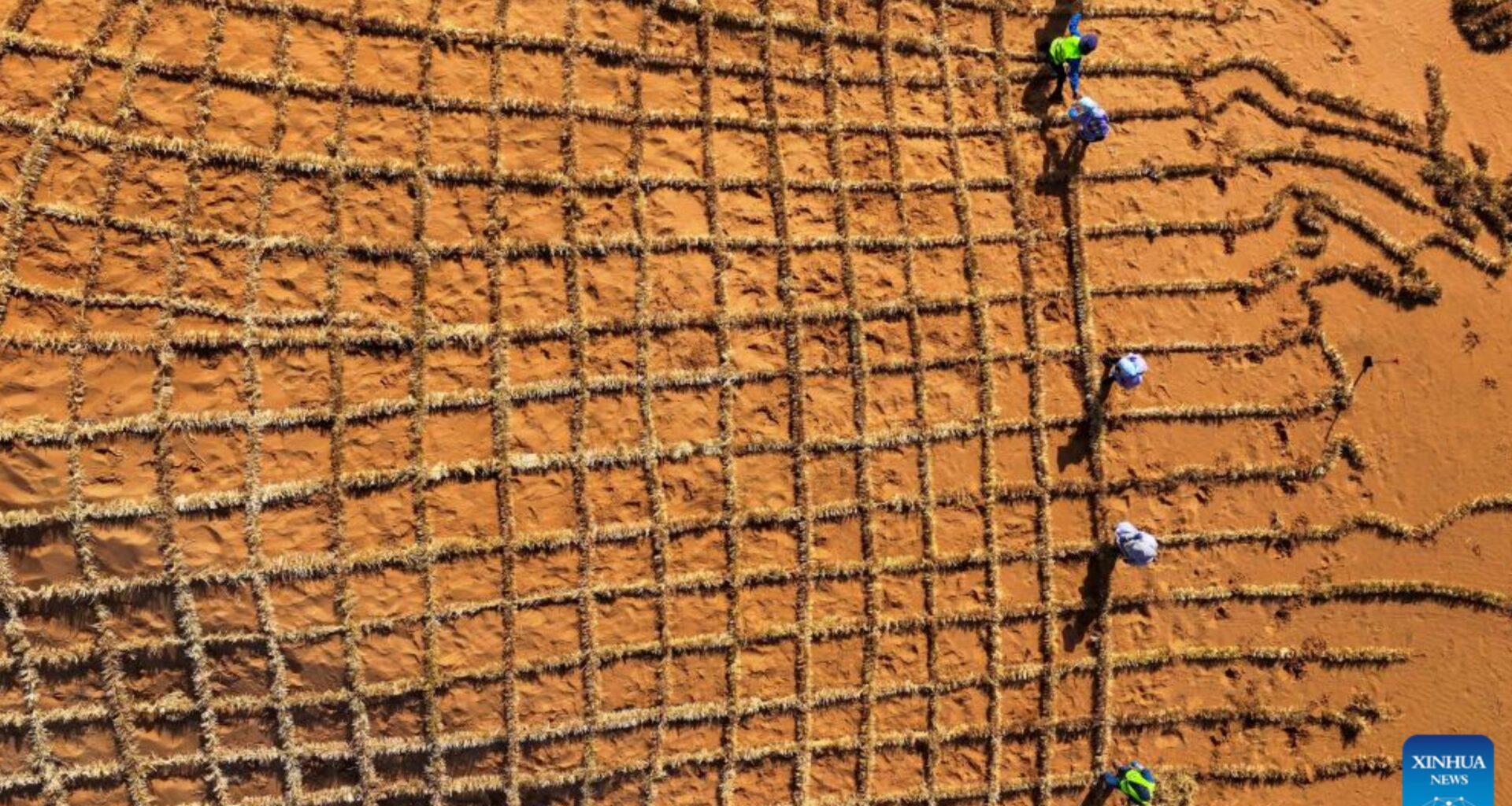
Scientists have used lab-grown microbes to bind loose desert sand into a thin, stable layer that wind cannot easily blow away.
That stronger surface gives restoration teams time to plant shrubs and grasses before harsh winds and heat wipe out young plants.
A crust takes hold

On straw checkerboards laid across northwest China, a dark film spread over treated sand and stayed after seasonal dust storms.
Tracking those plots through heat and frost, the Chinese Academy of Sciences (CAS) documented how fast the film hardened.
In trials near the Taklamakan Desert in Xinjiang in northwest China, CAS teams saw crusts stabilize sand within 10 to 16 months.
Even with that speed, planners focused on building the soil base first, so later plants could survive without constant replanting.
Meet ancient cyanobacteria
Long before forests existed, cyanobacteria, sunlight-powered bacteria that thrive in harsh places, likely appeared about 3.5 billion years ago.
Using sunlight and air, many strains pull carbon dioxide into their cells and leak the leftovers as simple organic matter.
In desert soils short on fertilizer, some species perform nitrogen fixation, turning nitrogen gas into plant-ready nutrients for the crust community.
Once they take hold, their living layer binds loose grains and gives the first plants a better place to root.
Sticky sugars bind sand
Under a microscope, biological soil crusts, thin living layers on soil surfaces, show a mesh of bacterial threads wrapped around sand grains.
To hold that mesh together, cells ooze sticky sugars between grains, and those sugars harden into a thin, cohesive layer.
The crust acts like glue by holding sand grains together and helping prevent invasive plants from taking root. Footsteps, tires, and hard raking can break the surface, so building crusts at scale also needs long-term protection.
Carbon starts building
Over the first year, the treated surface began holding nutrients near the top inch instead of letting dust blow away.
Mixing with drifting mineral dust, dead cells and leaked sugars formed organic matter that helped trap nitrogen and phosphorus.
As nutrients concentrated, more microbes could feed on them, and the crust community became harder to disturb.
For seedlings, that change created a better starting point, but survival still depended on rain arriving at the right time.
Water stays longer
After short rains, a crusted patch kept moisture closer to the surface, while nearby bare sand dried out quickly.
Rough pores and dark pigments reduced evaporation, because water stayed shaded and trapped under the thin layer.
Moisture held for even a few extra days can help grasses and shrubs sprout roots before heat returns.
During long dry spells, the living crust can go dormant, so results depend on climate and careful timing.
Succession adds partners
With time, the crust changed from mostly microbes to a mixed cover that included lichens and small moss patches.
Lichens added a tougher surface, and their slow growth helped keep the crust intact during high winds and cold nights.
Moss brought extra height and shade, which let tiny pockets of moisture linger and sheltered new microbes.
Once those later partners arrived, the system became more stable, but damage also took longer to heal.
A 59-year record
Behind today’s fast trials sits a record from China that followed crust growth across 59 years of desert recovery.
Using crust samples with known ages, the team compared untouched sites with plots treated with lab-grown cyanobacteria.
Nutrient gains matched which microbes dominated, and adding cyanobacteria shortened a decades-long process to just years.
Even in the best cases, that still meant waiting two to three years for a mature crust that resists disturbance.
Erosion drops fast
Wind provides the harshest test, and bare sand fails it when gusts pick up and carry grains away.
After spraying cyanobacteria, bound grains stayed put because the crust linked them, so fewer particles lifted into the air.
Lab tests with a manufactured crust cut wind-driven soil loss by more than 90% in controlled winds.
Less blowing sand could mean fewer sandstorms and longer-lived roads, but the crust must survive traffic and grazing pressure.
Limits in the field
Scaling this method beyond plots forces hard choices about where to spray microbes, since not every dune needs crust.
Local strains often handle heat, salt, and drought better than imported ones, so teams usually culture microbes from nearby deserts.
Because desertification, land losing plant cover and becoming more desert-like, has many causes, crusts cannot solve overgrazing or water misuse.
Without protection from vehicles and heavy foot traffic, a restored surface can crumble, and recovery may take years.
What changes next
Fast crust building turns microbial growth into a practical tool, linking desert sand control with slower, plant-based restoration.
Long-term monitoring will show whether durability, benefits, and side effects hold across different deserts and climates.
The study is published in Soil Biology and Biochemistry.
—–
Like what you read? Subscribe to our newsletter for engaging articles, exclusive content, and the latest updates.
Check us out on EarthSnap, a free app brought to you by Eric Ralls and Earth.com.
—–