
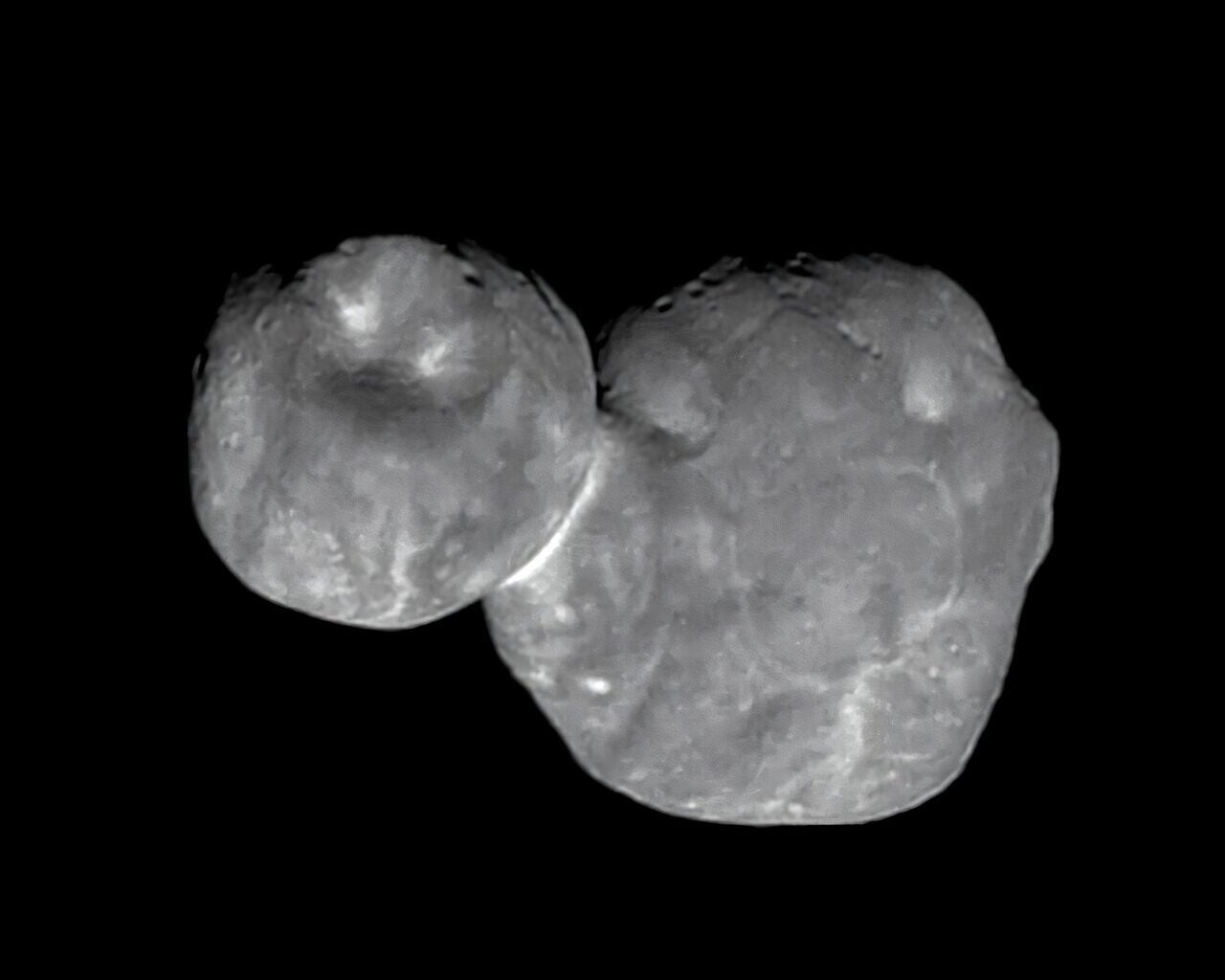
On a frigid orbit beyond Neptune, some of the solar system’s smallest worlds project a strange silhouette. Two rounded lobes, pressed together with a narrow “neck,” like a snowman that never melted.
Those shapes are common enough to demand an explanation. In the Kuiper Belt, about 10 percent of planetesimals are “contact binaries,” two bodies that touch and stay touching. NASA’s New Horizons made the form famous in January 2019 when it flew past the Kuiper Belt object (486958) Arrokoth, a bilobate world with a smaller lobe called Wenu and a larger one called Weeyo.
A new set of simulations led by Michigan State University graduate student Jackson Barnes argues that the snowman look can emerge from a basic process: gravitational collapse. The work is published in Monthly Notices of the Royal Astronomical Society.
A common shape needs a common origin
Scientists have floated plenty of ideas for how contact binaries form, including later-life events that push two once-separated partners together. Some proposals involve gas drag, Kozai–Lidov oscillations, or combinations of effects that change a binary’s orbit over time.
But the numbers in the Kuiper Belt have always posed a simple problem. If contact binaries make up a noticeable chunk of the population, their birth mechanism probably cannot be a once-in-a-while cosmic fluke.
“If we think 10 percent of planetesimal objects are contact binaries, the process that forms them can’t be rare,” said Earth and Environmental Science Professor Seth Jacobson, senior author on the paper. “Gravitational collapse fits nicely with what we’ve observed.”
Barnes’ simulations aim at that “not rare” standard by asking whether contact binaries can form right at the beginning, inside the collapsing cloud itself.
Not a liquid blob collision
Earlier computational models often treated colliding bodies like fluid blobs that merge into a sphere. That choice makes some problems easier, but it also erases a key detail needed here: solid bodies can keep their shape, lean against each other, and remain distinct even after a gentle impact.
Several examples of contact binary planetesimals created using the PKDGRAV SSDEM (panels a–d and f–i) as well as two shape models of (486958) Arrokoth from J. T. Keane et al. (2022) (panel e, left) and S. B. Porter et al. in preparation, S. Porter et al. (2024) (panel e, right). (CREDIT: Monthly Notices of the Royal Astronomical Society)
Barnes used an approach that does not force perfect merging. The simulations relied on an N-body code called PKDGRAV paired with a soft-sphere discrete element method, or SSDEM, which handles particle contacts with spring-and-dashpot forces rather than instant fusion. In plain terms, the objects can bump, rub, and settle.
That matters because the story of contact binaries begins as the story of a pebble cloud. Gravitational collapse, as described in the source material, gathers tiny solids into self-gravitating planetesimals, bypassing intermediate sizes that face “growth barriers.”
As the cloud contracts, it spins faster. It cannot simply shrink into one object rotating beyond a critical break-up limit. Instead, it can split into near-equal partners, forming a binary or even a multicomponent system.
The question was whether that early binary stage could naturally end in contact without needing an extra trigger later.
A gentle inward spiral
Barnes and colleagues ran 54 simulations of collapsing clouds. Each cloud had the mass of an approximately 100-kilometer-sized planetesimal system, but the code could not track the true count of mm-sized pebbles that would exist in such a cloud. Instead, the team represented the cloud with 10,000 “superparticles,” each about 2 kilometers in radius.
Across those runs, about 3 percent of resolved planetesimals formed as contact binaries. The team identified 29 contact-binary planetesimals out of a population of 834, using a by-eye requirement that the object still looked distinctly bilobate after contact. Twenty-four had a clear two-lobed shape, and five were borderline cases with a less pronounced neck. Objects below a threshold resolution were not counted because their shapes could not be distinguished.
Contact binary spin rates from simulated and observed populations as a function of the collision velocities of the mutually orbiting lobes. (CREDIT: Monthly Notices of the Royal Astronomical Society)
Every one of those contact binaries began as a gravitationally bound binary pair. Then, during the collapse, the binary interacted with other bodies in the cloud. Those encounters drained orbital energy. The components’ mutual orbits tightened until the pair collided.
Most of those collisions were mild. All but one contact event occurred between 0.4 and 5.8 meters per second. The outlier hit at about 16.9 meters per second. Many impacts clustered in a 2.9 to 5.0 meters per second band, a range hypothesized for Arrokoth’s lobe collision from geophysical and geomorphological arguments.
Barnes framed the payoff plainly. “We’re able to test this hypothesis for the first time in a legitimate way,” he said. “That’s what’s so exciting about this paper.”
Arrokoth, and what the simulations do and do not match
Arrokoth sits in the cold classical Kuiper Belt, far enough from the giant planets to avoid major dynamical evolution. Its distance also limits collisional and solar-driven processing, and its surface shows only a modest number of craters with similar inferred ages on both lobes. The source material notes that Wenu and Weeyo lack strong albedo and color differences, and they contain similar amounts of highly volatile chemical species. Those details support a shared origin and a gentle contact.
The simulations produced contact binaries with rounded, prolate lobes and shapes comparable to a limited sample of suspected primordial contact binaries across the solar system. They also produced post-contact spin rates typically between 2.1 and 3.0 revolutions per day, below a cited spin break-up limit of about 3.6 revolutions per day for equal-lobe-mass contact binaries with bulk densities around 1 g/cm³. Arrokoth, by contrast, rotates at 1.51 revolutions per day, or a 15.93-hour period.
The paper’s discussion offers a possible reason for that mismatch. It suggests that cratering collisions over long timescales could have slowed Arrokoth, potentially through largely inelastic impacts that compact the surface rather than excavate deeply. The source describes a scenario involving collisions with hundreds of roughly kilometer-sized Kuiper Belt objects.
Shape is another place where the match depends on which Arrokoth model you use. No simulated contact binary matches a distinctly flattened shape that was first estimated in one Arrokoth model. But an updated shape model described in the source has rounder lobes and fits the simulated population better, reducing the need to invoke major post-formation shape changes.
The simulations also hint at more complicated family structures. Four modeled contact binaries ended up with orbiting satellites, and two appeared as satellites inside multicomponent systems.
Related Stories