
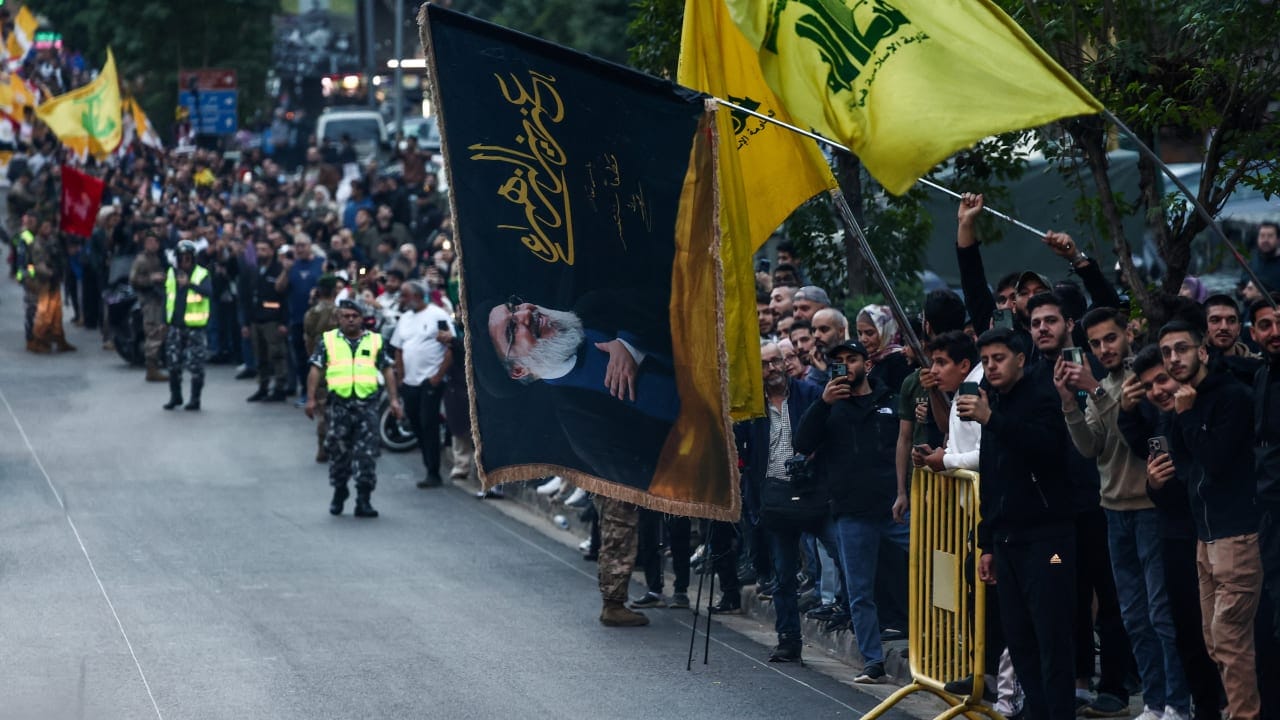
As tensions continued to escalate between the United States and the Islamic Republic of Iran, experts told The Jerusalem Post that Hezbollah remains capable and willing to join an attack on Israel, but such a move would prove costly for the Lebanese terror group.
The experts spoke to The Post after the Institute for the Study of War (ISW) had assessed, on Friday, that Hezbollah could participate in the potential conflict should the terror group perceive that the US or Israel were aiming at toppling the Islamic regime.
Former deputy national security adviser Prof. Chuck Freilich (New York University), an adjunct professor at Tel Aviv University (TAU) and Columbia, affirmed to the Post that the Hezbollah terror group had been created by Iran as a backup for any significant potential attack against the regime.
Founded on the ideology of velayat-e faqih (Guardianship of the Islamic Jurist), the Lebanese terror group is loyal to Ali Khamenei, binding his position as the authority on the group’s future role.
Freilich said that the regime had been “certainly disturbed” by Hezbollah’s absence from the 12-Day War in June, and that the potential incoming conflict would be treated as “the test” for the proxy group.

“They [Hezbollah] would like to join; the Iranians are going to be pressing them to join,” he said.
“On the other hand, they have domestic Lebanese constraints which are very much against it. I think a lot of the Lebanese public, even part of the Shia population, has had enough of paying the price for – so to speak – Hezbollah’s wars, and they’re under international pressure, and of course they’re under Israeli pressure, and we’ve seen Israel upping the ante in the last few days, especially.”
On Friday, the IDF struck several terrorists in charge of Hezbollah’s missile array in three separate command centers in the Baalbek area in Lebanon. The military claimed the terrorists were operating to accelerate Hezbollah’s readiness and force build-up while planning fire attacks on the State of Israel and advancing the readiness of terror attacks.
Freilich stressed that the loss of Tehran’s financial and military support would “make it very, very hard for them [Hezbollah] to survive as a military organization for very long” and “may be the scenario that finally forces them to go the political route and become a political party, more of a political and socioeconomic force in Lebanon.”
Zoe Levornik, a nuclear policy and security researcher and analyst at the Alma Research and Education Center, told The Post that, despite nearly two years of war with Israel, the terror group is understood to still have an arsenal of around 25,000 rockets and missiles, mostly short- and medium-range, and at least a 1,000 suicide drones, as well as approximately 40,000-50,000 personnel on active duty, with another 30,000-50,000 reservists.
With the collapse of the Assad regime in Syria, the damage inflicted during the conflict with Israel, along with its weakened political position in Lebanon, Hezbollah’s ability to recover has been slow.
ISW assesses Hezbollah could join war to protect Tehran
A disarmament campaign by Lebanese authorities, though criticized for its lack of speed, has also led Hezbollah to relocate many of its forces to north of the Litani River, according to ISW [a non-partisan, non-profit, public policy research organization].
Freilich predicted that in the coming days, it should be anticipated that there will be IDF activity to degrade the terror group.
“If they do join, they can still cause us a fair amount of pain, but much, much less than they could have a year ago, a year and a half ago,” he said, explaining how the IDF has significantly reduced Hezbollah’s capabilities and may choose to continue to do so.
Despite Hezbollah’s weakened state, ISW published that the terror group could still join an incoming conflict, both out of its loyalty to the regime and out of fear of losing its largest sponsor. That would result in serious setbacks in its ability to rearm and achieve its regional goals. This analysis was mirrored by the experts who spoke to The Post.
ISW noted that if Hezbollah does join the conflict, prioritizing loyalty to the regime over its domestic limitations, there are multiple courses of action that it could take, ranging from the symbolic to a large-scale aerial assault.
Most likely, according to the ISW assessment, the terror organization would carry out a symbolic attack by firing into open areas of northern Israel. This would likely avoid the risk of a large Israeli response but allow Hezbollah to continue to justify its existence as part of the “axis of resistance.”
Hezbollah took such action in firing two missiles at the Shebaa Farms in December 2024, claiming their missiles were a “defensive warning strike” in answer to what they alleged Israeli ceasefire violations; no casualties resulted, and while Israel responded with some attacks, the conflict did not escalate.
Hezbollah could also choose to target the five Israeli outposts in Lebanese territory, framing the attacks to align with the group’s image of “resisting occupation.” However, such attack would likely incur a swift response from Israel, ISW noted, which in turn would fuel discontent within southern Lebanese civilian society, which is still recovering from the last war Hezbollah started.
The terror group could also fire at IDF positions within Israel with medium-range projectiles, as it did during its war with Israel following Hamas’s October 7, 2023, attacks.
However, ISW highlighted that this type of attack, likely leading to a significant response from Israel, would then create significant political repercussions for Hezbollah and lead to further support for the Lebanese government’s disarmament plan.
Finally, Hezbollah could attempt to target civilians across Israel in missile and drone attacks, using large salvoes as it did during the October 2024 attack on Prime Minister Benjamin Netanyahu’s home.
ISW stressed that such an approach would likely lead to an Israeli response that would deeply endanger Hezbollah and its Shia support base, triggering major aerial operations.
“It’s possible that they will try to attack one of the Israeli communities by the border; try to fire a few rockets or missiles on Israel’s North. All of those are possible,” Levornik confirmed. “We don’t know if they will do something symbolic and limited or if they’ll join in a more supportive role as they did after October 7.”
Out of the question now, Levornik said, would be the type of October 7-incursion Hezbollah had been planning in the last quarter of 2023.
“They don’t have the capability to do what they were planning before October 7 because of the attacks on the Radwan unit and their infrastructure, and the fact that Israel is in those five strategic locations [outposts in Lebanese territory] and has cleared the contact line on the border,” she clarified.
“They don’t have the capability to do something at the moment that is very extensive with many operatives invading Israel, but as far as a small operation, a few operatives, a kidnapping; something like that is still possible.”
The ISW assessment came only days before Saudi media outlet Al-Arabiya reported that Hezbollah is now being led by officers from Tehran’s Islamic Revolutionary Guard Corps.
Citing sources close to the terror group, the outlet claimed that IRGC officers already in Lebanon had joined Hezbollah’s senior ranks, along with new arrivals from the Islamic Republic, with plans to accelerate the rebuilding of Hezbollah’s military capabilities.
Levornik told the Post she had seen similar claims coming out of institutes in Beirut, adding that it was “very possible that Iran is taking a more active role at the moment.”
“We do know that they’re very active in the rehabilitation of Hezbollah’s capabilities. So it makes sense that they’re also involved in organization and in leadership. They are, of course, involved in the decision-making process,” she confirmed.
Levornik added that Iran has taken a “more active role in the decision-making” since Hassan Nasrallah was killed in September 2024. The death of Nasrallah, she said, also led to significantly less consensus within Hezbollah.
“He had more of a standing vis-à-vis Iran; he [Nasrallah] wasn’t just taking orders, he was someone that they consulted with,” Levornik explained. “The current leadership is a little bit weaker when it comes to Iran…”