
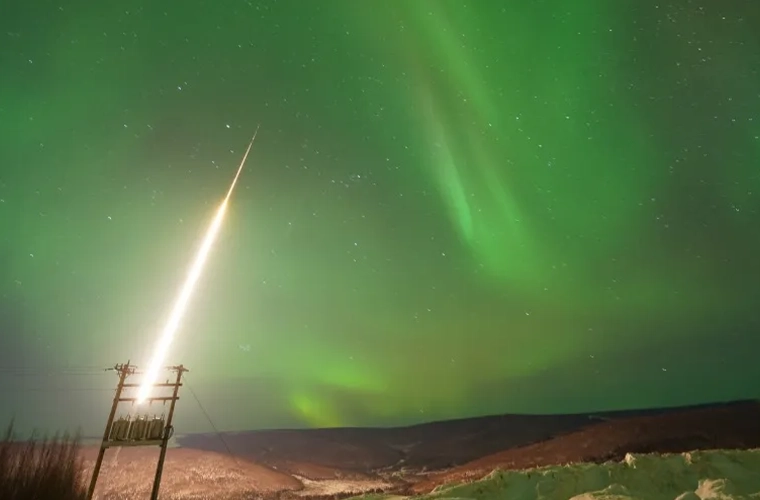
On a cold winter night above Alaska—beneath a sky already glowing with a shimmering green curtain of aurora—NASA pierced the darkness with a pair of sounding rockets launched seconds apart, slicing upward into the glowing storm like probes into a living circuit.
The goal wasn’t fireworks; it was diagnostics. NASA says the mission, called Geophysical Non-Equilibrium Ionospheric System Science (GNEISS, pronounced “nice”), is designed to produce something like a medical CT scan of the aurora’s electrical environment—an attempt to reconstruct, in 3D, how currents flow through the upper atmosphere when the northern lights turn on.
That might sound esoteric, but the stakes are very down-to-Earth. Auroral currents don’t just provide brilliant aerial displays. They help redistribute energy from space into Earth’s upper atmosphere in ways that can heat the air, stir winds, and change the conditions satellites move through.
Understanding that electrical channels matter for the kind of “space weather” that can disrupt navigation, communications, and spacecraft operations, especially as more infrastructure depends on reliable satellite services.
“We’re not just interested in where the rocket flies,” said principal investigator for GNEISS and a professor at Dartmouth College in New Hampshire, Dr. Kristina Lynch, said in a press release. “We want to know how the current spreads downward through the atmosphere.”
NASA’s Wallops Flight Facility team published the mission overview on Feb. 5 and later updated it with launch details from Alaska’s Poker Flat Research Range near Fairbanks. The Black and Diffuse Auroral Science Surveyor lifted off on Feb. 9, followed by GNEISS early Feb. 10, when two rockets launched back-to-back.
In describing the missions, NASA compared a glowing auroral arc to a lightbulb. The aurora shines because electrons are flowing, but the electricity doesn’t stop where the light appears. Like household power running through a cord, auroral electricity has to complete a loop. The visible aurora is only one step in that journey—electrons streaming down from space must ultimately find a return path that closes the circuit.
The mystery is that the “return path” is messy. NASA notes that after electrons set the aurora alight, they scatter in unpredictable directions, shaped by collisions, winds, pressure gradients, and shifting electric and magnetic fields. That complexity makes the closing current difficult to observe directly—yet it’s essential to understanding how the system works.
That’s where GNEISS and the CT scan metaphor come in. The mission’s architecture is built around tomography—reconstructing an internal structure by combining multiple “slices” taken from different angles. NASA says GNEISS does this with two rockets flying side-by-side through the same aurora along different slices, paired with a network of ground-based receivers.
“It’s essentially like doing a CT scan of the plasma beneath the aurora,” Dr. Lynch explained.
In a hospital CT scan, X-ray beams pass through tissue and are altered by what they encounter. Computer software reconstructs those measurements into a 3D image.
In GNEISS, the “patient” is the ionized gas—plasma—threaded by auroral electricity. As the rockets fly overhead, they transmit radio signals through the surrounding plasma to ground-based receivers.
NASA explains that the plasma alters those radio waves, allowing researchers to infer plasma density—effectively revealing where electricity can and can’t flow easily. That density map becomes the framework for understanding the auroral circuit.
The rockets don’t do this alone. Once inside the aurora, NASA says each rocket ejects four subpayloads—eight small measurement platforms in total—so the team can sample distinct locations within the auroral structure rather than relying on a single point along a single trajectory.
This is where sounding rockets—often overlooked compared to high-profile orbital missions—quietly shine. They’re fast, targeted, and can be launched in tight coordination with conditions in the sky.
NASA describes auroras as phenomena that emerge “where space meets sky,” driven by electric currents, particle flows, and collisions. Sounding rockets can be timed to fly through that action, placing instruments exactly where they need to be for a brief but information-rich window.
NASA’s recent update offers a snapshot of what that window looked like in practice. The Black and Diffuse Auroral Science Surveyor launched Feb. 9 at 3:29 a.m. Alaska Standard Time, reaching a peak altitude of about 224 miles (360 kilometers). GNEISS followed with two launches just 30 seconds apart on Feb. 10 at 1:19 a.m. AKST, with the rockets reaching peak altitudes of roughly 198 miles (about 319 kilometers).
Those altitudes are significant because the aurora is not a “high atmosphere” light show in the vague sense. It represents a specific region where charged particles and upper-atmospheric chemistry collide, and where the boundary between Earth’s atmosphere and the near-space environment becomes a dynamic, electrically active system.
The difference between measuring from below and measuring inside that system is the difference between watching lightning from a window and being inside the storm.
NASA notes that scientists have long studied auroras using ground-based observations, and that NASA’s EZIE satellite mission, launched in March 2025, measures auroral electrical currents from above. Combining ground imagery, in situ rocket data, and satellite measurements allows NASA to see the same system from multiple vantage points.

“If we can put the in situ measurements together with the ground-based imagery, then we can learn to read the aurora,” Dr. Lynch adds.
That phrase—“learn to read the aurora”—is doing a lot of work. For researchers, it implies moving from beautiful patterns to diagnostic signatures and recognizing what specific shapes, motions, and brightness changes in the aurora mean for the underlying currents and energy flow. For everyone else, it hints at a future where auroras aren’t just a spectacle, but a visible interface to space weather conditions that can influence modern technology.
NASA also highlighted a second mission flown in the same launch window: the Black and Diffuse Auroral Science Surveyor, which targeted the aurora’s strangest features—“unusual blank spots inside auroras known as black auroras.”
Scientists suspect these are locations where auroral currents suddenly reverse direction. An unsettling idea if you imagine the auroral activity as a power system with an unexpected switchback. NASA says it was the mission’s second attempt after a 2025 try was scrubbed due to unfavorable science and weather conditions.
The paired efforts are essentially a coordinated audit of auroral electricity. With one mission mapping how current spreads and closes through the atmosphere, while another probes the strange voids where that current may flip.
In an era when satellite constellations, GPS timing, and space-based communications underpin everything from aviation to finance, that kind of fundamental “wiring diagram” work can have consequences far beyond the auroral oval. Even if the immediate payoff is better understanding auroral physics.
For now, the data is in hand, and the analysis begins. NASA says the GNEISS principal investigator reported that ground stations, subpayloads, and booms functioned as expected, and that the team is pleased with the launch and the data collected so far.
Ultimately, auroras will keep dancing either way. However, with missions like GNEISS turning that dance into measurable structure—slice by slice—NASA is betting that the northern lights can become a readable display of the electric forces linking Earth to space.
Tim McMillan is a retired law enforcement executive, investigative reporter and co-founder of The Debrief. His writing typically focuses on defense, national security, the Intelligence Community and topics related to psychology. You can follow Tim on Twitter: @LtTimMcMillan. Tim can be reached by email: tim@thedebrief.org or through encrypted email: LtTimMcMillan@protonmail.com