
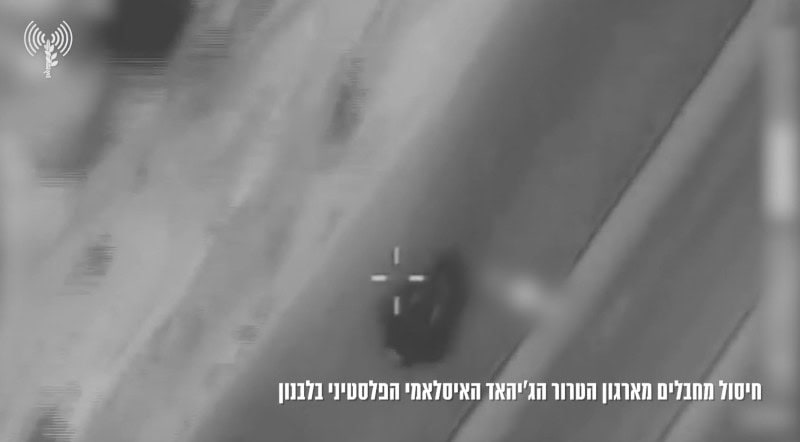
 An Israel Defense Forces (IDF) airstrike on a vehicle carrying Syrian Palestinian Islamic Jihad operatives in southern Lebanon. (IDF on X)
An Israeli strike on a Hamas site in Lebanon’s Ain al Hilweh camp on February 20 underscores a shift in Israel’s counterterrorism campaign: Palestinian terrorist groups operating from Lebanese territory are increasingly becoming targets. The attack, which killed two people, reflects a broader pattern of Israeli operations against Hamas and other Palestinian terrorist groups in Lebanon over the past three years.
According to the Israel Defense Forces (IDF), the strike targeted infrastructure used by Hamas to prepare attacks against Israel and Israeli troops. The camp, located near Sidon, has long served as a hub for Palestinian factions.
Hamas disputed Israel’s characterization of the site targeted by the IDF, claiming that it belonged to a joint Palestinian security force responsible for maintaining order in the camp. Furthermore, the terrorist group initially claimed that all of the dead and wounded were civilians. However, open-source information immediately indicated that at least one of those killed was a Hamas fighter, and the group “later issued an official statement announcing the deaths of Hamas operatives Bilal Deeb al Khatib and Mohammad Tareq al Sawi.”
The strike is consistent with Israel’s expanding campaign against Palestinian terrorists in Lebanon, which has accelerated since Hamas launched its October 7, 2023, attack on southern Israel. IDF statements and military operations indicate that Jerusalem views Lebanon not only as Hezbollah’s domain but also as another front where it needs to limit the military infrastructure of Hamas and other Palestinian terrorist organizations.
Besides the killing of senior Hamas member Saleh al Arouri in late 2023, one of the earliest high-profile strikes in this campaign occurred on March 13, 2024, when an Israeli drone killed Hamas member Hadi Ali Mustafa near Tyre in Lebanon. Israeli officials described Mustafa as a significant operative responsible for planning attacks against Israeli and Jewish targets worldwide. Hamas acknowledged his death, underscoring the presence of its military personnel inside Lebanon.
Israel continued targeting Hamas members in Lebanon in 2025. On February 17 of that year, an Israeli strike in Sidon killed Muhammad Shaheen, whom Israel identified as the head of Hamas’s operations department in Lebanon. Israeli officials said Shaheen had been involved in promoting terrorist plots against Israeli civilians with Iranian backing. Hamas confirmed his death, highlighting that the group’s senior-level operatives were active in Lebanese territory.
Additional Hamas figures were eliminated later that year. In April 2025, Israel killed Hamas commander Hassan Farhat in Sidon, accusing him of “advancing terror attacks” against Israel. Hamas acknowledged Farhat’s role and death, further confirming its operational footprint in Lebanon.
Israel also conducted larger strikes against Hamas infrastructure in Lebanese refugee camps. On November 18, 2025, the IDF struck what it described as a Hamas training compound in Ain al Hilweh, killing at least 13 people. Israeli officials said the facility was used to plan terrorist operations, though Hamas denied the allegation.
Besides Hamas, Israel has also targeted Palestinian Islamic Jihad (PIJ) members in southern Lebanon. On February 17, the IDF announced that it had killed “several terrorists” who belonged to PIJ’s Syrian branch. The suspects were attempting to cross into Syria after planning attacks against Israel, the IDF said. The February 17 strike was only one of multiple Israeli attacks against Syrian PIJ operatives in southern Lebanon after the October 7 attack.
The recent Israeli strike in Ain al Hilweh underscores both the persistence and growth of Israel’s evolving campaign against Palestinian armed groups beyond Gaza. By targeting Hamas and PIJ on Lebanese soil and outside of the context of a declared war, Israel is demonstrating that its counterterrorism operations against Palestinian factions are no longer confined to periods of large-scale conflict. Instead, these strikes signal a sustained, multi-front strategy aimed at degrading the infrastructure and operational capabilities of Palestinian armed groups.