
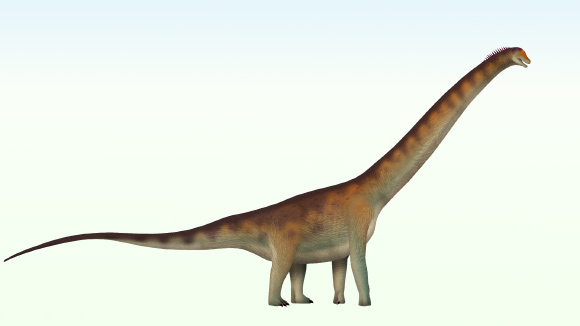
Paleontologists in Brazil have identified a previously unknown species of somphospondylan sauropod dinosaur with European affinities, hinting at ancient migration routes that once linked two continents now separated by the Atlantic Ocean.
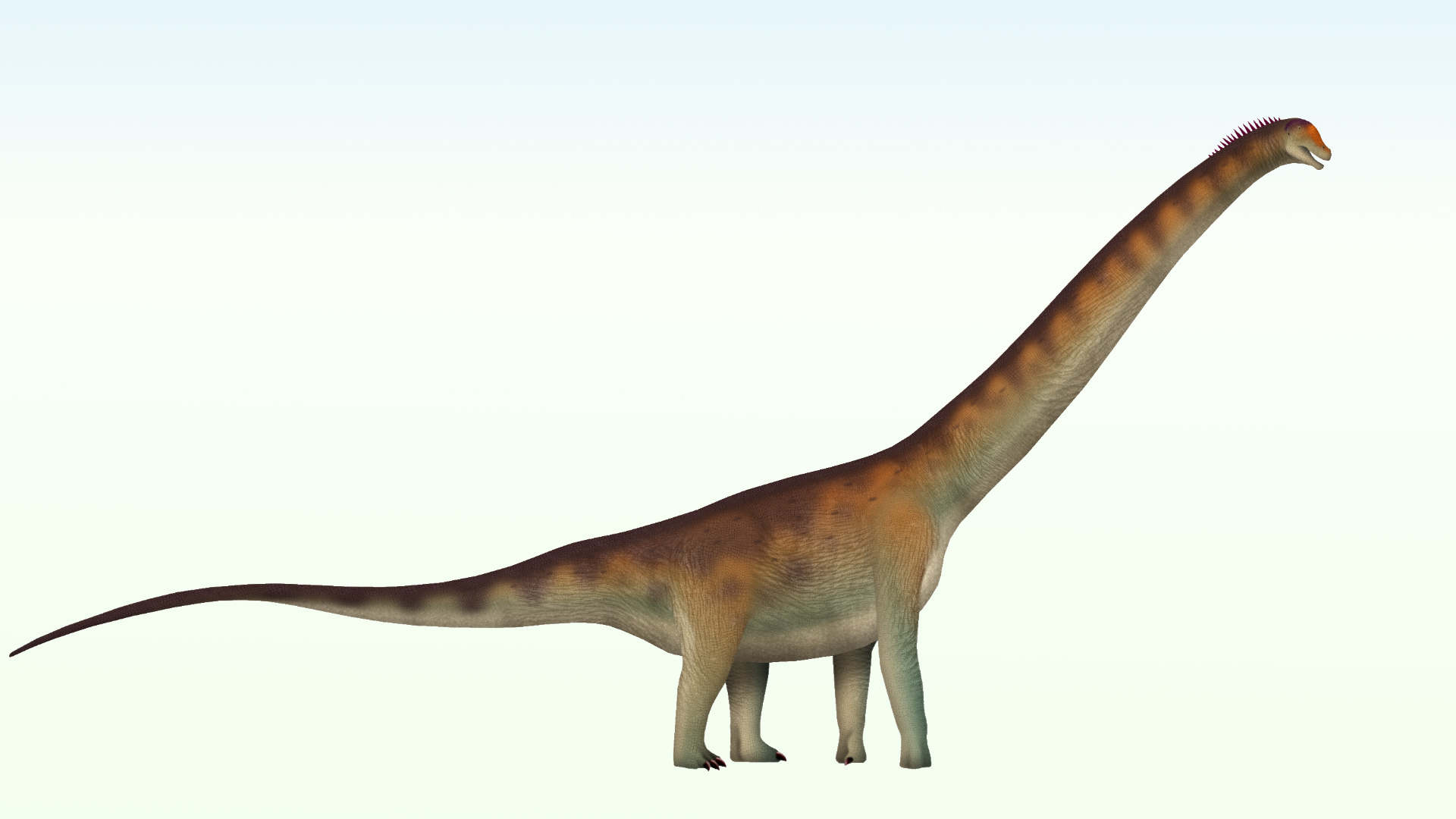
An artist’s impression of Dasosaurus tocantinensis. Image credit: TotalDino / CC BY 4.0.
The new dinosaur species lived about 120 million years ago during the Early Cretaceous epoch, when much of the world’s landmass was still stitched together in the southern supercontinent Gondwana.
Dubbed Dasosaurus tocantinensis, the animal measured approximately 20 m (66 feet) in length.
It belonged to Somphospondyli, a group of titanosauriform sauropods that lived from the Late Jurassic until the end of the Cretaceous period.
A partial skeleton of Dasosaurus tocantinensis was found in the Itapecuru Formation in northeastern Brazil.
The dinosaur’s tail vertebrae bear a unique set of three elongated ridges and grooves, while the thigh bone shows a pronounced lateral bulge — anatomical signatures not seen together in any previously described species.
These traits place Dasosaurus tocantinensis outside the titanosaur lineage, the subgroup of sauropods that would later dominate the southern continents.
Instead, the new species appears to be the closest known relative of Garumbatitan morellensis, a sauropod species that lived in what is now Spain around 122 million years ago.
Beyond naming a new species, the discovery strengthens evidence that Early Cretaceous South America was not an isolated evolutionary backwater.
Instead, it was part of a dynamic network of land connections that allowed dinosaurs to move between continents long before the Atlantic Ocean fully opened.
“Apart from expanding the known diversity of Early Cretaceous sauropods in the northern part of South America, this discovery highlights biogeographical connections with more northern Gondwanan areas, as well as Europe,” said lead author Dr. Max Langer from the Universidade de São Paulo and colleagues.
“In fact, numerical biogeographical analyses suggest that the clade formed by Dasosaurus tocantinensis and Garumbatitan morellensis had an European origin, with the lineage including Dasosaurus tocantinensis dispersing to South America via northern Africa at some point between the Valanginian (137-133 million years ago) and Aptian (121-113 million years ago).”
The discovery of Dasosaurus tocantinensis was reported in a paper published February 12 in the Journal of Systematic Palaeontology.
_____
Elver L. Mayer et al. 2026. A new titanosauriform with European affinities in the Early Cretaceous of Brazil: insights on Somphospondyli phylogeny, histology and biogeography. Journal of Systematic Palaeontology 24 (1); doi: 10.1080/14772019.2025.2601579