
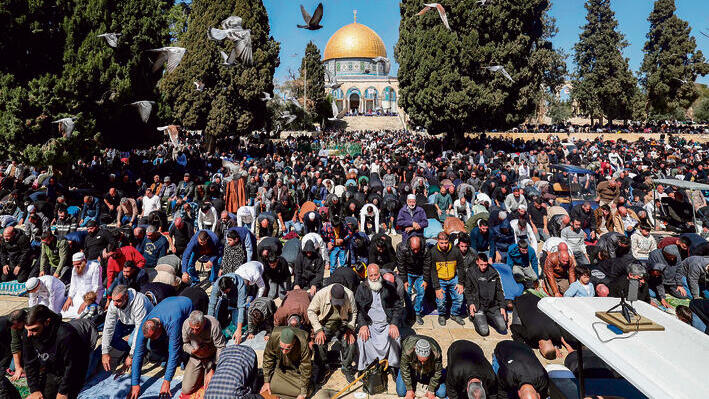
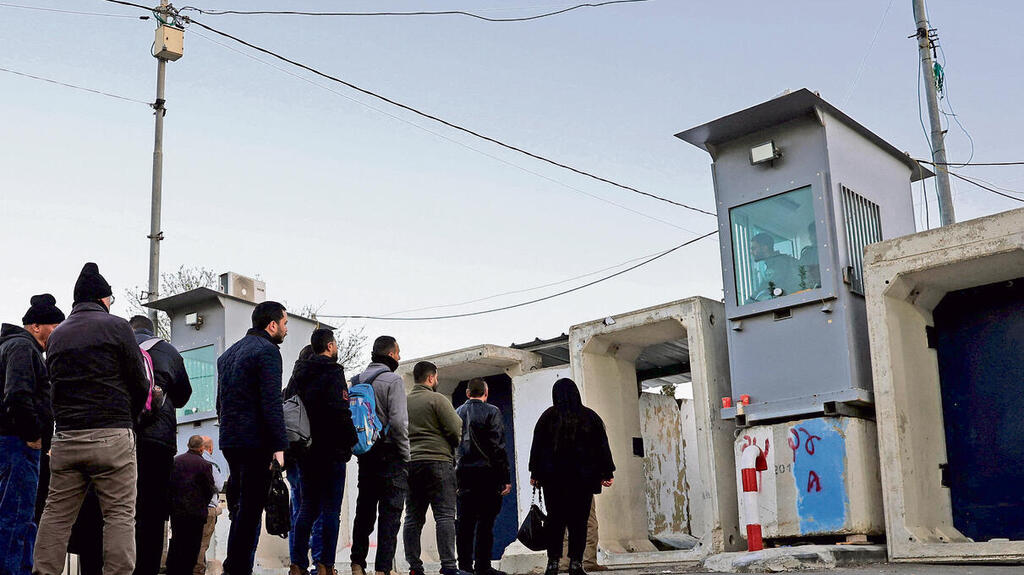
On Friday, 8,400 Palestinians with entry permits crossed through the Rachel and Qalandiya checkpoints to pray in Israel, about one-third of them women, according to defense officials. Under procedures in place since the start of the war, permit holders are required to report that they returned to their homes by 5 p.m.
2 View gallery
(Photo: AHMAD GHARABLI, AFP)
This year Ramadan coincides with the Jewish holiday of Purim. Dozens of settler events are expected across the West Bank, alongside implementation of Cabinet decisions to expand settlement activity, including at the site of Sa-Nur in the northern West Bank.
“The fact that it is Ramadan does not mean we halt operations,” said Lt. Col. A., an operations officer in Central Command. “In the past week we carried out five major brigade-level operations, including arrests.”
“Our mission is to enable freedom of worship for both sides,” he said. “That includes allowing all settlement-related activities. We will be wherever necessary to provide protection. We are carrying out all security measures required to enable a safe return to Sa-Nur. This is a Cabinet decision and we will implement it.”
Defense officials said they are also closely monitoring Palestinians released in hostage exchange deals, warning that some may attempt to reestablish terrorist infrastructure.
“Anyone who thinks those terrorists will not return to terrorism and attempt to rebuild infrastructure is mistaken,” a security official said. “We are conducting a range of actions, some daily. Anyone who tries to establish terrorist infrastructure — we will reach them.”
Focus on possible Iran conflict
Despite what officials described as relative success in preventing escalation during Ramadan, much of the security establishment’s attention in the West Bank is focused on the possibility of a war with Iran.
Central Command has completed preparations for such a scenario, officials said, including contingency plans affecting the West Bank during Ramadan.
“We have completed the relevant operational planning for the West Bank in the context of Iran,” Lt. Col. A. said. “Decisions regarding the entry of worshippers in the event of war will be made by the political leadership. Whether there is an order to close crossings or allow movement during fighting, we will know how to implement it.”
Officials said that in the event of war, all gates to the Temple Mount would be closed in accordance with Home Front Command directives.
2 View gallery
(Photo: Mussa Qawasma, REUTERS)
Within the Palestinian Authority, there is significant concern about a possible confrontation with Iran. Security officials said that beyond fears of missile fire, Palestinian leaders are worried about fuel and gas shortages and the possibility that goods would not arrive, further worsening an already fragile economic situation. Many areas lack adequate shelter infrastructure and in some places warning sirens cannot be heard.
Economic strain and terror concerns
Palestinian expectations for broader Ramadan easing measures — including increasing the number of worshippers allowed entry from 10,000 to 15,000 and lowering age restrictions — were not met, officials said.
The Palestinian Authority is facing economic difficulties and paid only about 50% of public sector salaries ahead of the holiday. Banks have tightened lending, and businesses in cities such as Ramallah report reduced activity. Some restaurants chose to close during Ramadan, anticipating that families would celebrate at home.
“The Palestinians entered the holiday in a difficult economic situation,” said Lt. Col. H., head of operations at the Civil Administration.
Central Command officials expressed concern that terrorist organizations, including Hamas and Islamic Jihad, may seek to exploit the economic hardship and the religious significance of Ramadan to rebuild terrorist networks that were recently dismantled.
In response, security forces carried out a series of arrests of known terrorist operatives in the lead-up to Ramadan, officials said.