
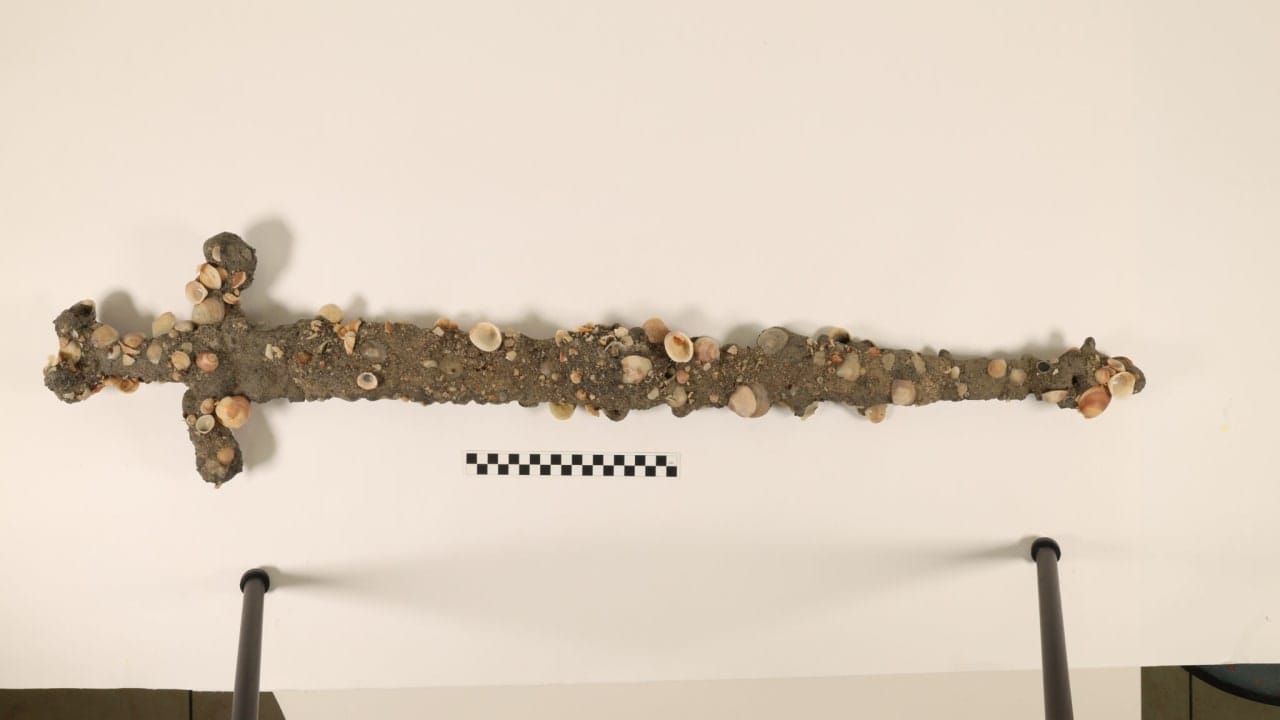
A sword dating to the 12th-century Crusader period was discovered buried in the seabed off northern Israel’s Dor Beach, Haifa University announced in a Sunday statement.
The discovery was made by Shlomi Katzin, a student at the University of Haifa ’s Department of Maritime Civilizations.
While at the beach, Katzin noticed a group of divers swimming in the area with a metal detector. Believing them to be antiquities thieves, he drove them from theareabefore spotting the sword protruding from the sea floor.
According to the statement, Katzin notified Prof. Deborah Cvikel from the Maritime Civilizations Department of the find. Cvikel, in turn, contacted the Israel Antiquities Authority (IAA), which gave Katzin special permission to remove the sword from the water to prevent further damage.
“Since their invention, swords have been among the most important tools in human history,” said Dr. Sarah Lantous of the University of Haifa. “In the Middle Ages, the sword became a symbol of knights and chivalry, as well as a symbol of Christian faith. It was also one of the most common weapons used by Crusader knights, whose lives depended on them.”

She noted that swords were considered highly valuable, and as such, were carefully preserved and maintained, and that “discovery and study of such a personal and symbolic object are rare.”
“Moreover, they provide us with a unique opportunity to learn about the lives of the Frankish knights in the Holy Land,” she added.
Cvikel echoed the sentiment, noting that the sword’s discovery “sheds light on the Crusader presence along the country’s shores,” and that only a handful of similar swords from the Crusader period have been discovered in Israel to date.
Sword undergoes CT scan
The sword, measuring approximately one meter long, was transferred first to a conservation lab at the Leon Recanati Institute for Maritime Studies (RIMS) at the University of Haifa, and then later to Elisha Medical Center in Haifa for an advanced CT scan to examine the blade’s condition without causing it further harm.
From the scan, researchers learned that the blade is a one-handed sword of European make, and had likely belonged to a Crusader warrior. The CT images also show a crack in the sword’s blade, and that only a small portion of the original iron had survived the ravages of time and the sea.
The CT scan “allows us to peer through layers of time and stone,” according to Dr. Eyal Berkovitz, medical director of Medica Diagnostics and a faculty member at the University of Haifa’s School of Medicine,
“Using the CT, we were able to see what the human eye cannot, the internal structure of the sword and its precise physical condition, all in a non-invasive scan that preserved the integrity of this rare find for future generations.”
Ziv Biton, CEO of Elisha Medical Center, shared that the hospital’s medical staff is proud and honored to have taken part in the project, opening a “time tunnel to the past in the form of a Crusader sword.”
“When the past meets the future within the walls of our hospital, there is nothing more rewarding.”