
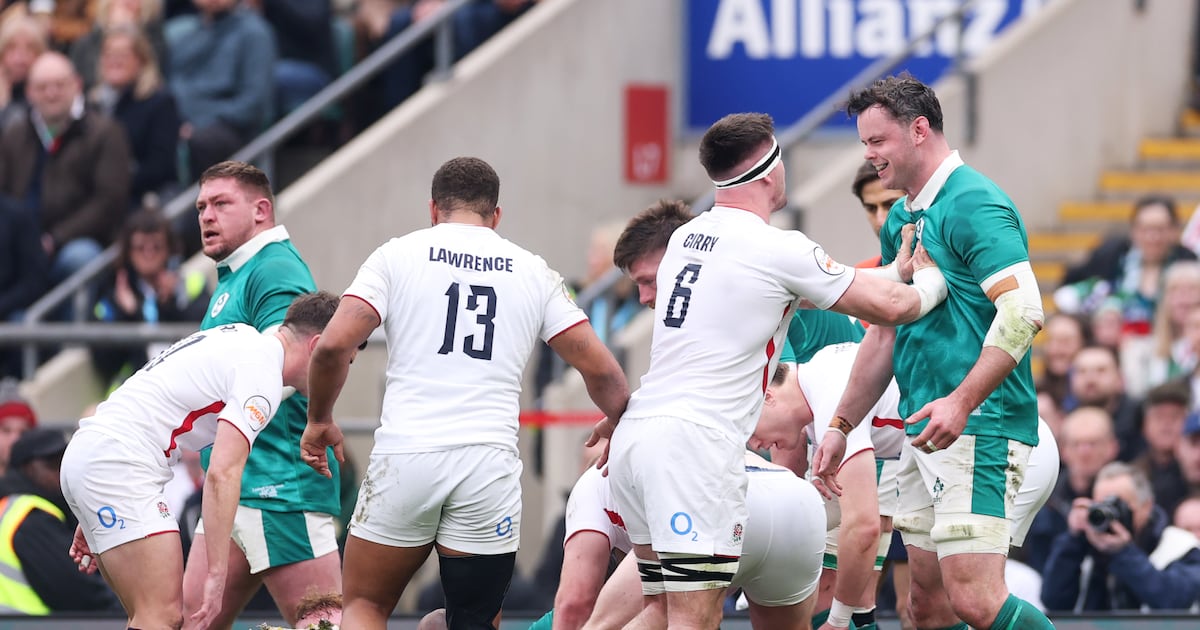
James Ryan extricated himself from a tangle of limbs and words by planting his hand on Henry Pollock’s cheek, using a long lever to facilitate the disengagement. The last two revellers to leave what began as a meatier pile of bodies at a breakdown.
It’s commonplace in rugby, a grapple and a chirp, before the combatants realise that the game has left them behind and rush to catch-up, but less so in Test rugby. It’s impossible to outrun a lens.
Given it happened in the opening throes of Saturday’s Six Nations game against England at Twickenham, it was given elevated status, Ireland’s “enforcer” looking to turn down the volume on an opponent bullish in expressing unsolicited views.
Ryan has acquired what is a relatively recent label, externally, because he’s been the pointy end of a stick when it comes to confronting opponents in a robust manner, especially in ruck clear-outs.
An upgraded 20-minute red card against South Africa for a poorly executed one on Springbok Malcolm Marx drew criticism, not just for the incident but also for his lack of apology.
But as he explained to the disciplinary hearing and subsequently released in the written verdict – he received a three-week ban, reduced to two through the ubiquitous tackle school route – he didn’t realise he had made contact with his opponent’s head, thought it was the upper body, and it was only the next day when he reviewed the footage that he became aware.
Ryan admitted that had he been aware then he would have contacted Marx to apologise, the Irish player pointing to his own history with concussion and most recently being knocked out while playing for the British & Irish Lions in the third Test against Australia last summer.
A yellow card for Leinster in Belfast the following month for another ruck offence didn’t soften the glare.
But an “enforcer”? Not really. Aggressive at ruck time certainly, but it’s not a tickling contest, without wishing to absolve recklessness. And there are consequences for those who mistime the contact or lead with a tucked arm and shoulder that clatters into the head area. As there should be.
Teams crave quick ball and that means unceremoniously shifting the malingerers, as the late great BBC rugby commentator Bill McLaren was wont to describe those who loitered at rucks with intent or otherwise. The are a few laws governing the jungle of the breakdown.
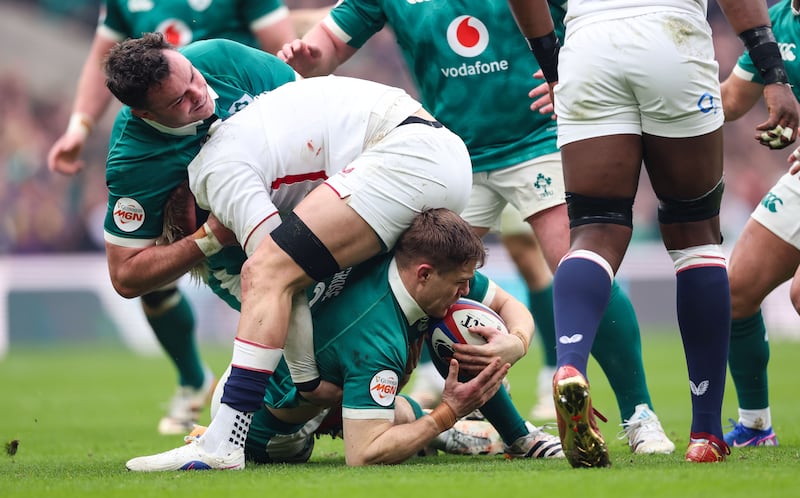 Henry Pollock of England tackles Ireland’s Garry Ringrose in Saturday’s game. Photograph: Billy Stickland/INPHO
Ryan is uncompromising and has a harder edge to his game now than the formative years, but his priority is not sourcing trouble. And to suggest that it’s the high-water mark of his input is misguided to put it mildly. Follow him in a match and witness how many times he effectively clears at the breakdown. There will be occasional missteps.
It is a selfless role, but highly prized by coaches and team-mates because attack patterns rely heavily on speedy ruck times. There’s so much more to Ryan’s game, including some of the attributes from his teenage days.
Watching the way that he carries the ball now offers a reminder of his athleticism, especially in the way he uses his footwork to win collisions, so prevalent in his early career.
His lineout work is also back in vogue with the national team, a more regular option in the Six Nations, while also a nuisance on the opposition ball. It’s not just about his physical attributes but his ability to read the game and pick those running lines.
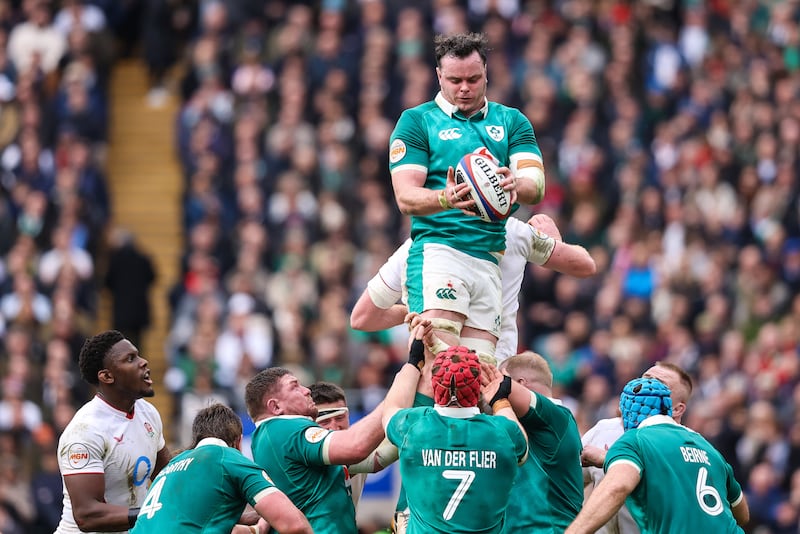 Ireland’s James Ryan receives the ball from a lineout at Twickenham. Photograph: Ben Brady/INPHO
The impact off the bench in Paris – he had five tackles and four carries in half-an-hour – was a significant down payment on a starting place against Italy, where his unapologetic physicality irritated opponents to a point where words and pushes were exchanged.
His carrying game provided Ireland with repeated gain-line success, the most notable in the build-up to Jamie Osborne’s try. That ability to make a metre or two in heavy traffic while occupying multiple tacklers ensures quick ball at breakdowns and space for others.
Before being replaced by debutant Edwin Edogbo, Ryan made 11 carries, eight tackles and five passes, the latter metric part of his broader remit in Ireland’s evolving attack. Against England, Ryan was again prominent on both sides of the ball from the get-go, his carry establishing a foothold in the home side’s 22, from which Jamison Gibson-Park’s opening try came.
His game in numbers: six carries, 10 tackles, one dominant tackle, one defender beaten. Ireland head coach Andy Farrell challenged Ryan in much the same way he did to Joe McCarthy, Josh van der Flier, Jamison Gibson-Park, Jack Crowley, Tadhg Beirne and James Lowe to be their best versions or risk riding the pine or maybe worse.
They have all responded superbly. Ryan in a very rounded way. He is so much more than the niggling presence that some focus on. Not that he will care much what other people think. It goes with the territory.
Ryan’s duties may have shifted a little, but it shouldn’t deflect from him possessing the wherewithal to play the game any which way.