
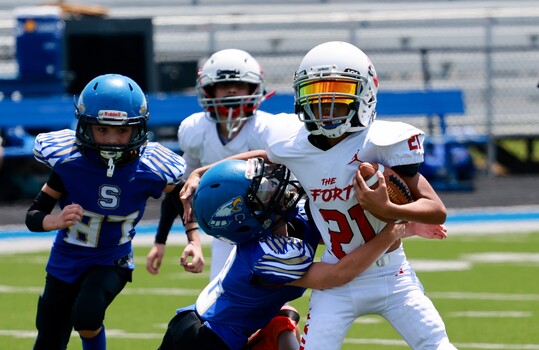
When outlets can fill galleries with “credit-only” submissions, quality drops, prices crater, and working shooters quietly burn out. I’ve been part of the problem. Here’s why I’m done working for free—and how I’m building paid alternatives that serious shooters can copy without burning bridges.
Walk any sideline on a Friday night, and you’ll see the same little ecosystem playing out. There’s a knot of long lenses on the forty, two more tucked behind the end zone, a volunteer with a mirrorless camera and a laminated badge, and a student with a kit zoom whose feet are planted a yard inside the line because no one taught them where to stand. Shutters rip. Cards fill. By morning, a recognizable media brand has queued a gallery sourced entirely from unpaid submissions. “Credit provided,” the line reads, as if a tag were a wage. The clicks roll in. The brand stays fed. And the photographers—amateurs and pros and the folks in between—help themselves to a dopamine snack while silently paying the bill for it.
I used to be one of them. It was exciting until the math stopped being cute. Gas costs what it costs. Insurance renews whether or not your handle gets tagged. Sensors get dirty. Shutters wear out. Software subscriptions auto-bill at 2 a.m. The time you spend culling and captioning after midnight doesn’t become imaginary because the invoice field says “exposure.” There’s also a quieter tab no one itemizes: the hour you miss with your family, the bedtime story you skip, the Saturday you trade for someone else’s Sunday spread. Those costs arrive whether or not you remember to add them up.
This isn’t a screed against beginners. I love beginners. I was one, and in many ways I still am. New people bring energy and curiosity. The problem isn’t new shooters; it’s incentives. If editors can fill a calendar with usable images for nothing, some will. If photographers accept “credit” as payment, credit becomes the going rate. There is no villainy required. It’s just the quiet gravity of supply and demand tugging the market downhill. The only lever I can reach is my own behavior. So, I drew a line. I will shoot for free no more—unless it’s for a cause I choose and call by its name. Everything else is scoped, priced, and delivered on time.
Why “Free” Keeps Winning
“Free” seduces for understandable reasons. You want access. You want the sideline pass and the thrill of working inside the ropes. You want the portfolio piece, the dopamine of seeing your name above the fold on a site you’ve read since college. You tell yourself that the first free gig will lead to the paid one. Early on, it might. Eventually, it won’t. When you price your labor at zero, you train the buyer. If your pictures are clean and your price is nothing, an editor is rational to favor you over someone who charges. Multiply that logic across a region, and the floor drops for everyone. The normalization follows a familiar script: honorarium rates, “credit-only” galleries, “we’ll tag you on Instagram,” and a content calendar that turns other people’s labor into someone else’s pageview strategy.
There’s an emotional trap built into all of this. The short-term buzz of recognition is louder than the quiet math of a profit-and-loss statement. You can’t post a spreadsheet to your feed and collect hearts, so you don’t. But the bills arrive on schedule, and the spreadsheet makes its decision about your future whether you look at it or not. That decision is brutally simple: you’re either a hobbyist with an expensive pastime that occasionally gets attention, or you’re a professional who can keep showing up next season without putting groceries on a credit card.
“Free” doesn’t just cost the shooter. It costs the craft. When a market normalizes zero dollars for “good enough,” everyone slowly forgets what “great” looks like and why it matters. Athletes pay a price when captions misidentify them or miss context because there are no required standards. Outlets pay a price when galleries are bloated with two hundred frames from the same angle and the same exposure. Audiences pay a price when the story of a game is told with pictures that are read like stock instead of memory. Excellence withers in soil that tells it, repeatedly, that its time is worth less than the ad slot it supports.
The Fix: Standards and Boundaries
How did we get here? The cameras got better, and that’s a gift. Sidelines loosened, which is partly good and partly chaos. Social platforms turned every frame into free marketing for teams, schools, and media brands. None of that is reversing. I’m not interested in gatekeeping; I have no desire to make the fence taller. The fix is a two-part job: raise standards and reclaim boundaries. Outlets can publish fewer, better frames, insist on complete captions, and attach a baseline license fee even for community submissions. Photographers can draw a clean line between generosity and exploitation and decide, in advance, that they won’t be baited into crossing it for a tag.
My Pivot: Sell Outcomes, Not “Content”
My own pivot starts with whom I shoot for. Instead of begging for a metro desk for twenty-five dollars a frame, I pitch the people who receive direct value when I do this well. Schools and booster clubs want ticket sales, sponsor visibility, and a clean story for the morning after the game. Families want framed prints, graduation banners, recruiting pages that feel like the kid they raised, and galleries that don’t bury the good stuff on page twelve. Local sponsors and training facilities want authentic, local images that look like the community they serve, not a glossy brochure from somewhere else. Those buyers aren’t purchasing “content.” They’re buying outcomes—attention that converts into action, memory that turns into an object, pride that becomes a banner, momentum that becomes a season.
The second part of the pivot is what I sell. I stopped offering “a game” and started offering specific results with names, coverage notes, delivery times, and rights language printed in plain English:
A school buys a twenty-to-thirty-five image Game Story with captions delivered by noon the next day, web license included, and print usage available as an add-on, so yearbook and program printers have clean files.
A family purchases a ten-image athlete gallery with a personal-use license, a small print credit to encourage something tangible on the wall, and a clear note about what they can share online without guesswork.
A sponsor receives a weekly set of polished, sized images with copy that fits their platforms, so their social person stops playing whack-a-mole with crops.
A team books a posters-and-banners day with production handled so the head coach doesn’t spend a Thursday morning calling a print shop.
A program buys a season pass for home games and rivalry weeks, so they never have to wonder whether a gallery is coming.
All of them have a number and a deadline I can beat.
Pricing Anchors That Keep You Honest
Numbers matter, and I’m not shy about them because opacity is the mud where unhealthy habits thrive. In plain English, that means:
A single game for one outlet typically lives between three hundred and six hundred dollars for a tight twenty-to-thirty-five image gallery with web use included and print use licensed per image.
Season work for a school or booster club lands between roughly two thousand five hundred and five thousand dollars, depending on schedule and scope.
Athlete galleries sit in the one-hundred-forty-nine to two-hundred-ninety-nine range for ten carefully edited images with a personal-use license and a small print credit.
Weekly sponsor sets tend to price more like four hundred to seven hundred fifty because they behave like miniature ad campaigns rather than souvenirs.
These aren’t commandments. They’re anchors that keep the conversation honest and keep you from quietly donating your gear depreciation and your sleep. My floor for a single local game with a web license lives in the mid hundreds, scaled by distance, turnaround time, and the complexity of the brief. Season packages for schools and boosters move into the low thousands as schedules stretch out and deliverables multiply. Athlete galleries stay reachable for families while still respecting edit time and rights. Sponsor work is priced like advertising because that’s what it is.
Refusing to work for free doesn’t mean you will never lose a job to someone who will. Sometimes you will. Let them have it. You’re not competing with free; you’re building a different product. The athletic director who needs a dependable, on-time, caption-accurate gallery will pay to avoid 2 a.m. maybes. The parent who wants a print that survives graduation day knows the difference when a lab gets it right the first time. The coach who needs a recruitment page in twenty-four hours cares about speed, accuracy, and licensing clarity more than hashtags. Those are paying problems. Solve them, and you will not miss the clients who never intended to pay you anyway.
Deliver Like a Business, Not a Hobby
If quality is your moat, it must be real, not a slogan. The shooters who keep getting called back are the ones who make pictures with a point of view and then deliver like a business. Faces matter more than helmets. Expression beats collision that says nothing. The ball matters, but so does the breath between plays where the truth of the sport lives. Clean layers and controlled backgrounds aren’t luxuries; they are the difference between a frame that reads instantly and one that requires a paragraph to explain. Light is a choice even under sodium lamps; it’s there when you learn to see it. And when the frame is made, the work is only half finished. Caption like a journalist, not a hashtag generator. Color like a printer, not an app. Cull like you respect your viewers’ time. Eighty good pictures are not better than twenty disciplined ones if the twenty tell the story and the eighty test a reader’s patience. A tight edit is not just a courtesy; it’s proof that you can think.
Presentation is part of the craft, not an afterthought. Your website should make it painfully easy for a buyer to say yes without guessing at your process. Give your packages names that a normal person can understand. Explain the scope and the license in a paragraph, not a thicket of legalese. Put the price where a human can see it without emailing you for permission to take you seriously. Connect your contact button to a person who replies in sentences. Deliver like a pro: consistent filenames that match captions, clean galleries that don’t feel like a dump, and a brief note at the top that says what the buyer is about to receive and when. Misspelled names cost trust. Crooked horizons cost patience. Color that shifts from frame to frame costs confidence. The standard is not perfection; it’s reliability without surprises.
There is a temptation to believe this is all a matter of personal backbone, and while backbone helps, processes help more. I keep a one-page rate and scope sheet that I can attach to an email without rewriting a manifesto every time someone inquires. I use a short agreement that spells out license, turnaround, and payment in plain language because no one loves surprises at invoice time. I maintain a gallery style that values tight edits and avoids the bloated dump that makes a client scroll angrily. I build my culling around the idea that a reader’s time is a scarce resource and that my job is to help them feel the shape of a game with a handful of images. I set my delivery clock to a promise I can beat and then try to beat it by an hour to make room for the moments that never go as planned.
The Emotional Part: Saying No Without Burning Bridges
The trickiest part of quitting free work isn’t economic; it’s emotional. Saying no feels like closing a door. It feels like betraying the enthusiastic beginner inside you. It feels, sometimes, like turning your back on a community you care about, especially if you came up inside it. I had to teach myself a different story. I am not rejecting the community. I am refusing to subsidize a system that burns out the people who give it their best pictures. I don’t owe my labor to a brand just because I admire its logo. I owe my best effort to the people who trust me enough to pay for it and to the family that trusts me to make the math work.
If you are reading this on your phone in the parking lot ten minutes before kickoff, with a credential in your pocket and that familiar knot of lenses a few feet away, you might be thinking, fine, but where do I start? Start with one boundary. Pick a number that covers your time and gas and the invisible hours of culling, color, and captioning, and decide that you will not cross below it. The first time you say it aloud, it will feel like jumping into freezing water. You will not drown. You may lose a “credit-only” slot you never should have taken. In exchange, you’ll gain a feeling you haven’t had in a while: the sense that your time belongs to you again.
Then give people a better yes. When someone asks for free, reply with scope, rate, license, and deadline in one sentence that doesn’t apologize for itself. End with a decision time that protects your calendar. Professionalism, delivered calmly, turns a surprising number of fishing emails into purchase orders. When it doesn’t, you haven’t set your evening on fire. The boundary stands, and the next inquiry finds you ready.
If you’re worried about the community work you love, remember that “no free photos” is not “no generosity.” Shoot for the cause you believe in, the youth league that truly can’t pay, the story you know needs to exist even if no one funds it. Do it with intention. Keep the rights. Keep the masters. Publish on your terms. Make the work as good as anything you would sell. The difference is choice. Generosity loses its power when it is coerced; it regains it when it is deliberate.
Sometimes people ask whether any of this is realistic in a saturated market. My answer is that saturation is the best possible argument for clarity. When there are ten cameras on the sideline, the editor isn’t just buying a frame; they are buying the likelihood that they will receive the right twenty frames, at the right time, with the right words attached, in a format that won’t break the website. They are buying the absence of drama. They are buying the confidence that if a number is wrong, you will fix it without a defensive email thread. They are buying a calm hand in a loud place. Those buyers exist in every market, and they remember who makes their jobs easier.
None of this will fix the entire market. It will fix your corner. And when enough corners improve, the map changes. Editors adjust when the pool they depend on develops a spine. Schools adjust when the people they trust become the ones who show up and deliver exactly what was promised. Families adjust when they realize that a few carefully made images beat a thousand forgettable ones. Even the brands built on unpaid submissions adjust when the galleries that earned them the most attention were made by people who treat photography like work, not like a slot machine.
The Pledge
So here is my pledge, written plainly so I can point to it when the inbox fills with requests for the privilege of working for nothing. No free photos. My work is valuable. My time has value. My license has value. I will donate my craft to causes I choose. Everything else is scoped, priced, and delivered on time. I will put this sentence on my site so I can’t wiggle out of it on a weak day. I will keep a one-page offer handy, so buyers never have to guess. I will teach the next wave of shooters to value themselves by modeling the behavior I wish someone had modeled for me.
I will be on the forty this Friday, contract signed, captions ready, gallery due before lunch. Not because exposure finally started paying bills, but because I finally stopped giving it away. If you’re tired of being paid in visibility, I hope you’ll join me. Draw your line. Write your floor on a sticky note and tape it on your monitor. Put your packages and prices where a buyer can find them without asking for permission. Show outcomes, not just highlights. Make fewer, better pictures and deliver them exactly when you say you will. When the market tests your resolve, remember that you’re not competing with free. You are building something free can’t replace: trust, craft, reliability, and the simple expectation that your time matters.
That is the future I want to work in. It’s smaller than the fantasy, quieter than the algorithm, harder than the shortcut. It’s also sustainable. And if we build it together—one boundary at a time, one honest rate at a time, one well-made gallery at a time—we might rediscover the stubborn pleasure that got us onto the sideline in the first place: the chase after a frame that matters, made by someone who knows exactly what that frame is worth.