
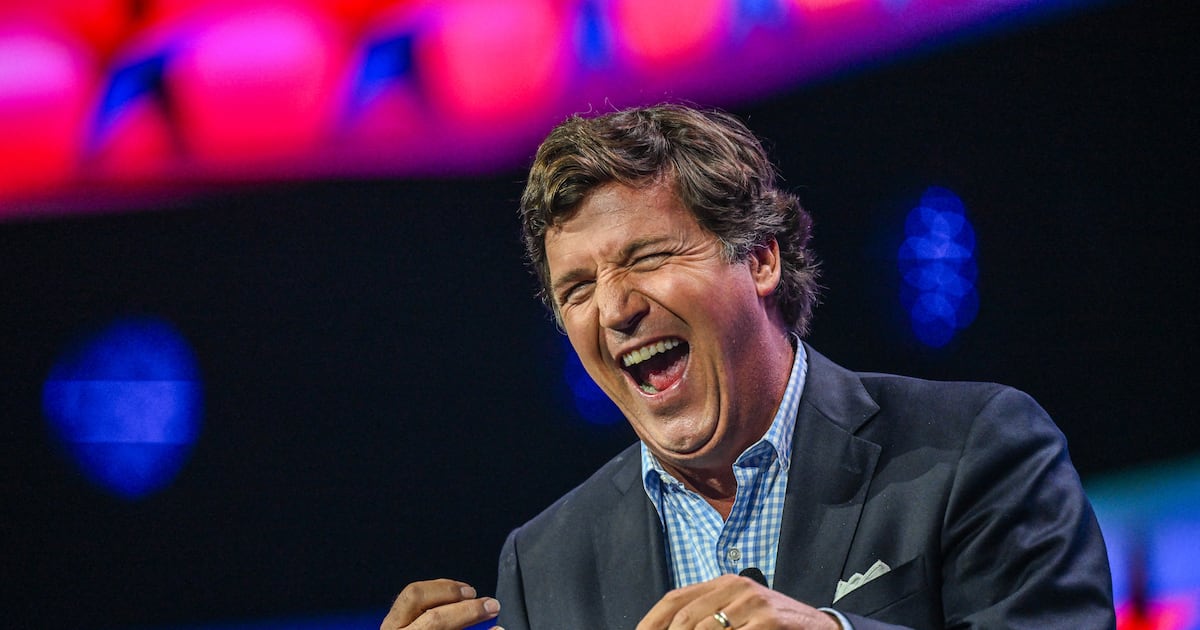
Hated by All the Right People: Tucker Carlson and the Unravelling of the Conservative Mind
Author: Jason Zengerle
ISBN-13: 978-1914484483
Publisher: Scribe
Guideline Price: £16.99
The Maga (Make America Great Again) movement is so centred on a cult of personality that it is difficult to imagine what will happen when Donald Trump is finally out of the picture. US vice-president JD Vance is jockeying to lead Maga, but there is another likely contender in media personality Tucker Carlson.
Carlson’s show on Fox News from 2016-2023 was the highest-rated in the history of cable television and it established Carlson as a crucial Maga mouthpiece. He has lost little influence since Fox mysteriously terminated his contract and now hosts a popular weekly podcast and runs his own website. It is possible that Carlson might run for president. It wouldn’t be the first time Republicans nominated a media celebrity with no prior history of public service.
Jason Zengerle’s biography of Carlson is timely, informative and highly readable. Hated by All the Right People focuses not on Carlson’s personal life but on how his career reflects shifts in right-wing politics and media. This is a great read for anyone interested in how Maga took over American conservatism.
Born into a wealthy family, after failing out of university, Carlson began his career in the 1990s as a staff writer for the influential neoconservative magazine Weekly Standard. Carlson got his start due to family and personal connections – all the while attacking affirmative action programmes for African-Americans and women as discriminatory against white men.
Carlson quickly sensed the declining significance of print journalism and the rising power of cable news. He parlayed his “natural glibness” into a position as a cohost of CNN’s popular debating show Crossfire, filling the seat “on the right” while debating a liberal seated “on the left”. With his preppy haircut and trademark bow tie, Carlson embodied the country-club Republicanism of the George W Bush era.
Comedian Jon Stewart single-handedly destroyed Crossfire when as a guest on the show he attacked it for “doing theatre” instead of debate while mocking Carlson as a “dick”. After Crossfire’s cancellation in 2005, Carlson spent a decade trying to regain his stature. He had a stint on MSNBC, where he gave Rachel Maddow her start, but he was let go in 2008 as the network became the liberal alternative to Fox News.
Two factors aided Carlson in his climb back to the top. First, he had an independent streak that enabled him to stand out from the usual partisan hacks. For example, he admitted that the Iraq War was a mistake years before most conservatives did. Second, his driving ambition trumped his principles. After leaving MSNBC, he began a website, The Caller, designed to provide evidence-based reporting from a conservative perspective. When the site did not receive the number of clicks Carlson had hoped for, he quickly abandoned his commitment to facts. He pivoted to providing liberal-bashing red meat to the conservative base. He increasingly hired staffers with links to the white supremacist far right.
Carlson’s radar on the right led him to be one of the first commentators on Fox News to recognise the appeal of Donald Trump’s populist, xenophobic and openly racist politics in the 2016 Republican primary at a time when most at the network were dead-set against Trump. For his perspicacity, Carlson was rewarded with his own show, which quickly became the network’s flagship. Carlson became an influential presence in the first Trump administration. Trump’s son-in-law Jared Kushner admonished one White House intern, “You can’t work in this White House and not watch Tucker Carlson.”
Though Zengerle offers a very strong narrative, he is weaker in analysing the meaning of Carlson’s transformation. He is right to conclude, “Whether Carlson really believes the awful things that he says these days matters less than that he says them at all, and that millions of people … listen to and take their cues from him.” Yet Zengerle stops here, failing to consider the nature of the relationship between Carlson and his followers. Is Carlson merely a weathervane who knows which way the conservative winds blow? Or is he making the weather? Zengerle also overlooks continuities between the conservatism of the 1990s and of today. Yet Carlson seems to have been consistently racist throughout his career.
To say Carlson has “descended into madness” is not much of an analysis. Nevertheless, the account Zengerle provides is essential to understanding the radicalisation of the American right from the first Trump administration to the second. Carlson appeared to break with Trump after the January 6th insurrection, privately calling him a “demonic force”. Yet he moved steadily to the right, even promoting the conspiracy theory that January 6th was a “false flag” operation designed to discredit Trump. Late last year Carlson made headlines by hosting on his podcast the neo-Nazi influencer Nick Fuentes, granting him a platform to rant against “organised Jewry”. Could Carlson be the future leader of Maga? The prospect is terrifying.