
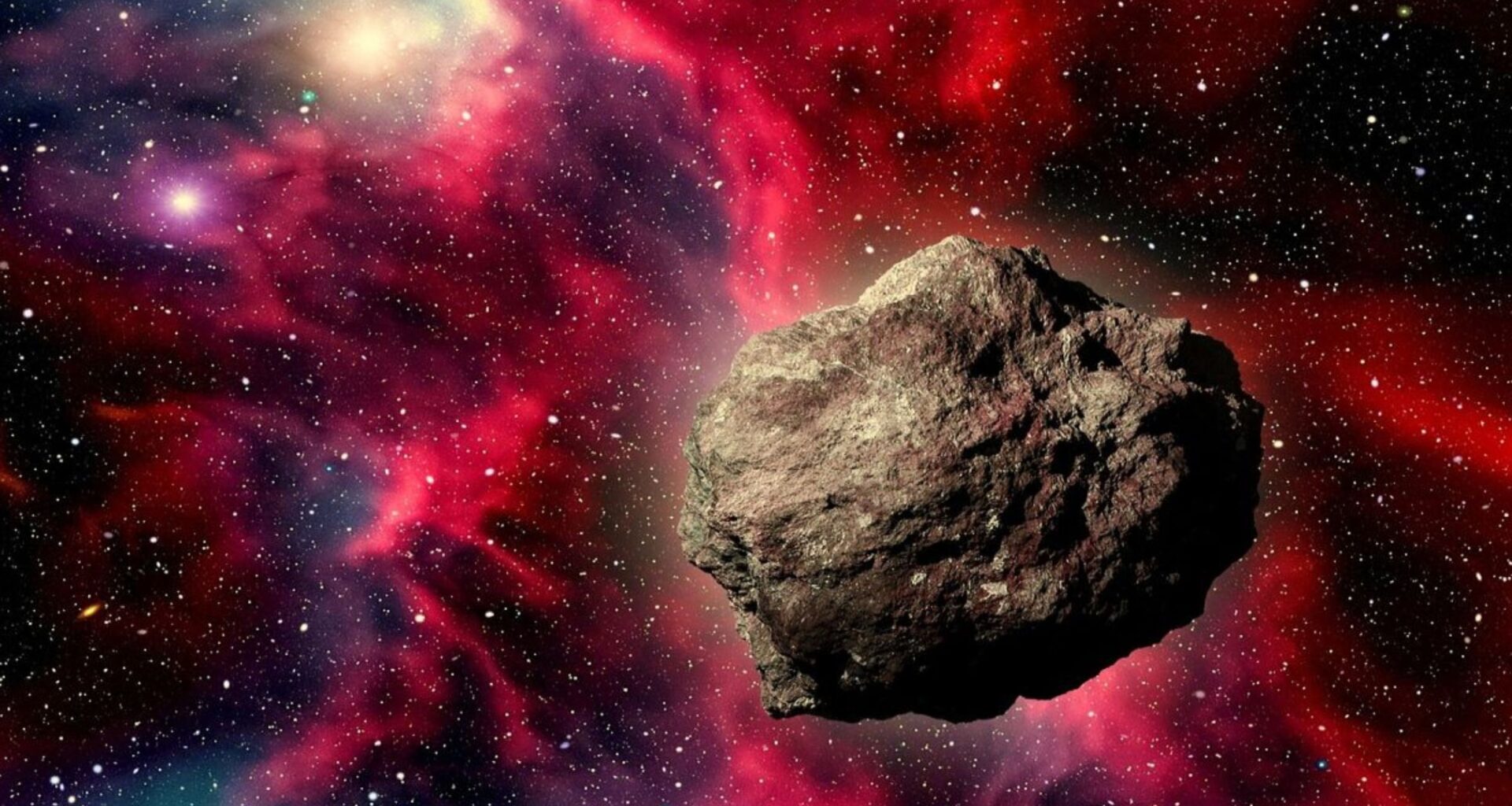
A new analysis has established that asteroid 2024 YR4 retains a measurable chance of striking the Moon in December 2032.
If the impact occurs, it would generate a flash bright enough to see from Earth and trigger effects that extend far beyond a single burst of light.
Timing of asteroid

Current orbital calculations place the potential collision within a narrow window on December 22, 2032, as the 200-foot-wide (60-meter-wide) asteroid sweeps past the Earth-Moon system.
By propagating thousands of possible trajectories, Yifei Jiao at Tsinghua University and her colleagues showed that Earth is no longer at risk. The Moon, however, remains exposed.
Their results confine the remaining impact probability to about 4.3 percent and cluster the possible strike zone across a defined swath of lunar terrain.
That constrained scenario now turns a once-theoretical hazard into a timed celestial event that astronomers can prepare to watch.
A burst as bright as Venus
At impact, the Moon could flare with a point of light about as bright as Venus in the night sky.
That glow comes from impact energy heating rock and dust so fast that it radiates visible light, the preprint explains.
For naked-eye viewers, the burst could stand out for about 10 seconds, while telescopes could track it for minutes.
Across the Pacific Rim, observers in East Asia, Oceania, Hawaii, and western North America would have the best shot.
Heat after the flash
Minutes after the flash, a patch of molten rock would keep glowing in infrared, light that your eyes cannot see.
As the melt cools from roughly 3,100°F (1,700°C), its fading heat would map crater size and rock texture.
Longer-lasting warmth would give orbiters and big ground telescopes hours to watch cooling, not just a quick flash.
Those thermal readings would help scientists test how lunar soil stores heat, information that matters for future landers.
Measuring a lunar quake
Beyond light and heat, the impact could shake the Moon hard enough to produce a quake near magnitude five.
Seismic waves would race through the crust, and a seismometer – a sensor that records ground shaking – could catch them.
Because the Moon carries no oceans or weather noise, the signal could ring for a long time after impact.
Clear records from multiple stations would let researchers probe hidden layers inside the Moon, even far from the crater.
A new lunar crater
The asteroid impact would gouge a new Moon crater roughly half a mile (0.8 kilometers) across into the lunar surface.
A hit that powerful would unleash explosive force equal to millions of tons of TNT and liquefy rock at the crash site.
Some material would blast outward as ejecta – rock blasted outward by an impact – and a fraction could escape the reach of lunar gravity.
Fresh scars like this help calibrate impact models, but they also add new debris to the space around Earth.
Satellite risks from asteroid
In the largest scenarios, escaping rock could total around 220 million pounds (about 100,000 metric tons), enough to pepper space with fast fragments.
Once fragments leave the Moon, they can cross the paths of satellites, where even pebble hits can damage hardware.
Most fragments would miss Earth entirely, yet some could loop around the planet for months before drifting away.
Tracking that cloud could also spot boulders a few feet wide that surveys might flag as new asteroids.
Meteors on a schedule
Days after a lunar strike, tiny fragments could start reaching Earth’s atmosphere and burn up as meteors.
Computer runs in the paper suggest the first arrivals could come within two to eight days, depending on launch direction.
Even when pieces are small, a dense burst can raise risks for spacecraft, which cannot dodge a sudden spray.
Over the longer term, the same ejecta stream could feed a meteor outburst anytime within the next 100 years.
Lunar meteorites on Earth
A small share of larger chunks could survive the fall and land as meteorites with a known lunar origin.
When a rock slams into the Moon, the impact can launch deeper material upward before heat and shock reshape it.
Recovered pieces would let labs compare crater chemistry with orbital maps, connecting remote images to samples in hand.
Because the delivery would spread across the globe, rapid recovery teams would need good timing and solid tracking.
Planning for impact
After telescopes first spotted the asteroid on December 27, 2024, the European Space Agency (ESA) described it as roughly 200 feet (60 meters) across and tracked it.
With the asteroid now too faint to track, the next clear look comes in June 2028, and planners have to wait.
Coordinated networks can rehearse pointing and time stamps, while lunar missions can ready sensors for light, heat, and shaking.
“It is a very rare event for an asteroid this large to impact the Moon,” said Richard Moissl, head of the ESA’s Planetary Defence Office.
Next steps for now
A single lunar impact would produce light, heat, shaking, and debris, giving scientists a rare test with a fixed time.
Until new observations tighten the odds again, space agencies can practice rapid coordination and refine models that protect future missions.
The study is published in arXiv.
—–
Like what you read? Subscribe to our newsletter for engaging articles, exclusive content, and the latest updates.
Check us out on EarthSnap, a free app brought to you by Eric Ralls and Earth.com.
—–