
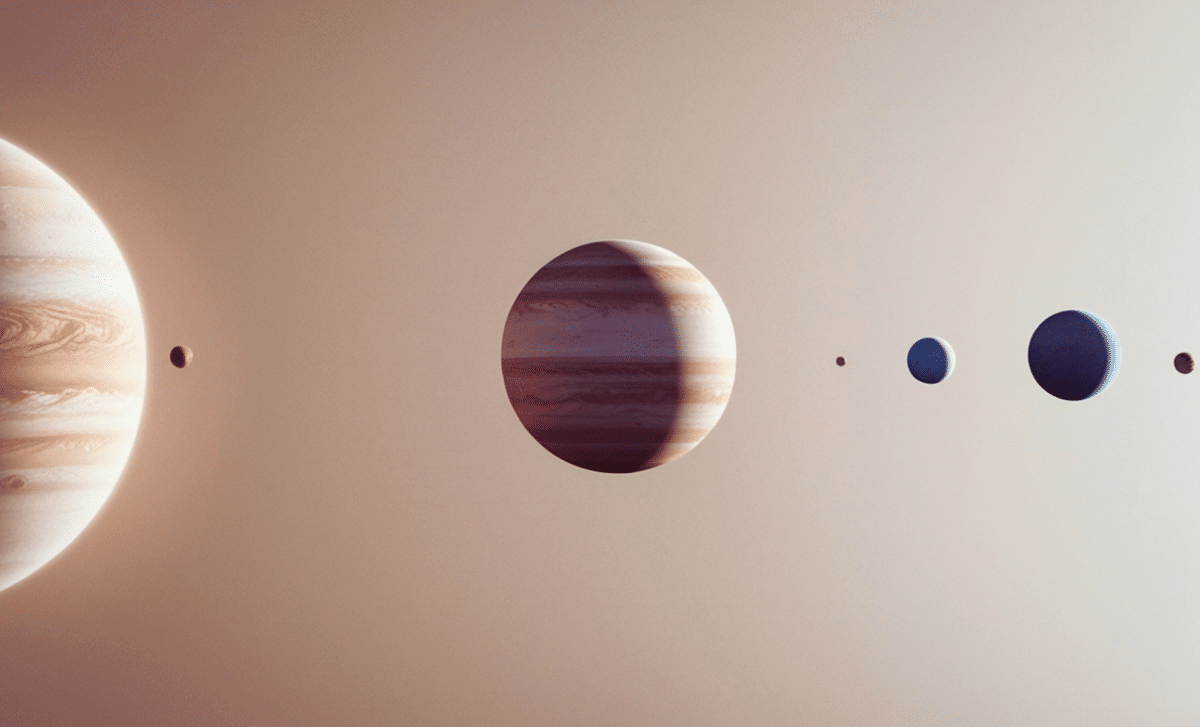
Jupiter’s Galilean moons, Europa, Ganymede, Callisto, and Io, have long been subjects of intense scientific scrutiny, particularly regarding their potential to harbor life. Recent research has brought new insights into their origins, suggesting that these moons may have been born with not only water but also the fundamental chemical building blocks essential for life.
The Mystery of Jupiter’s Moons: Could They Have Inherited Life’s Building Blocks?
Jupiter’s Galilean moons have long been of interest to scientists studying the potential for life beyond Earth. The new research, featured in The Planetary Science Journal and Monthly Notices of the Royal Astronomical Society, suggests that these moons may have begun their existence with complex organic molecules (COMs) already incorporated into their icy composition. These molecules are key precursors to life, including amino acids and nucleotides, essential for the formation of proteins and DNA.
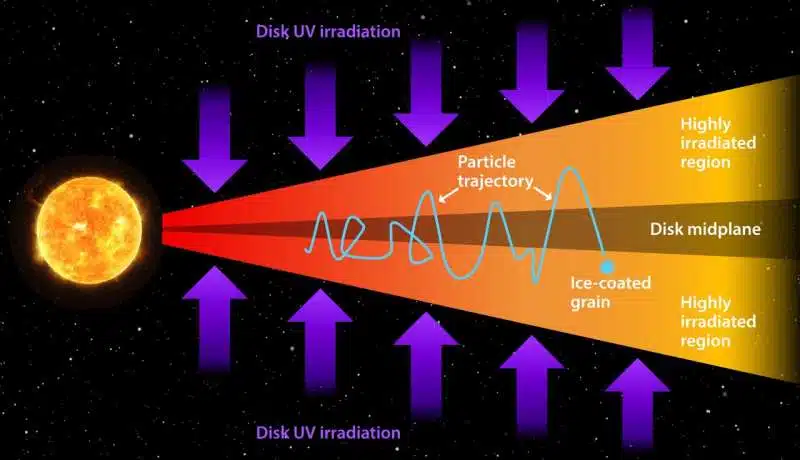
One of the study’s lead authors, Dr. Olivier Mousis from SwRI, emphasized that through their innovative models of disk evolution and particle transport, they could accurately quantify the radiation and thermal conditions under which icy grains evolved.
“By combining disk evolution with particle transport models, we could precisely quantify the radiation and thermal conditions the icy grains experienced,” said Dr. Mousis.
The team’s work suggests that these grains could have transported vital organic molecules from the surrounding protoplanetary disk to the moons during their early formation.
This revelation not only shifts our understanding of the Galilean moons’ chemistry but also provides an intriguing connection to the potential habitability of these moons. As scientists continue to search for the origins of life, these findings suggest that organic chemistry may have begun in these moons billions of years ago, long before the icy crusts that cover them today.
 Credit: Southwest Research Institute
The Role of Jupiter’s Circumplanetary Disk in the Formation of Organic Molecules
The circumplanetary disk surrounding Jupiter played a pivotal role in shaping the formation of its moons, and it may also have been a crucial factor in the development of life’s building blocks. In their study, the research team focused on how organic molecules could form under the harsh conditions present in these disks. Using sophisticated models, the researchers showed how organic chemistry could occur when icy grains containing simple compounds like methanol or ammonia were subjected to ultraviolet radiation and moderate heating in both the protosolar nebula and Jupiter’s own circumplanetary disk.
Dr. Mousis explained the precision of the study:
“Then we directly compared our simulations with other laboratory experiments that produce COMs under realistic astrophysical conditions. The results showed that COM formation is possible in both the protosolar nebula environment and Jupiter’s circumplanetary disk.”
This finding is particularly significant because it provides strong evidence that the chemical precursors of life could have formed in the same region where Jupiter’s moons were forming, possibly leading to their eventual incorporation into these moons.
By analyzing how grains transported these complex molecules through Jupiter’s disk, the team uncovered a path that could have led to the delivery of COMs to the young moons, offering a new lens through which to view the origins of life on these icy worlds.
How Jupiter’s Moons May Have Accumulated Prebiotic Chemicals at Birth
One of the most striking conclusions of this research is that Jupiter’s moons may not have started as chemically pristine worlds. Instead, they could have accreted, or accumulated, significant quantities of organic molecules at their birth, setting up the possibility for prebiotic chemistry to unfold. As the moons grew, they likely captured the organic material present in the disk that surrounded Jupiter, creating a chemical foundation that could have later interacted with the liquid water beneath their icy surfaces.
“Our findings suggest that Jupiter’s moons did not form as chemically pristine worlds,” said Dr. Mousis. “Instead, they may have accreted, or accumulated, a significant inventory of COMs at birth, providing a chemical foundation that could later interact with the liquid water in their interiors.”
presence of liquid water on moons like Europa, Ganymede, and Callisto is already considered a key factor for habitability. The idea that these moons might have also inherited the chemical building blocks for life makes them even more intriguing targets for exploration in the search for extraterrestrial life.
Implications for Life on Europa, Ganymede, and Callisto
The findings from this study suggest that the Galilean moons of Jupiter may have started with everything needed for life to take hold. If organic molecules were indeed present in the moons’ primordial material, then the combination of these compounds with the liquid water and energy sources available beneath the icy surfaces could have created conditions ripe for the formation of life. Europa, in particular, is of great interest to scientists because of its vast subsurface ocean, which is believed to be in contact with a rocky core, potentially providing the right environment for life to emerge.
By establishing a credible pathway for the formation and delivery of COMs, this study offers a critical framework for future missions aimed at investigating the moons’ subsurface chemistry. Dr. Mousis noted,
“Establishing credible pathways for COMs formation and delivery provides scientists with a critical framework for interpreting upcoming measurements of Jupiter’s surface and subsurface chemistry.”
This framework could prove invaluable for interpreting data from NASA’s Europa Clipper mission and the European Space Agency’s JUICE mission, both of which aim to explore the composition and potential habitability of Jupiter’s moons in greater detail.
A New Understanding of Prebiotic Chemistry in the Jovian System
This study also highlights the importance of linking laboratory chemistry, disk physics, and particle transport models to create a comprehensive understanding of how habitable conditions can emerge. The researchers’ work may point to how organic molecules could have been incorporated into the moons at a much earlier stage, influencing their chemical evolution.
“By linking laboratory chemistry, disk physics and particle transport models, our work may highlight how habitable conditions are rooted in the earliest stages of planetary formation,” said Dr. Mousis.
This integrated approach is helping scientists better understand how life could potentially arise in environments far beyond Earth. It also underscores the complexity of planetary formation and the multitude of factors that contribute to habitability in distant worlds.