
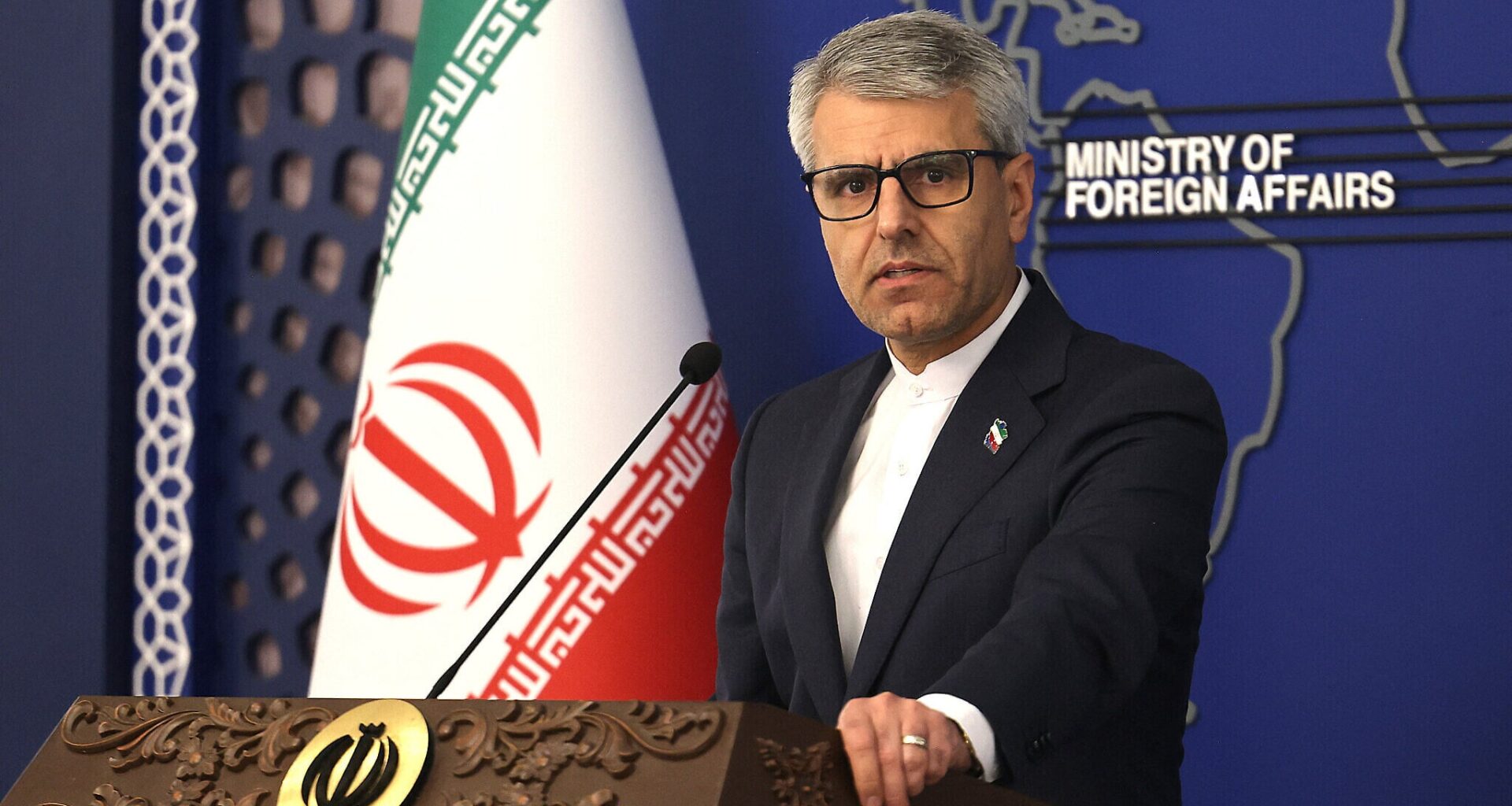
Iran pushed back Wednesday against US President Donald Trump’s pressure tactics ahead of critical talks in Geneva over Tehran’s nuclear program, comparing the US and Israel to Nazi propagandist Joseph Goebbels.
The remarks by two Iranian officials ahead of Thursday’s talks come with America having assembled its biggest deployment of aircraft and warships to the Middle East in decades, amid Trump’s efforts to get a deal and Tehran’s struggles at home with growing dissent following nationwide protests last month.
Iran’s foreign ministry dismissed US claims as “big lies,” after Trump said during his State of the Union address that Tehran was developing missiles that can strike the US.
“Whatever they’re alleging in regards to Iran’s nuclear program, Iran’s ballistic missiles, and the number of casualties during January’s unrest, is simply the repetition of ‘big lies,’” ministry spokesman Esmaeil Baqaei said on X.
“‘Repeat a lie often enough and it becomes the truth,’ is a law of propaganda coined by Nazi Joseph Goebbels. This is now systematically used by the US administration and the war profiteers encircling it, particularly the genocidal Israeli regime, to serve their sinister disinformation and misinformation campaign against the Nation of Iran,” he wrote.
Get The Times of Israel’s Daily Edition
by email and never miss our top stories
By signing up, you agree to the terms
Trump repeatedly has threatened to attack Iran if the negotiations fail — something Mideast nations fear could spiral into a new regional war. Already, Iran has said Israel and all US military bases in the Mideast would be considered legitimate targets.
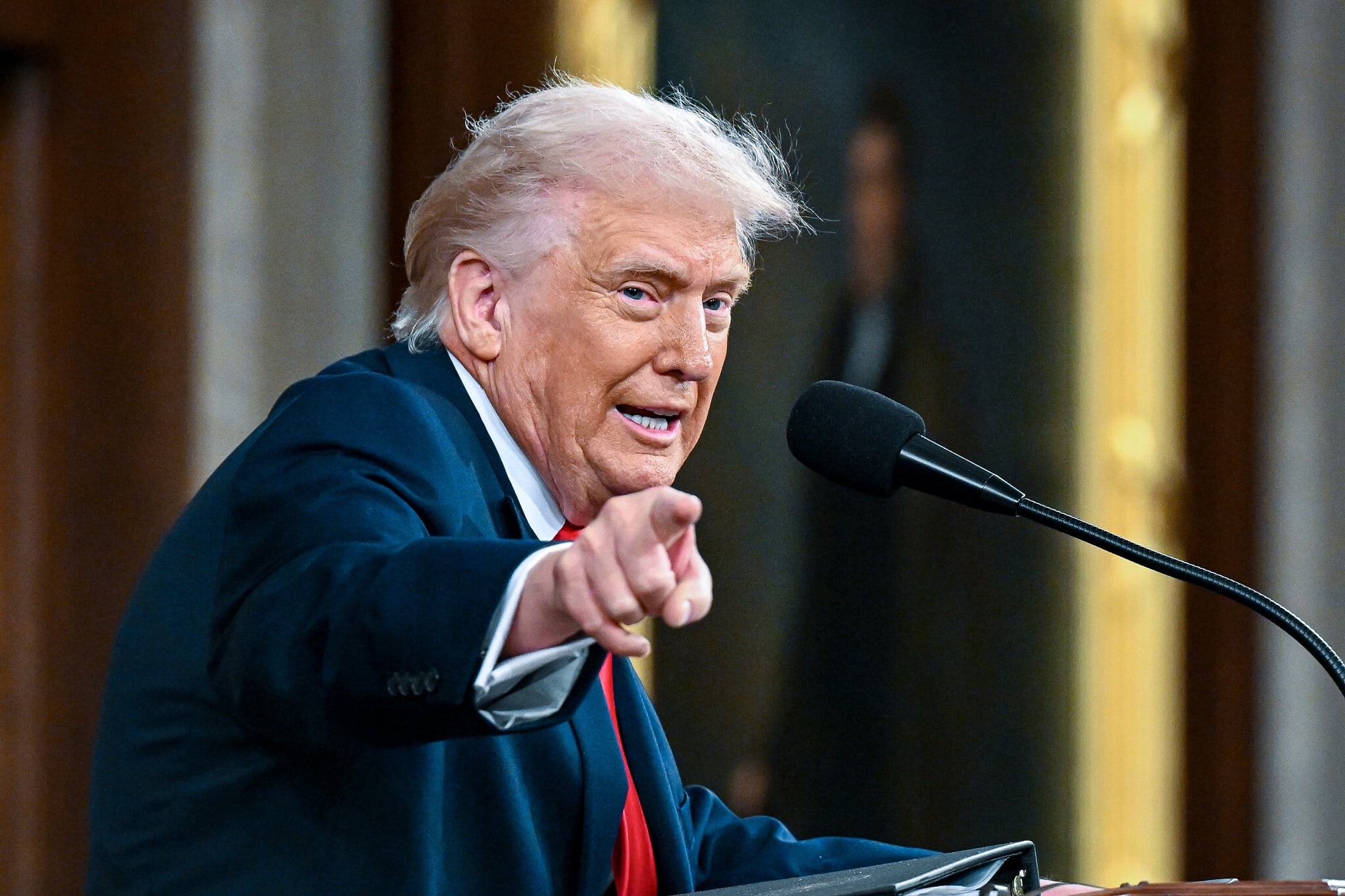
US President Donald Trump delivers the State of the Union address to a joint session of Congress in the House chamber at the US Capitol in Washington, Tuesday, Feb. 24, 2026. (Kenny Holston/The New York Times via AP, Pool)
Mohammad Bagher Qalibaf, Iran’s parliament speaker, separately said the US could either try diplomacy or face Iran’s wrath.
“If you choose the table of diplomacy — a diplomacy in which the dignity of the Iranian nation and mutual interests are respected — we will also be at that table,” Qalibaf said, according to the semiofficial Student News Network, a media outlet believed to be close to the all-volunteer Basij force of Iran’s paramilitary Revolutionary Guard.
“But if you decide to repeat past experiences through deception, lies, flawed analysis and false information, and launch an attack in the midst of negotiations, you will undoubtedly taste the firm blow of the Iranian nation and the country’s defensive forces.”
Satellite photos shot Tuesday by Planet Labs PBC and analyzed by The Associated Press appeared to show American vessels that are typically docked in Bahrain, the home of the US Navy’s 5th Fleet, all out at sea.
The 5th Fleet referred questions to the US military’s Central Command, which did not immediately respond. Before Iran’s attack on Qatar in June, the 5th Fleet similarly scattered its ships at sea to protect against a potential attack.
Talks hang in balance
Iran and the US are due to meet on Thursday in Geneva, their third round of talks under the mediation of Oman, which has long been an interlocutor between Tehran and the West.
If the talks fail, uncertainty hangs over the timing of any possible attack, as well as its mission and goals.
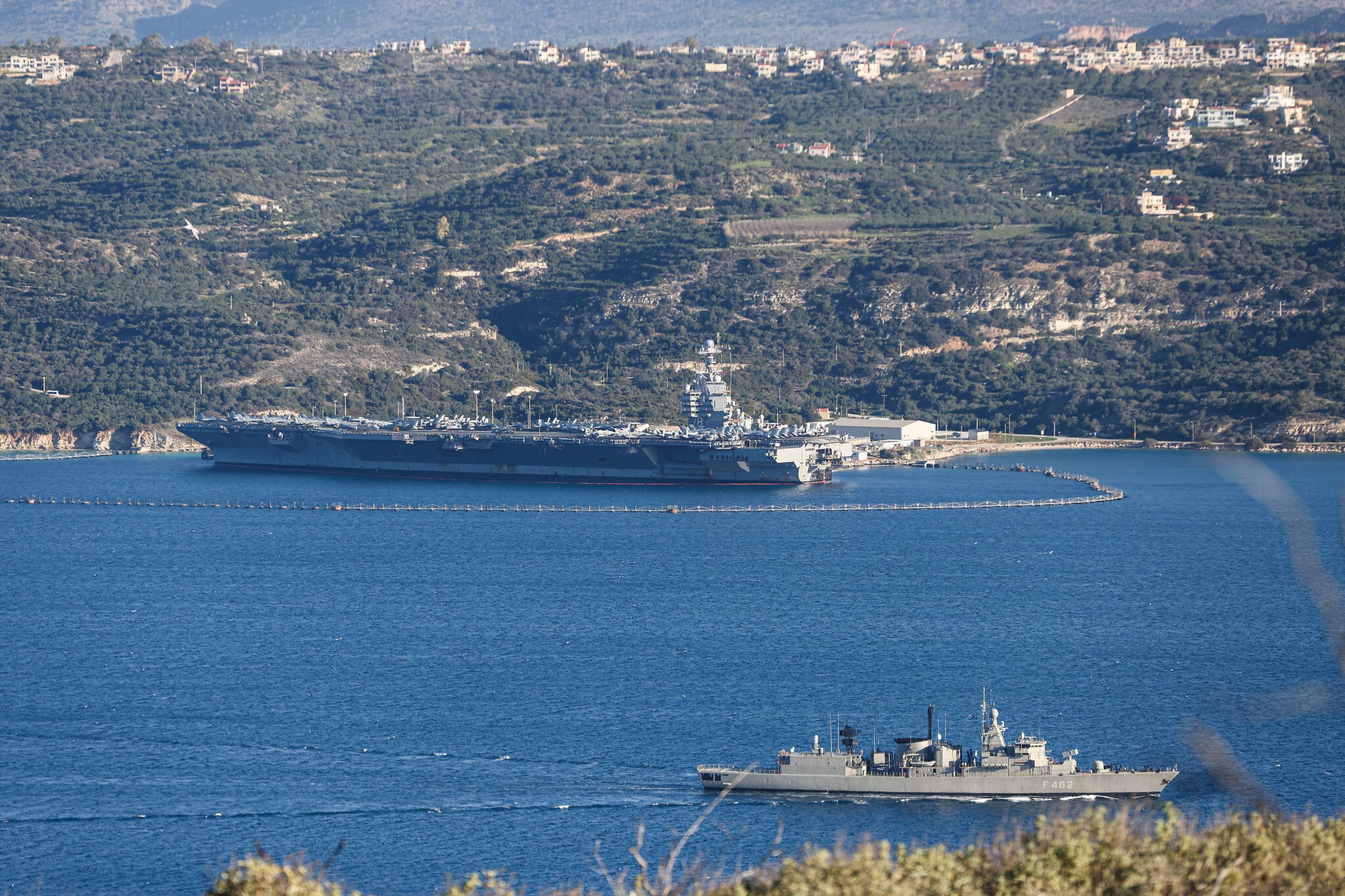
US aircraft carrier USS Gerald Ford (L) is pictured docked at Souda Bay in the Greek Mediterranean island of Crete, on February 24, 2026. (Photo by Costas METAXAKIS / AFP)
The US has not made clear the aims of possible military action. If the goal is to pressure Iran to make concessions in nuclear negotiations, it’s not clear whether limited strikes will work. If the goal is to remove Iran’s leaders, that will likely commit the US to a more massive, longer military campaign. There has been no public sign of planning for what would come next, including the potential for chaos in Iran.
The status of Iran’s nuclear program is another mystery. Trump earlier said American strikes “obliterated” it. Now, dismantling whatever remains of the program appears to be back on the administration’s agenda. IAEA inspectors have not been allowed to inspect those sites and verify what remains.
There is also uncertainty about what any military action could mean for the wider region. Tehran could retaliate against American-allied nations of the Persian Gulf or Israel. Oil prices have risen in recent days in part due to those concerns.
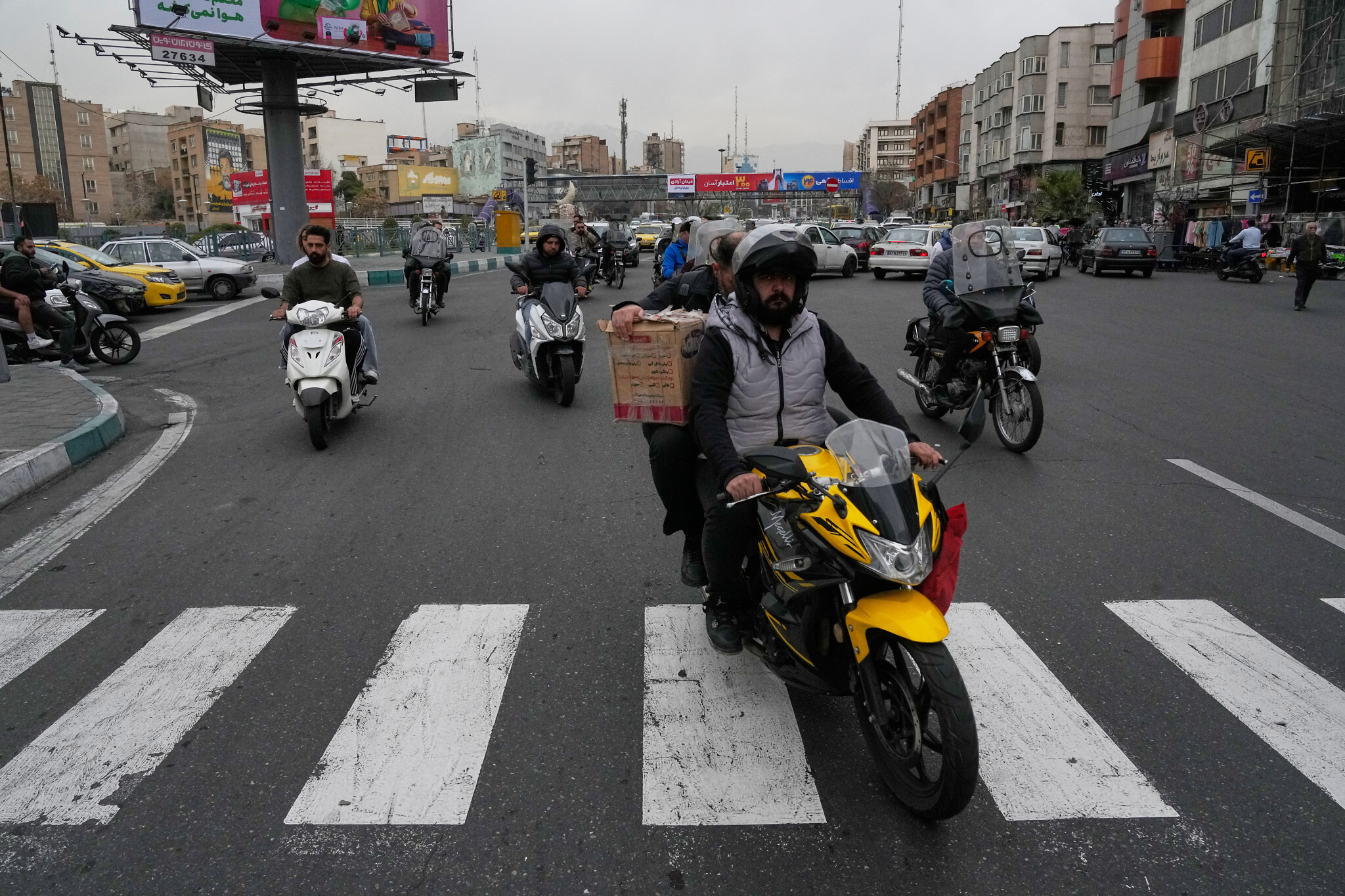
People drive their motorbikes in a square in downtown Tehran, Iran, February 24, 2026. (Vahid Salemi/AP)
Israel launched strikes on Iranian nuclear and military sites in June, saying the regime in Tehran had moved towards weaponization. Iran responded with missile attacks on Israeli military sites and cities. The US brokered a ceasefire immediately after its own bombing runs.
Satellite photos have shown Iran beginning to rebuild its missile production sites and doing some work at the three nuclear sites attacked by the US in June, at the tail end of the Israel-Iran war.
Iran, which vows to destroy Israel, has long maintained that its nuclear program is peaceful. The West and the International Atomic Energy Agency say Iran had a nuclear weapons program until 2003. It had been enriching uranium up to 60 percent purity before the June attack — a short, technical step away from weapons-grade levels of 90%, and which has no civilian use.
Is accurate Israel coverage important to you?
If so, we have a request.
Every day during the past two years of war and rising global anti-Zionism and antisemitism, our journalists kept you abreast of the most important developments that merit your attention. Millions of people rely on ToI for fact-based coverage of Israel and the Jewish world.
We care about Israel – and we know you do too. So we have an ask for this new year of 2026: express your values by joining The Times of Israel Community, an exclusive group for readers like you who appreciate and financially support our work.
Already a member? Sign in to stop seeing this
You appreciate our journalism

You clearly find our careful reporting valuable, in a time when facts are often distorted and news coverage often lacks context.
Your support is essential to continue our work. We want to continue delivering the professional journalism you value, even as the demands on our newsroom have grown dramatically since October 7.
So today, please consider joining our reader support group, The Times of Israel Community. For as little as $6 a month you’ll become our partners while enjoying The Times of Israel AD-FREE, as well as accessing exclusive content available only to Times of Israel Community members.
Thank you,
David Horovitz, Founding Editor of The Times of Israel