
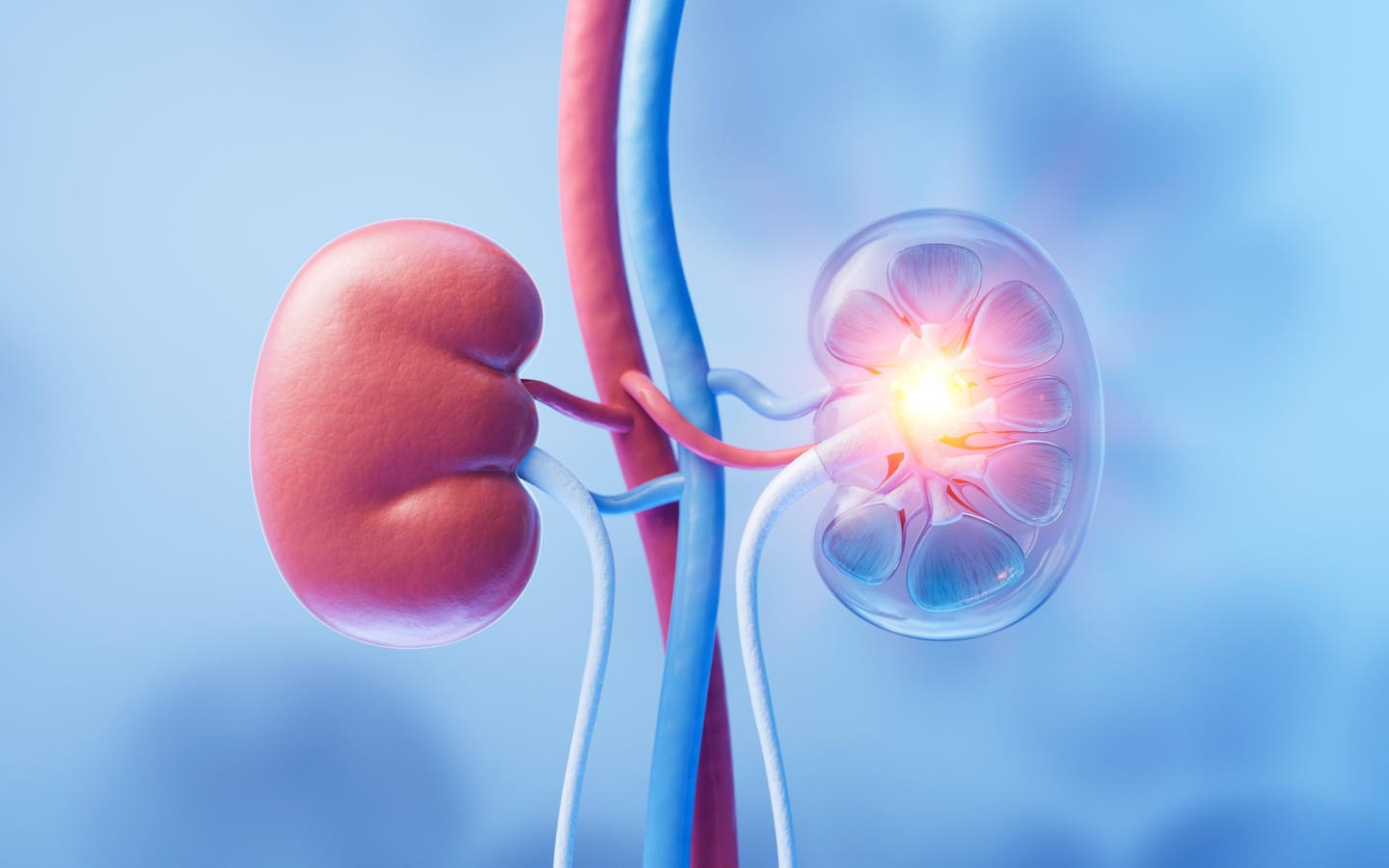
Kidney with biology and health care concept, 3d rendering. 3D illustration.
getty
We hear a lot about medical advances with AI, including at the conventions where people address the current realities around LLMs, but sometimes, it’s good to get a little more of a granular idea of how positive change works on the backs of neural net capabilities. After all, AI doesn’t just “revolutionize medicine” by itself: it provides the design capability for tools and solutions that clinicians, and administrators, still control.
Some of this was on display as Ami Bhatt, Chief Innovation Officer (CIO) at the American College of Cardiology, interviewed Salvatore Viscomi of Carna Health about his company’s achievements at the Imagination in Action event at Davos in January. (Disclaimer: I help to run Imagination in Action, a free conference on AI at the Swiss convention.)
First of all, Viscomi clarified that Carna has been focusing on chronic kidney disease, and described how this works in terms of serving world populations.
“It’s predicted to be the fifth cause of death around the world. And one is: there’s a lack of awareness. There’s a lack of specialists around the world. There’s a lack of resources. So AI can only help.”
Predictive Analysis, and Upskilling
Viscomi named these two aspects as needs around this kind of innovation.
In many parts of the world where the disease is poorly understood … identifying who’s at risk of disease, and then risk of progression, is really important,” he said.
As for the upskilling:
“(It’s) taking advantage of the resources that are available,” he said. “Primary care doctors, pharmacists, nurses … when a specialist is not available, upskilling them, so they can be able to take care of patients who need treatment. So when we think about this area of kidney metabolic disease, it really needs to be addressed at the governmental level.”
Luckily, the company, he said, recognizes government champions, officials who advocate for addressing these problems.
“You want this to be a national program, a national incentive, because governments reap the benefits of prevention,” he said. “They’re paying for dialysis, or when dialysis is unavailable, people will die, unfortunately. So we have met with several presidents, vice presidents, ministers of health and ministers of finance who are sort of our champions.”
Just a Phone
Viscomi spoke about the ability to really scale up solutions and applications with AI in an age of digital progress.
“It’s amazing … the wonders of technology with point of care testing and with digital platforms,” he said. “Really, all you need is a cell phone and a cellular signal.”
However, he did point out that in some ways, you need a support system for these initiatives.
“When we think about being successful at this, it’s not just AI,” he added. “It’s not just point of care testing. You’re talking about the government being behind it, the people on the ground being willing to understand it and then enact it, (with) patient agency and having people understand why it is that they need these point of care diagnostics.”
The Value of This Work
Later, Viscomi provided a value statement around what Carna has been doing.
“There’s probably no other group of diseases that’s as big a return on investment, from a health economics perspective,” he said. “Every dollar in prevention saves $45 in healthcare savings.”
That, in turn, he suggested, has led to a vibrant source of funding.
“We’ve been fortunate with investors that have, in the last few years, seen the return on your investment,” he noted. “It’s been challenging, because population health is generally not one that investors have gravitated towards, but I think that this grouping of diseases is one that has been attracting investors.”
That’s a good overview of how AI is changing this one aspect of medicine today. There’s a lot more going on – at MIT and elsewhere – so stay tuned, as 2026 commences.