
Watch EarthSky’s Deborah Byrd and Marcy Curran discuss the February 28 planet parade and what you can see in the night sky.
February 28 planet parade: Here’s what you can really see
The internet has been full of memes and claims that there will be a spectacular lineup of six visible planets on February 28. But, as is often the case with online chatter, some of it is not accurate. So here’s what you can really see in the sky on the evening of February 28.
As soon as the sun sets, the first thing you’ll probably notice in the sky is the moon. It will already have risen in the east and it will be big and bright, at almost 93% full. It’s just a few days away from full moon, on March 3, when there will be a total lunar eclipse. But on the evening of February 28, it’s not yet full, and there’s a bright “star” shining higher in the sky above the moon. That star is really the planet Jupiter.
While Jupiter and the moon make a pretty scene, you’ll have to tear your eyes away and look toward the western horizon where the sun has recently set. There you’ll find a cluster of planets that will also soon be setting. Venus is the brightest, but it’s also currently close to the horizon. So it will be competing with the evening glow of twilight.
Mercury is dimmer and a bit north of Venus. Next is Saturn, a bit higher above the horizon. So it will be visible as the sky gets darker. But to see any of these three, you must have a flat horizon with no buildings, trees or other obstructions blocking your view.
So that’s only four planets, and really just one of them is easy to see. There are two other planets in the sky that night as well. Uranus is close to the pretty star cluster known as the Pleiades, while Neptune is not far from Saturn. But both of these planets require optical aid to see.
Star charts for the planetary parade
Why do posts on social media point to February 28? It’s a bit of a mystery, because the planets have been in these same general positions for weeks. Planets don’t move that quickly. Perhaps this date is popular because the moon is at one end of the line of planets, near bright Jupiter.
Check out the charts below to find where the planets are, in case you want to hunt them down yourself. And keep up with where the moon and planets are every night with EarthSky’s visible planets and night sky guide.
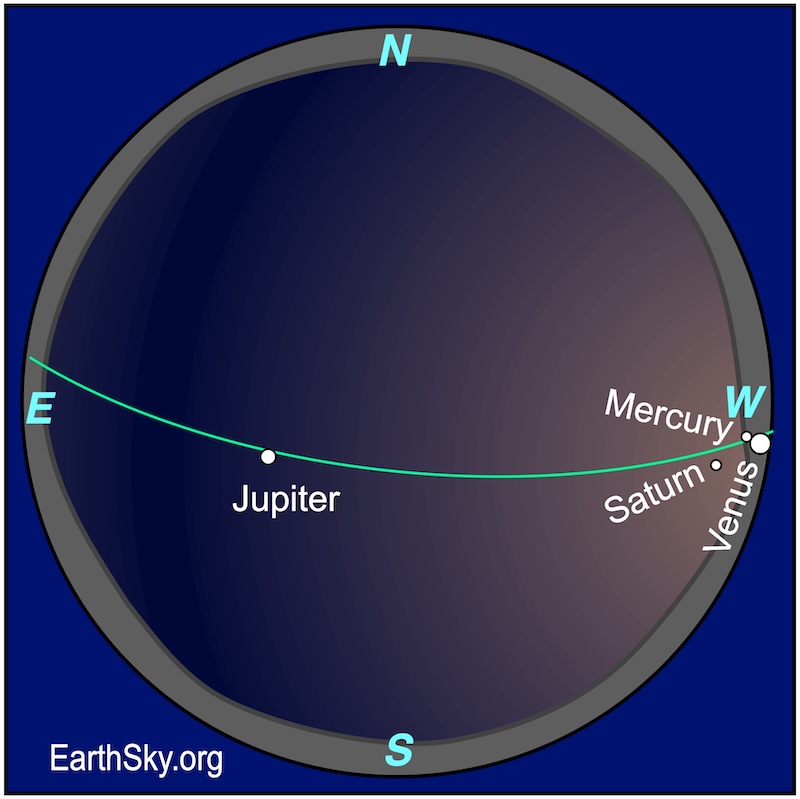 As seen from across Earth toward the end of February – about 40 minutes after sunset – the bright planet Jupiter will be in the east. Very low in the west, just above the horizon, is Venus, Mercury and Saturn. Note that these planets lie along the path the sun travels in the daytime (the green line on our chart, or the ecliptic). Chart via EarthSky.
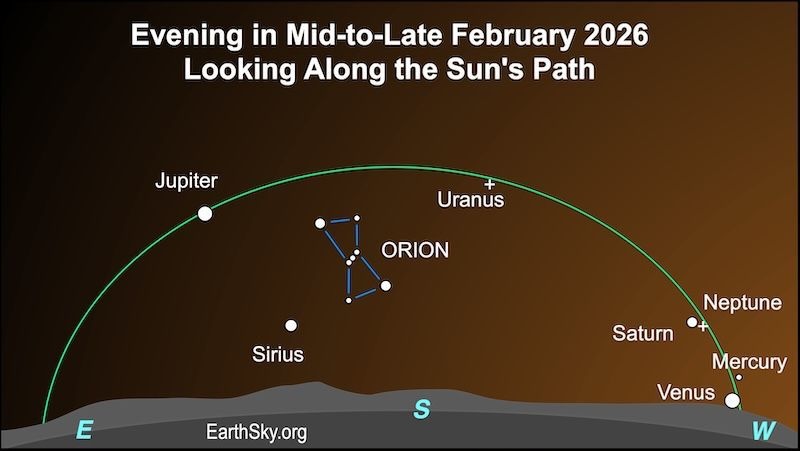 It’s true that there are 6 planets in the sky after sunset in mid-to-late February. But 3 (Venus, Mercury and Saturn) are hiding near the sunset’s glow, and 2 (Uranus and Neptune) require optical aid to see. Yet you can see them if you have patience, persistence, optical aid, a detailed star chart and a location with a clear view to the western horizon. And anyone can spot bright Jupiter, not far from the famous constellation Orion. Chart via EarthSky.
Bottom line: Rumors of a February 28 planet parade are sweeping the internet. Will you be able to see six planets in a line? Get the details here.
Listen to this month’s “Planetary Parade” with NASA’s Chandra
Kelly Kizer Whitt
View Articles
About the Author:
Kelly Kizer Whitt – EarthSky’s nature and travel vlogger on YouTube – writes and edits some of the most fascinating stories at EarthSky.org. She’s been writing about science, with a focus on astronomy, for decades. She began her career at Astronomy Magazine and made regular contributions to other outlets, including AstronomyToday and the Sierra Club. She has nine published books, including a children’s picture book, Solar System Forecast, and a young adult dystopian novel, A Different Sky.