
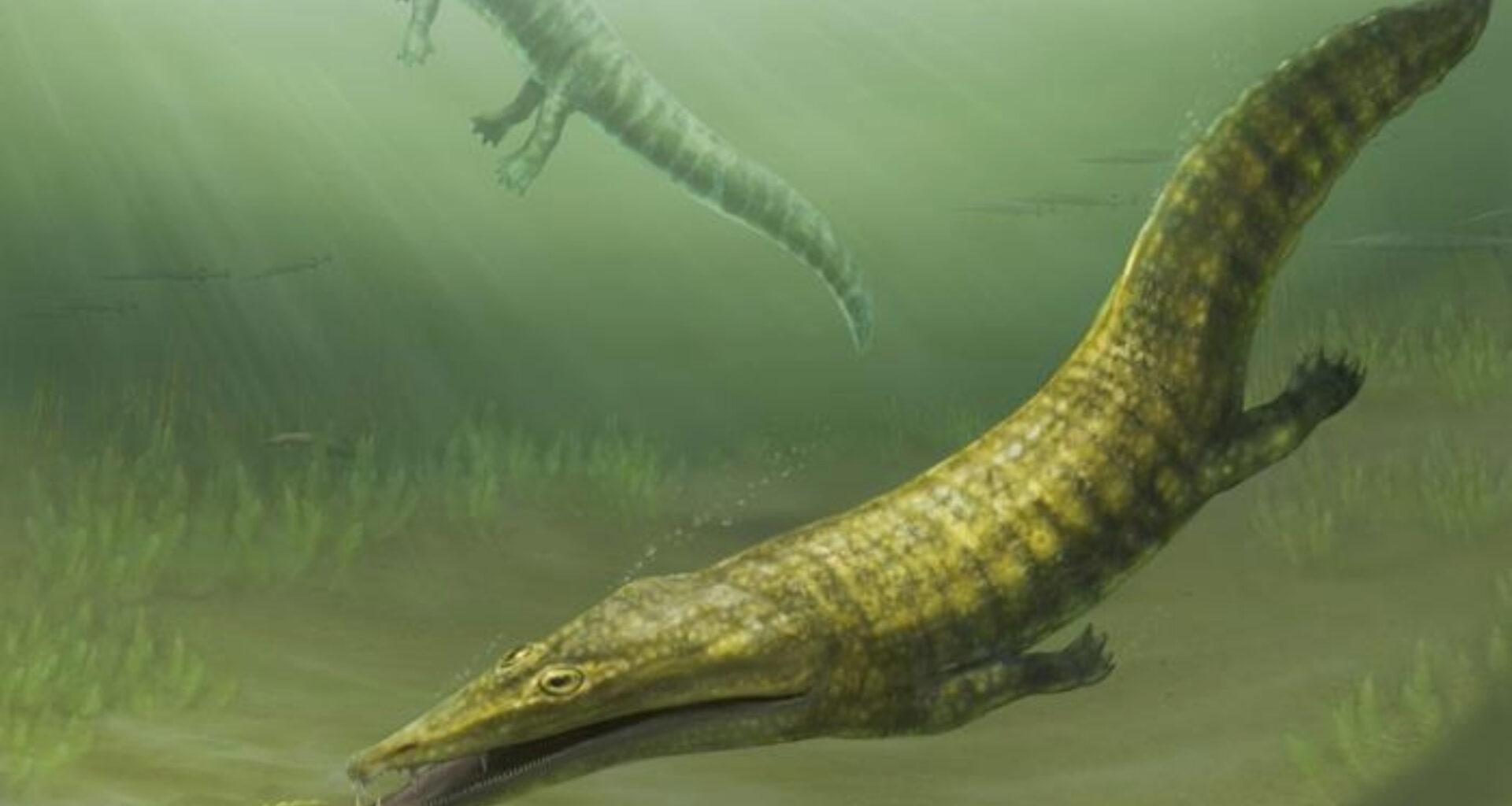
Fossils found in northwestern Australia show that 250 million years ago, the red, dusty Kimberley region was nothing like it is today. Instead of a desert, it was a shallow coastal bay, with tropical waters lapping over the area and crocodile-like amphibians swimming just offshore.
These creatures lived in a world that was still recovering from the end-Permian extinction event, in which global warming had disrupted the oceans.

As the oceans began to recover at the start of the Age of Dinosaurs, sea-going tetrapods, such as amphibians and reptiles, evolved to become the dominant predators.
For several decades, the majority of fossils of these early sea hunters were found in the Northern Hemisphere, and the southern continents were barely mentioned in the story. A fresh look at old Kimberley fossils is now starting to turn this around.
Museum drawers yield fossil secrets
The fossils at the center of this story were first found during scientific expeditions in the early 1960s and 1970s.
Researchers from the Swedish Museum of Natural History collected ancient marine amphibian remains from a rock outcrop on Noonkanbah cattle station, east of the remote township of Derby. The material was split between museums in Australia and the United States.
In 1972, scientists published a study identifying a single species from several skull fragments. They named it Erythrobatrachus noonkanbahensis.
Then something strange happened. The original fossils of Erythrobatrachus were lost sometime during the intervening 50 years.
That loss might have ended the story. Instead, it sparked a search through international museum collections.
In 2024, researchers finally rediscovered and reassessed these ancient marine amphibian remains. What they found changed the picture.
Two predators, one bay
Erythrobatrachus belonged to a group called trematosaurids, crocodile-shaped relatives of today’s salamanders and frogs that could grow to about 6.5 feet (2 meters) long.
Their fossils are especially important because they appear in coastal rocks formed less than a million years after the end-Permian mass extinction. That timing makes them some of the earliest marine tetrapods of the Mesozoic Era.
At first glance, the Kimberley skull fragments seemed to belong to just one species. A closer look told a different story.
Detailed re-study showed that the skull fragments of Erythrobatrachus did not all belong to a single species. Rather, they represented at least two distinct types of trematosaurids – Erythrobatrachus and another species attributable to the well-known genus Aphaneramma.
High-resolution 3D imaging helped settle the case. The Erythrobatrachus skull was about 40 cm long when complete. It came from a large-bodied, broader-headed top predator. Aphaneramma was about the same size but had a long, thin snout for catching small fish.
Hunting side by side
Both trematosaurids swam through the water column of that shallow bay. But they did not compete for the exact same meal.
One likely tackled larger prey with its broader head and stronger bite. The other used its narrow snout to snap up smaller fish. They shared a habitat but filled different roles.
That matters. After a mass extinction, ecosystems don’t recover all at once. They begin with a few hardy species, and complex food webs take time to return.
So the discovery of two different marine amphibians living side by side not long after the end-Permian crisis suggests that ocean life was already becoming more established. Predators were diversifying. Ecological niches were filling up.
The global connection
One of the biggest surprises involves geography. Erythrobatrachus is known exclusively from Australia. Aphaneramma, however, has been reported from similar-aged deposits on Svalbard in the Scandinavian Arctic, the Russian Far East, Pakistan, and Madagascar.
That spread is striking. During the early Mesozoic, Earth’s landmasses were still joined together in the supercontinent Pangaea. Long coastlines wrapped around connected shores.
The Australian trematosaurid fossils show that these early marine tetrapods did more than just diversify into different roles. They also spread around the world, likely moving along the coastlines of connected supercontinents during the first two million years of the Age of Dinosaurs.
Ancient sea under desert sands
Today, the Kimberley is hot, dry, and remote. Cattle stations sit where waves once broke. It is hard to square that landscape with a shallow bay filled with crocodile-like amphibians.
Yet the rocks remember. Fossils tucked away in drawers for decades have brought that lost world back into view. They show that life rebounded faster and spread farther than we once thought after the worst mass extinction in Earth’s history.
The early Age of Dinosaurs was not just about giant reptiles on land. It was also a time when limbed vertebrates returned to the sea and built new marine ecosystems from scratch.
In a place that is now desert, ancient hunters once patrolled warm coastal waters. Their bones, nearly forgotten, are helping scientists piece together how life reset itself after disaster.
The full study was published in Journal of Vertebrate Paleontology.
Photo credit: Pollyanna von Knorring/Swedish Museum of Natural History
—–
Like what you read? Subscribe to our newsletter for engaging articles, exclusive content, and the latest updates.
Check us out on EarthSnap, a free app brought to you by Eric Ralls and Earth.com.
—–