
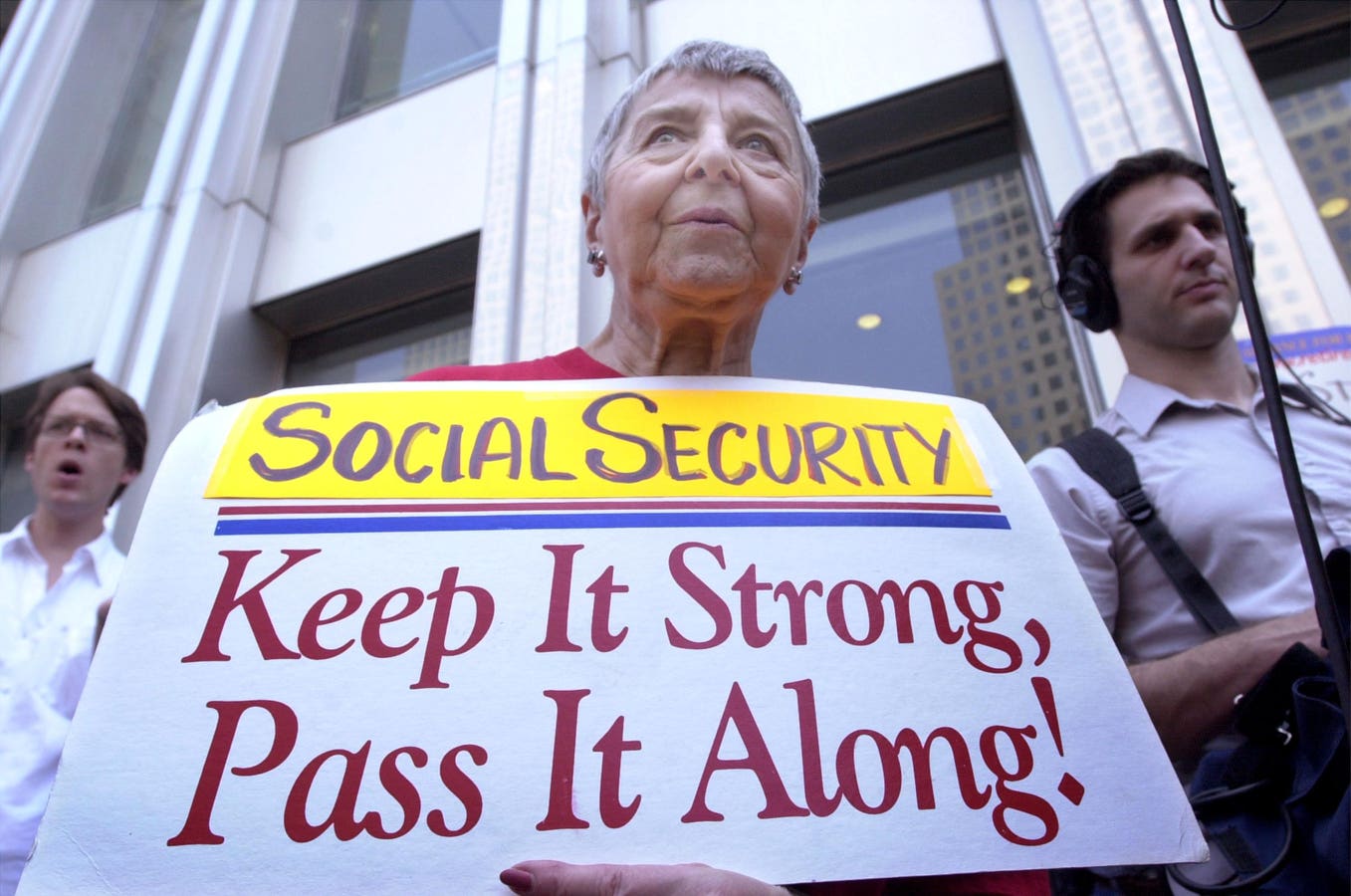
390742 05: A protester demonstrates against a Bush administration plan to add private investment accounts to Social Security, June 18, 2001 in New York City moments after U.S. Treasury Secretary Paul O”Neill addressed a luncheon given by the Coalition for American Financial Security. (Photo by Spencer Platt/Getty Images)
Getty Images
Social Security is not going bankrupt, and by extension benefits won’t be cut. Not now, not in four years, not in forty.
The irony in all of this is that existing and future retirees wouldn’t much care even if benefits were reduced. More on this in a bit, and why it’s better for U.S. taxpayers that benefits not be shrunk.
For now, it’s useful to address bankruptcy and benefit cut rumors. The frequently wise Washington Examiner columnist Tiana Lowe Doescher wrote there recently that a failure to do anything about Social Security means bankruptcy in four years and 28% benefit cuts. The bad news is that Doescher’s prediction won’t age well, while the good news is that she’s got lots of company when it comes to making a prediction that won’t reveal itself.
The many predicting doom ignore that Social Security is all about general revenues, not what’s in a “lockbox” that has never existed as is. Better yet, the surest sign there’s no risk of Social Security bankruptcy or looming benefit cuts is the lack of a “lockbox.” Think about it.
In the past, monies paid into Social Security that did not fund benefits didn’t go into a Social Security bank account, rather they went into general government revenues. Translated, any overages collected by Social Security were spent by Congress.
Of course, the fact that Congress has always spent what the Social Security Administration (SSA) didn’t pay out means that if Social Security ever goes “bankrupt,” Congress will cover any benefits payments that the SSA lacks. In other words, and as stated up front, neither bankruptcy nor benefit cuts loom for Social Security or its recipients.
Which brings us to present and future retirees who will be Social Security recipients. It’s long been said (correctly) by members of the right (including the recently deceased Cato Institute co-founder Ed Crane) that Americans should be able to own the Social Security portion of their retirement with private accounts. This would be great.
Just the same, it really wouldn’t matter. And it wouldn’t because it’s increasingly evident that enterprising Americans have worked around the ridiculously low Social Security payments that await.
As was recently reported in the Wall Street Journal, “As of the third quarter of last year, people 70 and over controlled roughly 39% of all equities and mutual funds owned by households.” The report confirms what was written above: with no constitutional right to own their Social Security accounts (see Flemming v. Nestor), the elderly in America went private on their own. And in a big way.
Ironic about all this is that the Cato Institute’s present-day scholars are calling for Social Security benefit cuts that would fall on the well-to-do. The scholars there won’t debate their contention, but perhaps they could be persuaded to open their eyes to leaving Social Security alone, with no cuts.
Precisely because America’s elderly have worked around the abject foolishness of a federal retirement program, the damage wrought by Social Security is increasingly muted. Contrast the latter with benefit cuts that would free up dollars for Congress to direct toward existing or all new programs.
Better to keep Social Security intact not because it’s a good idea, but because it’s a bad one. As a bad idea that the elderly are working around in growing numbers, Social Security will crowd out other spending ideas that Congress would just love to introduce.
For now, there’s once again no looming bankruptcy for Social Security. Though even if there were, a rapidly growing number wouldn’t care.