
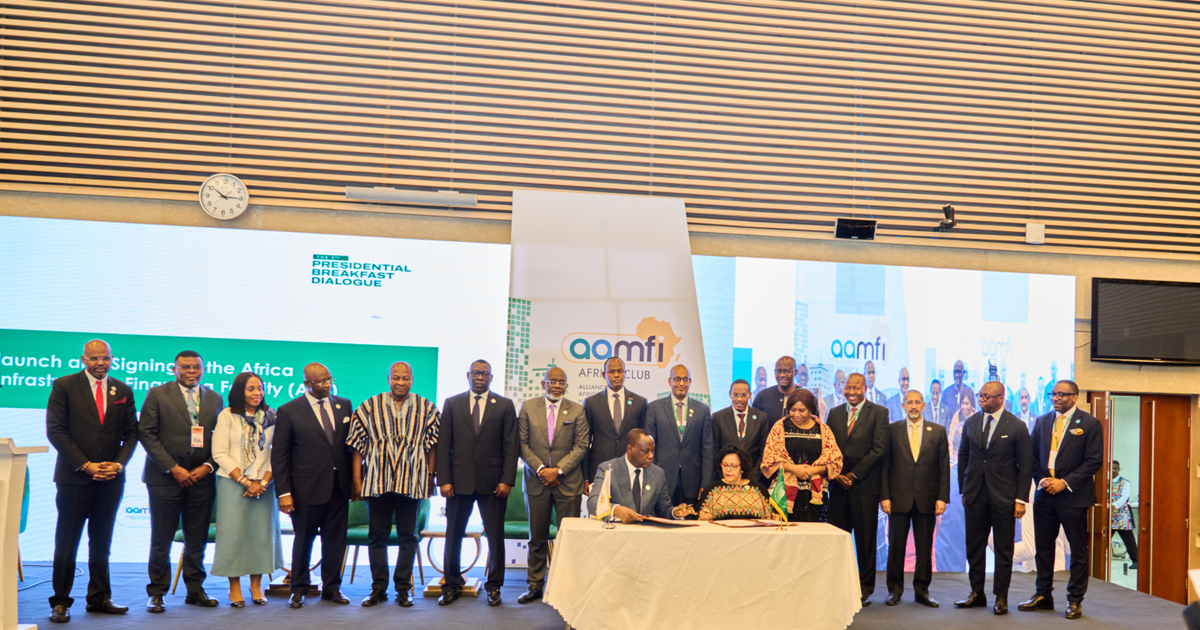
The Africa Infrastructure Financing Facility (AIFF) created jointly by AUDA-NEPAD and the Alliance of African Multilateral Financial Institutions was unveiled on 14 February during the Third Presidential High-Level Dialogue of African multilateral lenders, held alongside the 39th African Union Summit.
The initiative is designed to fix one of the continent’s most persistent challenges: the gap between political approval of major infrastructure schemes and the actual financing needed to deliver them.
The Dialogue was convened under the patronage of the President of the Republic of Ghana, John Dramani Mahama, who also leads the African Union agenda on financial institutions.
Mahama said Africa’s development problem is not the absence of money, but the lack of a coordinated system to channel local capital into infrastructure, industrialisation, and job-creating sectors.
“Africa has domestic capital pools exceeding $2.5 trillion. The challenge is not the availability of capital, but how intentionally we deploy it,” he said, warning that fragmented financial markets continue to inflate Africa’s borrowing costs.
Representing the African Union Commission, Commissioner Francisca Tatchouop Belobe said the AIFF shows what is possible when political will is matched with institutional coordination. She noted that Africa faces an annual infrastructure financing gap of about $221 billion through 2030.
Samaila Zubairu, outgoing chair of AAMFI and head of the Africa Finance Corporation, said member institutions collectively hold more than $70 billion in balance sheets, which could be deployed more effectively if African lenders coordinate capital and strategy rather than working in silos.
From the banking side, Afreximbank President Dr George Elombi said too many projects fail because they are not well-prepared, improperly structured, or mismatched with investor requirements. The AIFF, he said, is designed to close the execution gap by pooling technical expertise and risk frameworks.
Incoming AAMFI chair Dr Corneille Karekezi, CEO of Africa Reinsurance Corporation, added that Africa’s financial future depends on institutions working together to share risk, mobilise domestic capital, and attract private investment.
Despite strong political commitment across the continent, early-stage bottlenecks—such as limited project preparation funding and inconsistent regional policies—continue to stall major projects. The AIFF aims to address these weaknesses by offering a structured, Africa-led mechanism for project preparation and early-stage financing engagement.
The Dialogue ended with a symbolic milestone: Cameroon formally deposited its ratification of the protocol establishing the African Monetary Fund, a planned institution designed to boost macroeconomic stability and financial cooperation across African Union member states