
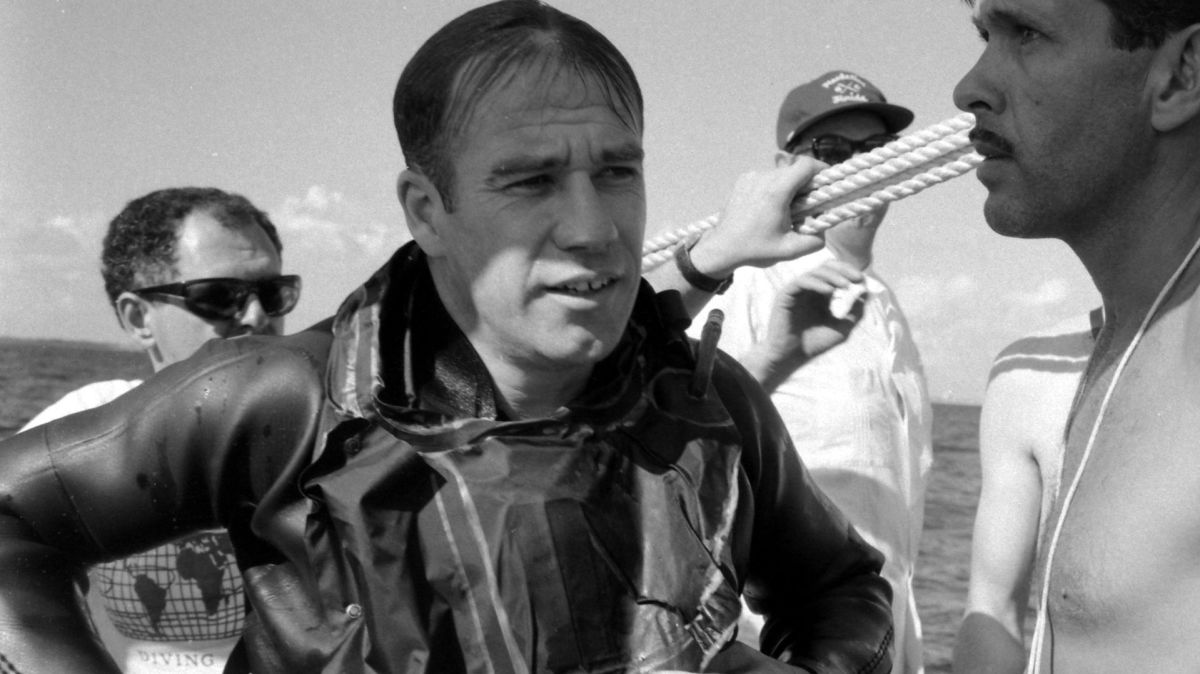
Free diving — the art of holding your breath and swimming towards the sea bed without an oxygen tank — requires a remarkable amount of physical and mental endurance. At the core of its popularity is a blend of athletic prowess and a scientific curiosity about the limits to which the body can be pushed.
Today that curiosity is supported by custom-made fins and sophisticated breathing techniques. It wasn’t always so. Breath-holding techniques were practised largely by military divers, sponge divers and spear fishermen. There was little data about the body’s response to extreme depth because scientists and diving experts did not believe that the body was built to safely dive beyond 40 metres. The pressure, they thought, could crush the lungs and cause other fatal injuries.
Perhaps it took someone soaked in the disciplines of the military to test this assumption. In the 1950s Bob Croft, a diving instructor for the US navy, trained sailors in underwater operations and emergency procedures in 36m-deep tanks. He began organically to experiment with techniques to hold his breath for long stretches of time, teaching himself to overfill his lungs with a “packing” technique whereby he used his tongue as a pump to force extra air into his lungs, and using the nascent “scleral contact lenses”. Normal diving masks compressed as divers descended, and to prevent “mask squeeze” they had to exhale air into the mask. Using the contact lenses, with no mask, helped Croft preserve oxygen.
After increasing the time he could hold his breath from two to six minutes, Croft became the first diver to journey beyond 61 metres on a crisp morning in February 1967. Ignoring the caution of his commanding officer — “You know you’re gonna die, right?” — he launched himself into the cold waters of the Atlantic off the coast of Fort Lauderdale in Florida, using a rope to guide himself down and back up, and clasping a lead weight in his hand.
The dive, which lasted just over two minutes, was historic because it demonstrated that the body could be pushed to greater limits than was previously thought. It galvanised not only the free-diving community but scientists studying the mammalian dive reflex by which marine mammals, such as dolphins, conserve oxygen by slowing the heart rate and redirecting blood flow to the vital organs.
Croft’s dive led to an influential study on the blood-shift phenomenon, the human reflex that allows the body to withstand high pressure at depth. At one point in 1967 he dove with 25 pounds (11kg) of electrodes attached to himself to help researchers gauge the effect of pressure on the heart’s ability to pump blood.
Known as the “father of American free diving”, Croft inspired a generation of high-profile divers who made a competitive sport out of it, including Enzo Maiorca (of Italy) and Jacques Mayol (of France). The safety procedures, rules and training techniques which accompanied the professionalisation of the industry in the 1970s were, in large part, influenced by Croft’s work.
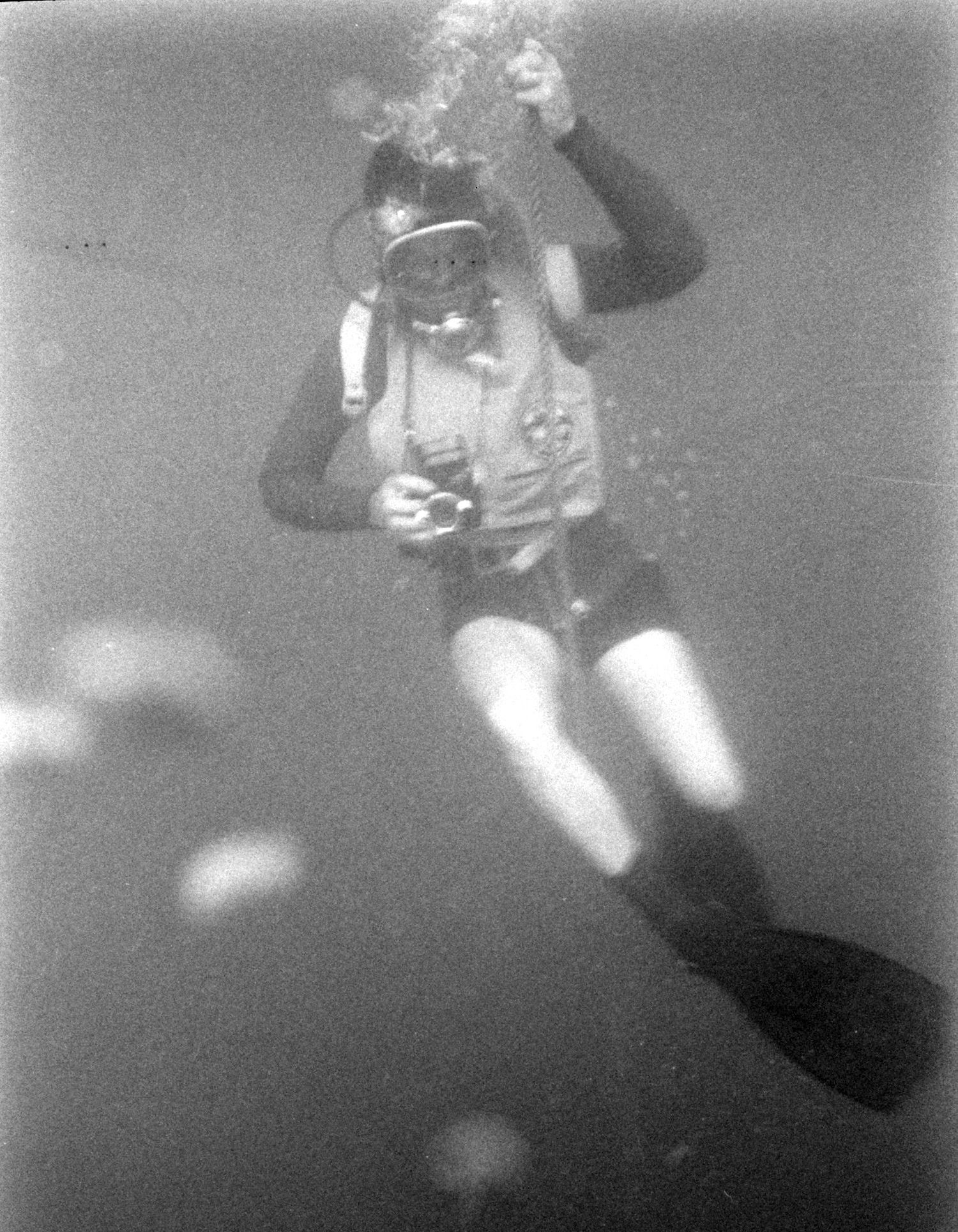
Croft broke the world record with his 64-metre dive in 1967. Scientists had expected him to die from the water pressure
STAN WAYMAN/THE LIFE PICTURE COLLECTION/SHUTTERSTOCK
Though he became something of a national treasure, profiled in Life magazine and featured in television specials, he was in reality rather broke. His first dive had cost more than $11,000 (about $108,000 today) because he had to personally pay for a doctor, lawyer, agent and dive team. “It’s no longer a fun thing — it’s a job,” he later told a newspaper.
Robert Arthur Croft was born in Manhattan, New York, in 1934. Growing up near Narragansett Bay in Rhode Island, a 147-square-mile estuary pierced with the sound of gulls and ferry engines, he would experiment with holding in lungfuls of air to dive farther than his friends. He later attributed this remarkable talent partly to a childhood case of rickets which had softened his bones and enabled him to expand his rib cage.
Dropping out of school early to support his family — he delivered baked goods, worked for a jeweller and looked after horses at an amusement park — Croft joined the navy in 1951 and became a submariner, later working at the naval submarine base in Groton, Connecticut.
He broke the record twice more after his dive in 1967 — it had been challenged by Maiorca and Mayol — with his final stab in 1968, when he reached 73 metres. The Maiorca-Mayol rivalry continued into the 1970s and 80s with 100m-plus dives. Maiorca’s dives were generally “variable weight”, which meant that instead of pulling himself down a rope,he would hold on to a heavy metal frame called a “weighted sled” which was attached to a cable. Croft always practised “constant weight”, swimming down and up without pulling on a rope, using only his muscle power, with no fins and minimal assistance.
After retiring from the navy in 1974 Croft coached and mentored aspiring free divers, joined a tool manufacturer which made decompression chambers for oil-rig divers, wrote and lectured about breath-hold techniques and judged free-diving competitions. In 2013 his autobiography Navy Diver, Submariner and Father of American Freediving was published. He is survived by his wife Edna and their three children, Jeff, Randall and Jennifer.
Today, free divers can descend twice as far as Croft’s 73m dive in 1968 — with the use of more sophisticated gear and techniques. In August 2023, the Russian free diver Alexey Molchanov set a new world record when he reached a depth of 136 metres.
It was a far cry from the laidback way in which Croft had begun the whole thing. He smoked as many as four packets of cigarettes a day and once drank with his navy colleagues into the early hours before a dive. To entertain visitors at the Groton submarine base he would sometimes dive to the bottom of the training tank carrying a pair of trainers, put them on, languidly tie up the laces and return to the surface for a breath of fresh air.
Still, he admitted to feeling nervous before his deepest ocean dives. “If you’re doing something that could possibly kill you and you don’t have at least a small amount of apprehension,” he said, “you’re either a liar or a fool.”
Bob Croft, free diver, was born on July 19, 1934. He died on January 9, 2026, aged 91