

While black market sale of jaguars, tigers and other big cats has been carefully tracked for decades, trade in small and medium-sized felines has gone largely undocumented. Many are threatened or endangered species.Researchers in Colombia discovered that a substantial number of smaller wild cats were seized by or surrendered to wildlife officials from 2015 to 2021.The cats are mostly sold alive as pets, though some skins, teeth and other parts were also confiscated.Seizures of illegally traded wildlife represent just a small percentage of those that are poached and trafficked. The smaller cats are, the more they seem to be traded, researchers say, and globally, there needs to be greater monitoring of international trade in small and mid-sized felines.
See All Key Ideas
Jaguars are increasingly targeted across Latin America for their roseate-patterned pelts and canine teeth, following decades of relatively little poaching. When researchers in Colombia investigated the jaguar trade within the country, they made a troubling discovery: Colombia’s small wildcats are also in the crosshairs.
Official records revealed that between 2015 and 2021, more than 700 small wildcats were seized or surrendered to authorities.
The vast majority of these cats were found alive, including more than 400 ocelots (Leopardus pardalis) as well as oncillas (Leopardus pardinoides), also known as the clouded tiger cat, jaguarundis (Herpailurus yagouaroundi) and margays (Leopardus wiedii).
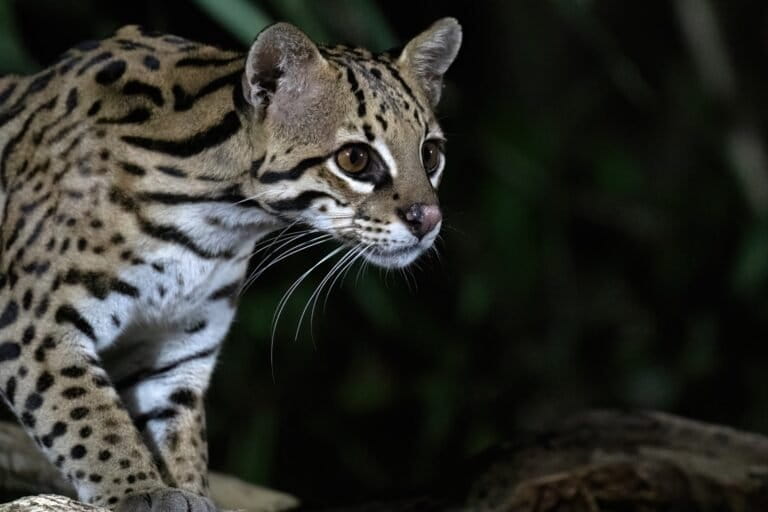 Between 2015 and 2021, more than 400 ocelots were seized by or surrendered to Colombian authorities. Image by Robin Gwen Agarwal via Flickr (CC BY-NC 2.0).
Skins, teeth and other parts were also confiscated.
The research, which was published in the journal Biological Conservation, suggests an established demand for small wildcats as exotic pets in Colombia.
“Until now, the trade in small cats in Latin America had always seemed [to be at] a very low scale — opportunistic activity,” says Melissa Arias, a wildlife trade specialist at the Zoological Society of London and a co-author of the study. “But what we saw with the numbers is that it is actually quite significant.”
Their findings are both unsurprising and worrisome, as the true scale of trade is likely to be higher, says Pauline Verheij, a wildlife crime specialist with the NGO EcoJust, who wasn’t involved in the research. “It’s a given that law enforcement agencies only ever see very small fragment of the actual volumes of illegal trade in wildlife,” she says.
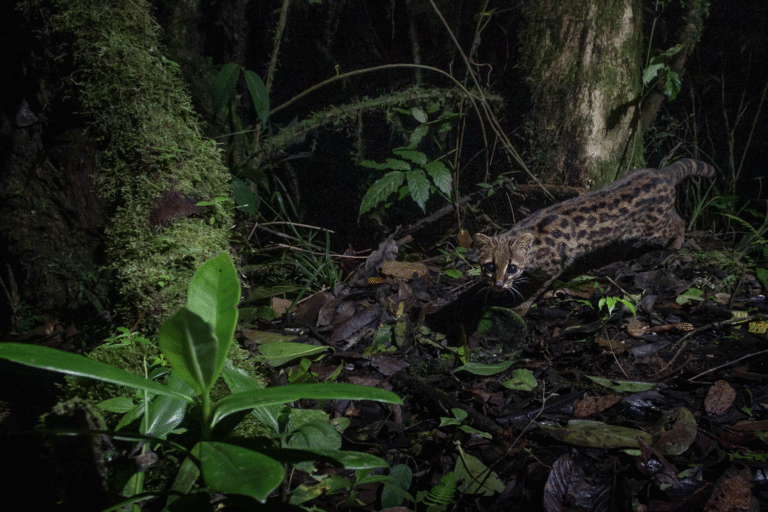 Recent research uncovered illegal trafficking of small felines, including ocelots, jaguarundis, and margays, as well as clouded tiger cats — which are highly threatened in Colombia. Image courtesy of Camilo Botero.
Verheij conducted an extensive media-based survey quantifying wildlife trade in Latin America, which was released in December 2024. Though she identified relatively few cases of trafficking in small wildcats, she says she’s “convinced [that] what I found was just a fraction of the overall illegal trade, both in small felids and other wildlife species.”
Juan Camilo Cepeda-Duque says he’s also concerned, citing the dearth of research on small and medium-sized wildcats. Cepeda-Duque is a biologist with expertise in small cats who works with the Andean Tiger Cat Conservation Project and the Chinampa Environmental Organization.
“We don’t even know how many individuals of these species exist in Colombia, much less how many we are actually losing to illegal trafficking networks,” he says.
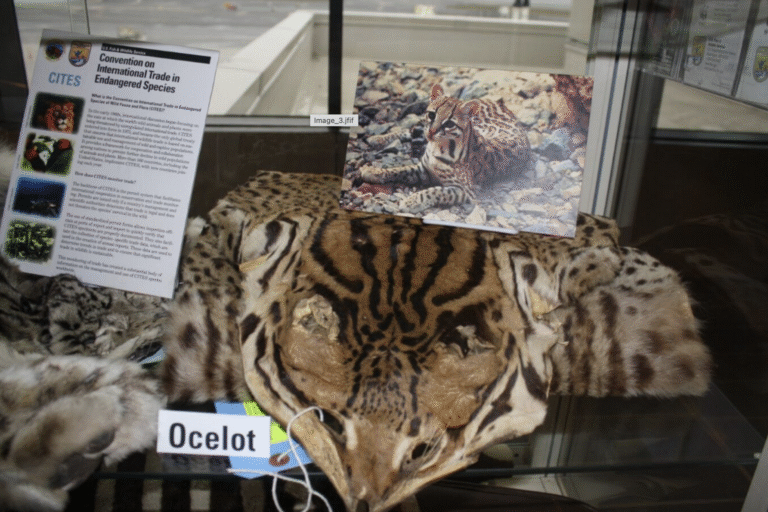 Ocelots and other small cat species are trafficked alive but are also killed for their skins and other parts. Image by USFWS (Public Domain).
Small cats under pressure
Experts say the situation in Colombia is likely not unique to the country. They believe small cats across Latin America and globally are at risk from this largely unnoticed illegal trade for the pet market and for their parts.
With many small cat species living in proximity to humans, the possibility of conflict and capture is heightened. Experts report that in Asia, the leopard cat (Prionailurus bengalensis) — a spotted, long-legged feline about the size of a housecat — has adapted to living in farmed and deforested areas, and that proximity means it’s often caught up in the wildlife trade.
Data gathered from market surveys in countries in Asia, Latin America and Africa show that several species of small wildcats — including leopard cats, servals (Leptailurus serval), caracals (Caracal caracal), jungle cats (Felis chaus), clouded leopards (Neofelis nebulosa and Neofelis diardi) and Asiatic golden cats (Catopuma temminckii) — are captured live and sold as pets or are killed for their parts.
Bangladesh appears to be both a source and transit country for the illegal trade in cat species, both big and small, across the region, according to a 2023 study published in the journal Global Ecology and Conservation. The authors reported trade in numerous species using falsified permits. Under a global treaty, CITES, international trade in some rare plants and animals is illegal; for other less-threatened CITES-listed species, limited cross-border trade is legal, but requires a permit.
Other research points to Myanmar as a central trader in numerous small cat species, including golden cats, clouded leopards and marbled cats (Pardofelis marmorata) that are sold in outdoor markets. Experts have also flagged concerning trends in India, with small cat parts passed off as those of larger species. In Africa, another study documented skins of caracals and servals for sale in medicine markets in Benin and Niger.
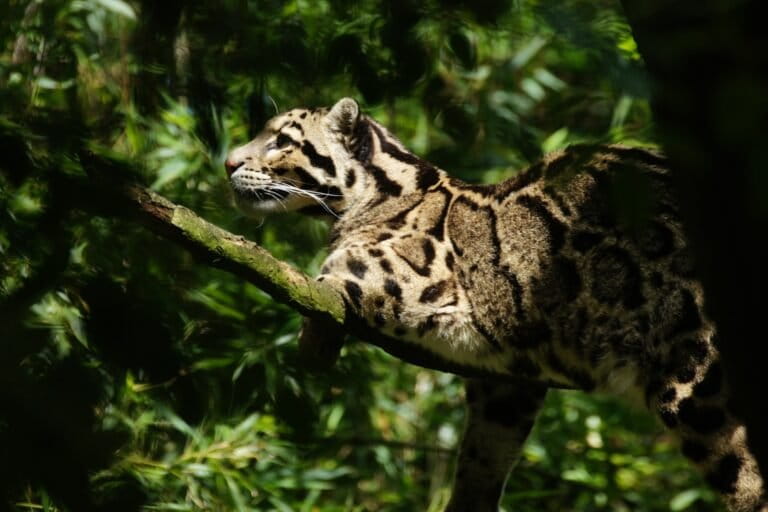 Clouded leopards, like the one pictured here, are targeted for their skins and other parts, with poaching a significant factor in their decline across Asia. They’re often considered the largest of the small cats or smallest of the big cats. Image by Tim Ellis via Flickr (CC BY-NC 2.0).
“The general trend is clearly that the smaller they are, the more they are traded, but the less attention they are given,” says Vincent Nijman, head of the Oxford Wildlife Trade Research Group at Oxford Brookes University in the U.K. Illegal trade is increasing online and on social media in some countries, he adds.
Muntasir Akash, a wildlife biologist at the University of Dhaka in Bangladesh, says he believes there is some level of demand within the country for small cat species, specifically jungle cats, leopard cats and, to a lesser extent, fishing cats (Prionailurus viverrinus). While out setting remote cameras to document wildlife there, he’s been approached by hunters inquiring how to capture these animals, he says.
Akash adds the trade in small wildcats is of “increasing concern” in Bangladesh and potentially across South Asia. “While robust, systematic data remain limited, anecdotal evidence and media reports suggest that such activities have been growing in recent years,” he writes in an email.
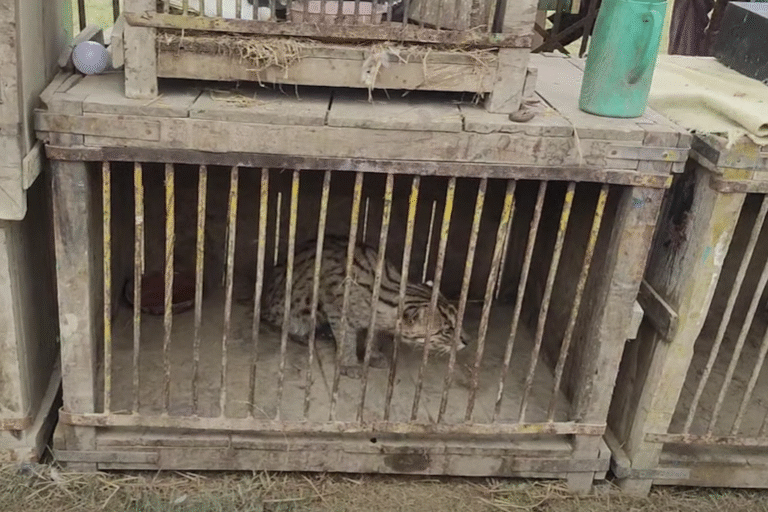 A captive fishing cat in Mirpurkhaas, Pakistan. Small wild cats are openly sold in markets in Karachi, and researchers have observed fishing cats, jungle cats, leopard cats and a Pallas’ cat for sale in markets and online in recent years. Image courtesy of Waqar Marri / Indus Fishing Cat Project.
Masking the problem
One of the most striking discoveries from the research in Colombia is that many of the animals are “voluntary surrenders,” says lead author Natalia Muñoz Cassolis, an illegal wildlife trade researcher at the University of Maryland in the U.S.
Voluntary surrender is a legal mechanism used in Colombia and elsewhere that allows individuals to hand in animals to the authorities without necessarily facing penalties.
If these aren’t accounted for in research, Cassolis and co-author Arias say, this can hide the true scale of wildlife trade in felids and other species.
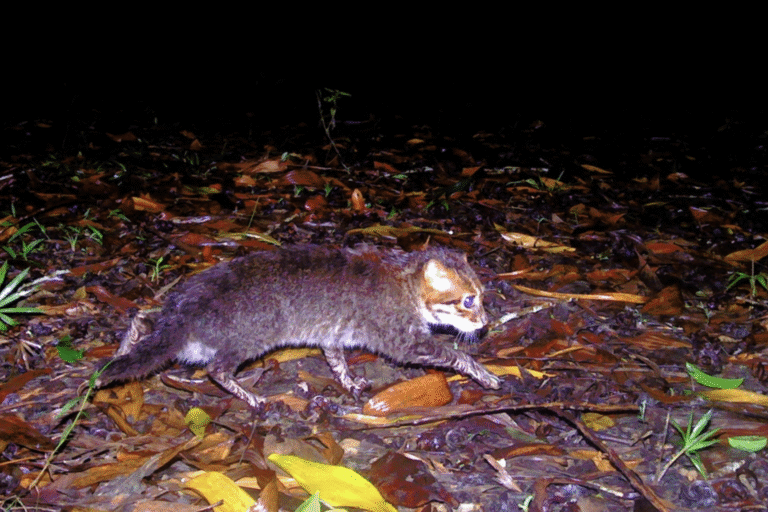 The recent rediscovery of flat-headed cats in Thailand came with a warning that they could be targeted by poachers. That was sparked by the seizure of two flat-headed cats there in 2025, potentially destined for the exotic pet trade. Image courtesy of DNP / Panthera.
“If we’re not looking at those numbers as part of the wildlife trafficking matter, we’re missing a big part of the picture,” Cassolis says — not just for cats, but for many species. “Felids are just a tiny piece of the puzzle of the entire wildlife trafficking problem in terms of voluntary surrenders and how they operate.”
She points to a study in Peru that suggested a decline in felid trafficking in recent years. But that may not paint a full picture if surrenders weren’t included in the assessment. Peru, like Colombia and many other countries, allows for voluntary surrenders.
Nijman says it’s an issue worldwide. “The predominance of voluntary surrenders over confiscations and seizures is a problem, as this does not reflect the seriousness of the trade in these legally protected species.”
Arias and Cassolis plan to continue their research, focusing on voluntary surrenders in Colombia and other Latin American countries to better understand what, if any, penalties are applied in these cases. They call on other wildlife trade investigators to also include this critical information in future studies, and to look deeper into the trafficking of small wildcats.
“The trade in small cats has always been kind of forgotten, not understood, or not really documented, and it’s always been dismissed as something very rare and opportunistic,” Arias says. “For us, it was really important to bring more attention to it, to show that the numbers are really high, and that this probably means that it may be the same in other countries.”
Banner image: A captive sand cat in Nushi, Pakistan. Illegal trade is occurring amid a paucity of information about population sizes of small cat populations. Experts say It’s often happening under the radar, with not enough being done to stop or mitigate this threat. Image by Shuja Jan / Pakistan Sand Cat Program.
Citations:
Muñoz Cassolis, N., Perera Rieder, F., Herrera Montoya, J., MacMillan, D., & Arias, M. (2026). Trafficking in silence: The overlooked illegal trade of small felids in Colombia. Biological Conservation, 314, 111639. doi:10.1016/j.biocon.2025.111639
Nijman, V., Morcatty, T., Smith, J. H., Atoussi, S., Shepherd, C. R., Siriwat, P., … Bergin, D. (2019). Illegal wildlife trade – surveying open animal markets and online platforms to understand the poaching of wild cats. Biodiversity, 20(1), 58-61. doi:10.1080/14888386.2019.1568915
Uddin, N., Enoch, S., Harihar, A., Pickles, R. S., & Hughes, A. C. (2023). Laundered alive? The transnational trade in wild felids through Bangladesh. Global Ecology and Conservation, 41, e02356. doi:10.1016/j.gecco.2022.e02356
Bal, A. K., Gouda, S., & Giordano, A. J. (2023). The price of gold? A note on the illegal trade in Asiatic golden cats and other small felids between Mizoram (India) and Myanmar. Biodiversity, 24(3), 109-111. doi:10.1080/14888386.2023.2211051
Gerstenhaber, C., Ipavec, A., Lapeyre, V., Plowman, C., Chabi-N’Diaye, Y., Tevoedjre, F., … Durant, S. M. (2024). Illegal wildlife trade: An analysis of carnivore products found in markets in Benin and Niger. Global Ecology and Conservation, 51, e02880. doi:10.1016/j.gecco.2024.e02880
Mena, J. L., Vento, R., Martínez, J. L., & Gallegos, A. (2021). Retrospective and current trend of wild‐cat trade in Peru. Conservation Science and Practice, 3(12). doi:10.1111/csp2.558
More to explore:
Small cats face big threats: Reasons to save these elusive endangered species
Small cats should be a conservation priority, says Panthera’s new board chair Jonathan Ayers
Getting rewilding right with the reintroduction of small wildcats
