
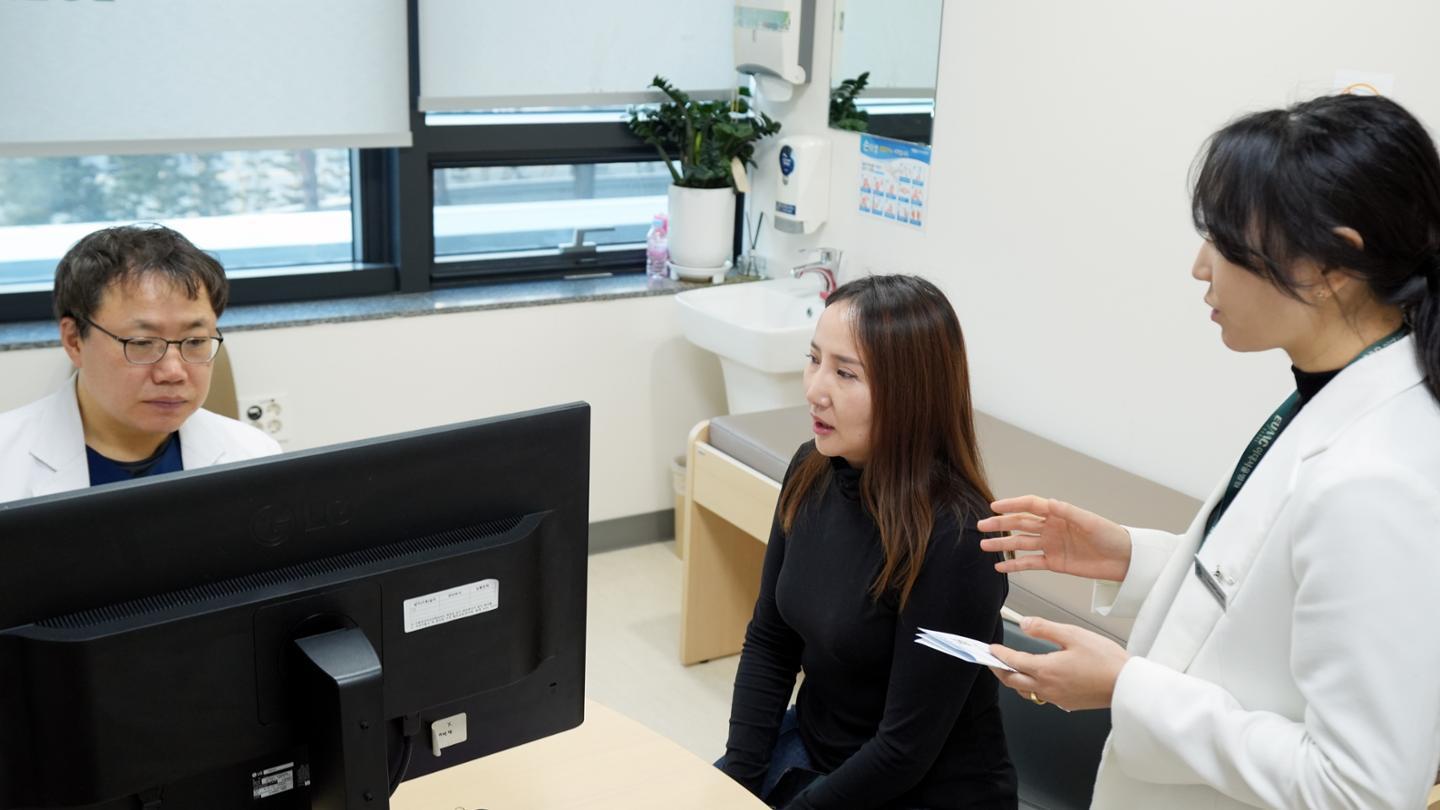
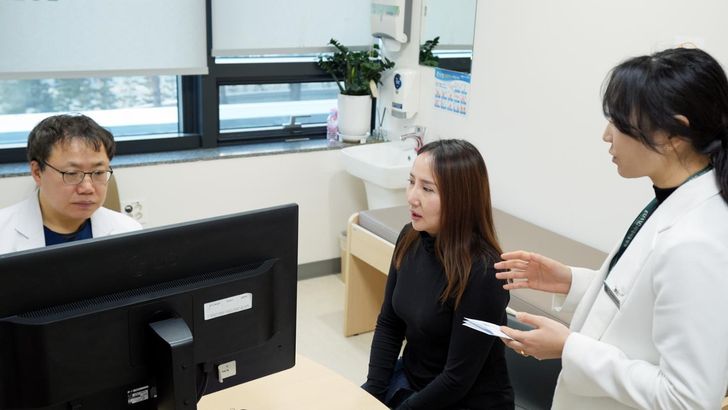
Chuluunbaatar Odgerel, a Mongolian patient, consults with medical staff at Ewha Womans University Seoul Hospital in Seoul’s Gangseo District on Feb. 12. Courtesy of Ewha Womans University Seoul Hospital
Chuluunbaatar Odgerel, 43, let out a sigh of relief in an exam room in Ewha Womans University Seoul Hospital in Seoul when doctors showed her biopsy results. A week earlier, she had undergone robotic surgery to remove a suspected thyroid tumor. Results showed it was benign, not cancerous.
The journey to board a flight from Mongolia to Korea had been emotionally taxing for Odgerel. An 8 centimeter tumor on the left side of her thyroid had been pressing against her esophagus, causing significant discomfort, but visits to multiple hospitals in Mongolia failed to produce a clear diagnosis. One hospital warned it could be cancer and suggested surgery that would involve a long incision across her neck and removal of the entire thyroid.
After careful consideration, she decided to travel to Korea. Explaining her decision, she said that while China and Turkey were also options, she had heard many positive things about Korea’s advanced medical technology. A strong recommendation from a friend who had undergone thyroid surgery in Korea also helped convince her.
Immediately after the surgery, the pressure on her esophagus vanished. No scar was visible on her neck because robotic thyroid surgery involves inserting surgical instruments through the mouth or armpit. Relieved, Odgerel left for the airport that day. She plans to return in two months for a follow-up examination.
Foreign language notices at plastic surgery clinics
The Korean wave is spilling into the medical sector. Statistics published by the Korea Health Industry Development Institute show the number of overseas patients visiting Korea reached a record 1.17 million in 2024, nearly doubling from a year earlier.
Of patients from 202 countries, Japan made up the largest share with 440,000, followed by China at 260,000 and the U.S. at 100,000. Combined medical and tourism spending by patients and their families totaled about 7.5 trillion won ($5.2 billion).
Aside from cancer care or surgery, a visit to Garosu-gil in Gangnam offers another glimpse of “K-medical tourism.” On the street lined with dermatology and plastic surgery clinics, foreign tourists can be seen with bandaged faces or thick masks, browsing for cosmetics.
Inside a large health and beauty store, a foreign customer whose entire head was wrapped in compression bandages, suggesting recent facial contouring surgery, handed cash to the cashier. A young man who appeared to have undergone rhinoplasty used a translation app to ask staff where to find the cosmetics he was looking for.
“There are too many to estimate,” a staff member answered when asked how many foreign patients with bandaged faces visit the store. The nearby plastic surgery clinic had notices written in six different foreign languages — English, Japanese, Chinese, Thai, Indonesian and Russian.
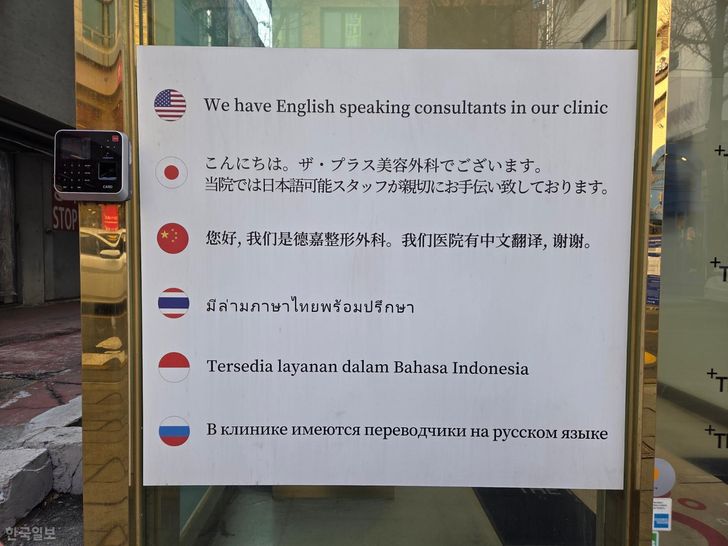
A notice at the entrance of a plastic surgery clinic in Seoul’s Gangnam District informs visitors in six languages that staff who speak those languages are available. Korea Times photo by Son Young-ha
A survey from the Korea Health Industry Development Institute found that 6 out of 10 respondents answered positively when asked whether they intend to revisit Korea for medical purposes or medical-related tourism. The most frequently cited reasons were advanced medical technology and treatment outcomes, followed by state-of-the-art facilities.
“Systematic infection control and efforts to minimize complications have helped raise global awareness of Korea’s high-quality health care,” said Kang Kyung-ho, deputy director of the International Healthcare Business Center at Ewha Womans University Medical Center, commenting on the surge in overseas patients.
Dermatology and plastic surgery account for two-thirds of foreign patients
Among medical specialties, dermatology is seeing rapid expansion alongside the rise of K-beauty. The number of overseas patients seeking dermatological care rose eightfold over five years, from 85,163 in 2019 to 705,090 in 2024.
Patient numbers for plastic surgery, which also increased by 57 percent over the same period from 90,494 to 141,845, ranked second.
“Chinese medical tourists traditionally preferred plastic surgery, but that changed after COVID-19. Dermatology is now the most popular,” said Park Ju-hyuk, director of The Hill Dermatology Clinic in Seoul.
Many hospitals in Gangnam now operate primarily for foreign patients, he added, noting that difficulty finding reliable cosmetic doctors overseas is another factor driving patients to Korea.
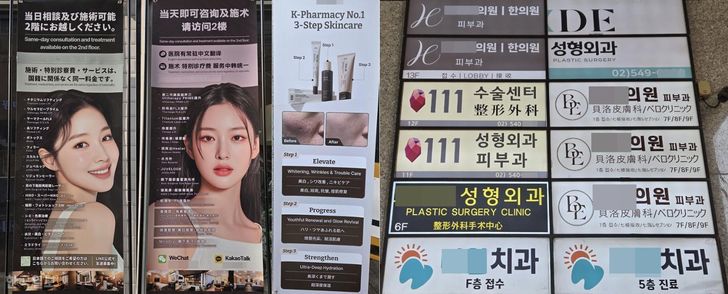
Banners advertising dermatological treatments and products along Garosu-gil in Seoul’s Gangnam District are displayed in foreign languages. Korea Times photo by Son Young-ha
But there are voices calling for changes to make medical tourism sustainable. For now, 68 percent of total patients are concentrated on two specialties — dermatology with 56.6 percent and plastic surgery with 11.4 percent.
There is also a need to bolster comprehensive health screenings and follow-up care, said Kang. Establishing a system that allows foreign patients to continue receiving care through telemedicine after returning to their home countries could help boost confidence in Korea’s health care system and attract new patients.
“Korean medical tourism can turn into a multilayered industry from the current beauty-based, one-time treatment focused market,” said Lee Kwan-young, associate research fellow at Yanolja Research.
He added that steps such as establishing a central coordinating body, fostering a transparent market ecosystem and building a follow-up care system would be needed to support that shift.
This article from the Hankook Ilbo, the sister publication of The Korea Times, is translated by a generative AI system and edited by The Korea Times.