
Takeaways
Smart glasses have several intriguing features that could make life easier for farmers and technicians.
AI technology has already made an impact in agriculture, but many farmers are still hesitant to fully trust and embrace it.
I stopped by a Best Buy on my lunch break today to check out these new Meta AI Glasses I’ve been hearing all about. First, I have to say I was blown away by how different the store looked.
Back in the day, I went to Best Buy almost weekly to browse the video games, DVDs and CDs (remember those?). This was the first time I’ve stepped foot in one in quite some time, and if 14-year-old Noah Newman teleported to the present-day version of Best Buy, he wouldn’t be able to comprehend the technology on display. The only thing that hasn’t changed is the friendly person greeting you at the door.
It truly feels like we’re living in a Sci-Fi movie sometimes, doesn’t it?
Endless Possibilities
As you’ll see in the photo below, when walking up to the Meta AI Glasses demo, I had my choice between Oakley HSTN glasses and Oakley Vanguard glasses. Elton John or Bret “The Hitman” Hart? I woke up feeling dangerous, so I went with the Vanguards, which are a bit more expensive ($499 compared to $399) and have an extra hour of battery life.
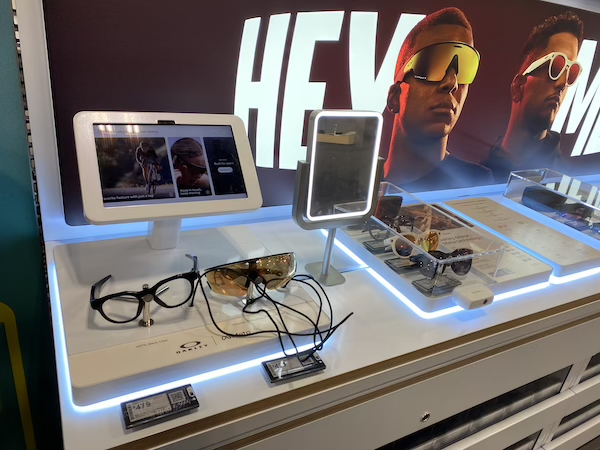
You can also customize the glasses with prescription lenses. My wife keeps telling me I need to buy glasses, so maybe these could be an option for my 20/70 vision.
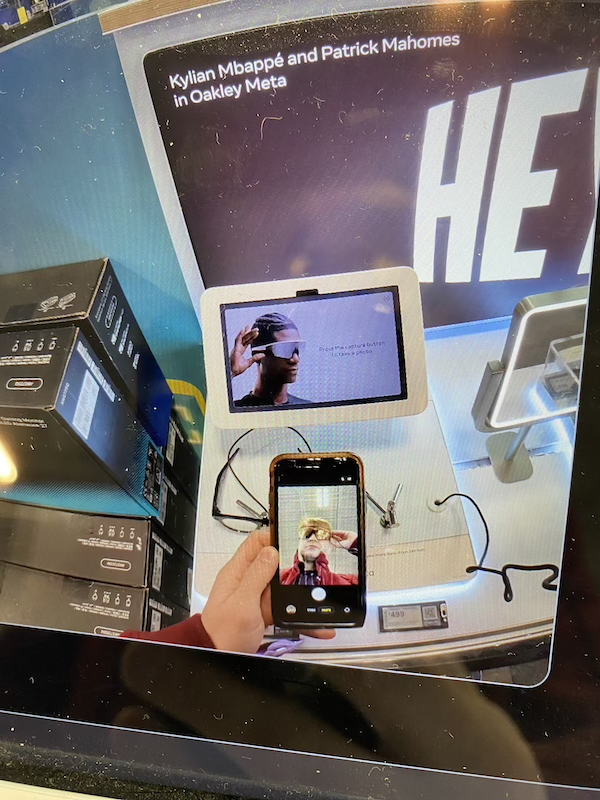
The Vanguards are designed for intense action and are probably better suited for precision specialists and farmers. But both glasses have the same core Meta AI features, including hands-free calling, voice assistance, 3K video recording, wind-optimized open-ear speakers and they’re water resistant. You can take a photo or video of what you’re looking at with the click of a button on the frame, as you can see below.

I unfortunately didn’t get to try out the new Meta Ray-Ban Display Glasses, which have a built-in high-resolution display on the lens for viewing videos and text messages. It also has a closed caption feature that essentially puts subtitles on anyone you’re talking to. Users wear a “neural band” on their wrist to control everything. The Ray-Ban Displays go for $799.
The Next Big Thing?
Could these Meta AI Glasses be game changers for farmers and precision specialists? Picture an equipment breakdown in the middle of planting season. A technician miles away could see what the farmer sees and walk them through a solution right away.
Or maybe a farmer could use the built-in camera to record, stream and document pivotal moments throughout the growing season. Perhaps they could even analyze soil data with an agronomist remotely while they’re walking their fields.
“I remember when the original Google glasses came out, you could look at a cow and they could give you all the stats on a cow,” says Joe Anderson, who works closely with precision technology for Wisconsin and Illinois Case IH dealer Johnson Tractor. “We’re going to find a way to use AI technology in ag, there’s no doubt about it. I could also see these glasses helping technicians by allowing them to pull up a video on how to repair something. We have techs aging out every day, and many of the new ones don’t have that ‘farm boy’ experience, so any kind of educational tool would be helpful. The possibilities are endless.”
“It’s like when we made the switch from the flip phone to the smart phone. At some point we had to bite the bullet and do it because it made life easier.”
Joe wears glasses. I asked him if he’d consider buying a pair of prescription smart glasses.
“Maybe I’d give them a try,” he says. “It depends. Where’s the technology at right now? Maybe I’m not ready to wear them until it gets more reliable. It’s like when we made the switch from the flip phone to the smart phone. At some point we had to bite the bullet and do it because it made life easier.”
Joe doesn’t know anyone who’s wearing smart glasses now. But he could see a world where OEMs make their factory workers wear smart glasses that flash green (for correct) or red (for wrong) when assembling parts.
He also says it might be a bit until we see widespread adoption of this technology on the farm.
“That’s going to be the bigger step for AI as a whole — getting the older generation of farmers to be OK with it,” he says. “It’s not necessarily the data privacy that’s a concern, but the privacy of what’s going on at their farm.
“On the agronomic level, we can already take a smart phone, walk a row of corn and get a snapshot of how well we did. If we can put tools like that in the hand of the farmer and give them the upper edge, it just depends on when they become accepting of the technology.”
What do you think — practical or not? Will we see a shift from regular glasses to smart glasses like we did with the flip phone to the smart phone? Have you or someone you know used Meta AI Glasses on the job yet? Let us know in the comments section below.