
SINGAPORE – Singapore’s total social spending has increased in Budget 2026 to provide more help for Singaporeans, said Prime Minister and Finance Minister Lawrence Wong on Feb 26.
While some have observed social transfers to be smaller than in Budget 2025, support remains substantial and has been broadened in scope, with more given to those with greater needs, he added.
Even while it helps cushion the cost pressures for households here, PM Wong said the Government’s approach is for steady and sustainable wage growth, which is a more durable solution in the long term.
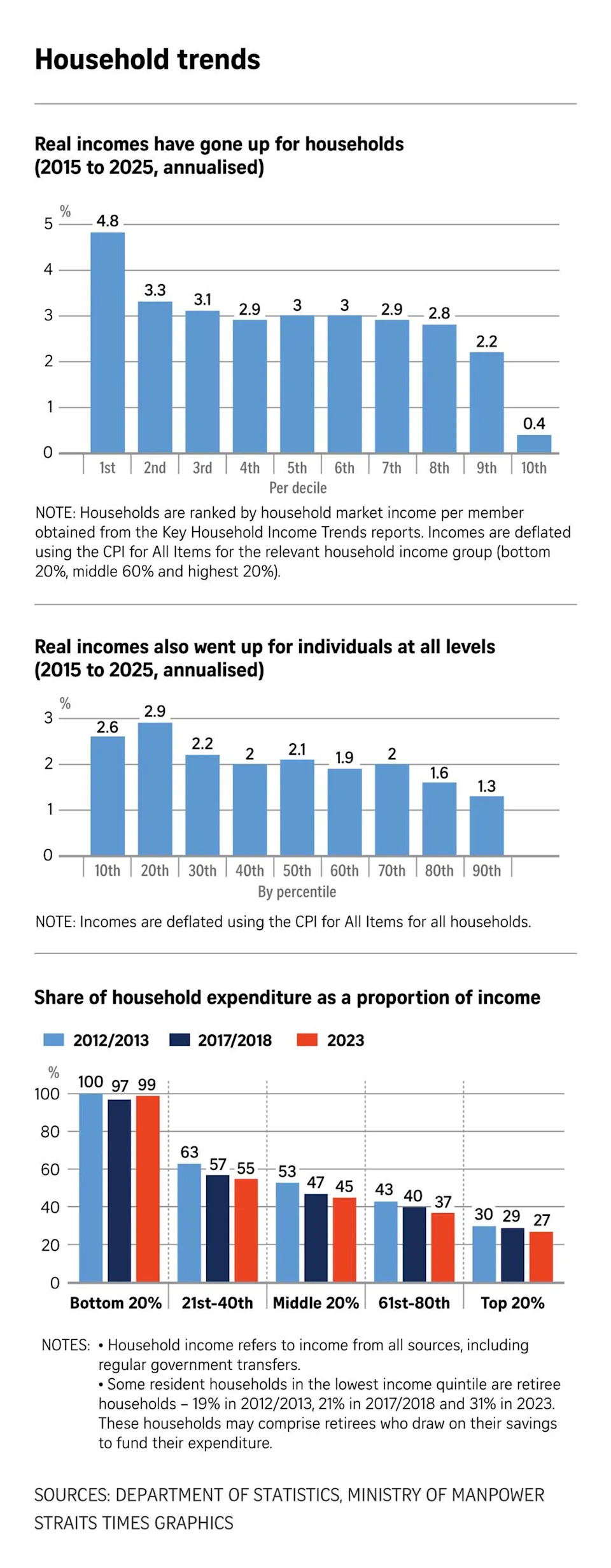
Addressing cost-of-living concerns that MPs had raised across the three days of the Budget debate, PM Wong said data at both the household and individual levels showed that incomes had risen faster than inflation over the past decade across the entire income distribution.
While spending has risen in dollar terms, Singaporeans are also spending less on essentials such as food, public transport and education across all income quintiles, he added.
But the lived experience of higher costs does matter, said PM Wong, who noted that while inflation caused by the Covid-19 pandemic and the war in Ukraine has moderated, price levels remain high.
For instance, food consumption forms a smaller share of income, but high prices are experienced each time one dines out. “The psychological impact is immediate and visible,” he acknowledged.
To cushion the spike in inflation, the Government provided more than $10 billion through the Assurance Package.
Budget 2026 also saw more help given to seniors, who have to cope with higher prices on fixed incomes, said PM Wong.
A retired elderly couple will get about $7,600 in social transfers from the Budget, while a lower-income household with young children will get about $5,000.
This is on top of substantial, broad-based subsidies and targeted support for lower-income families, PM Wong said as he rebutted Mr Louis Chua’s (Sengkang GRC) charge that the Government’s primary response has been to rely on one-off handouts.
“He said that last year, and I had clarified the matter,” said PM Wong. “But regrettably, he has repeated this false claim again.”
The fact is that only about 5 per cent of the overall Budget is for one-off measures, which was also the case in Budget 2025, said the Prime Minister.
Another driver of costs is manpower, and PM Wong acknowledged that labour costs have indeed risen in recent years.
This was partly due to structural factors such as an ageing population and tighter labour supply, but also the outcome of policies such as the Progressive Wage Model to raise wages at the bottom.
PM Wong said that is the right thing to do, as it narrows wage gaps and strengthens dignity in work. But when wages rise, costs also increase, and that is the fundamental tension every economy must manage.
Some countries suppress service wages to keep prices low, but this traps a segment of workers in low-paying jobs, he noted.
On the other hand, others such as European countries have high wages, but that leads to higher prices, which in turn has to be supported by a large welfare state.
Singapore is forging its own path, pursuing broad-based wage growth where wage increases are supported by skills upgrading and productivity improvements.
At the same time, the Government bears a substantial share of the cost of essential services through subsidies and transfers, with more support for lower- and middle-income households, added PM Wong.
“Overall, this balance has delivered good and affordable services to Singaporeans, at a sustainable cost,” he said.
PM Wong noted that the one category where household expenditure has gone up as a share of income is healthcare, which reflects Singapore’s ageing population.
This is why the Government has provided significant and growing subsidies for healthcare services and for national health insurance premiums, while also taking steps to rein in overly generous private riders and other practices that drive up medical inflation, he said.
“We will continue to ensure that healthcare remains affordable in Singapore,” he said. “No Singaporean will be denied the healthcare they need because of an inability to pay. That is our assurance.”
Noting that members such as Mr Saktiandi Supaat (Bishan-Toa Payoh GRC) and Nominated MP Terence Ho had suggested additional asset-based transfers, the Prime Minister said this has been the approach the Government has long taken.
It has done so using mechanisms such as Edusave, the Central Provident Fund and housing policies to enable Singaporeans to accumulate assets, which gives them a concrete stake in the nation’s success, said PM Wong.
Singapore also has progressive taxes on wealth, such as on properties and vehicles, and the Government will continue to study ways to moderate excessive wealth concentration.
But redistribution has its limits, as capital and talent are mobile. Redistribution alone also cannot build a strong and resilient society, said PM Wong.
“If we rely solely on ever, ever higher taxes, eventually, the broad middle will also have to shoulder the burden,” he said.
Instead, Singapore complements it with heavy investments in human capital – through early childhood education, quality schooling and lifelong learning.
“Upward mobility remains central to our social compact,” he said. “Because here in Singapore, your starting point should never determine your finishing position.”
Source: The Straits Times © SPH Media Limited. Permission required for reproduction