
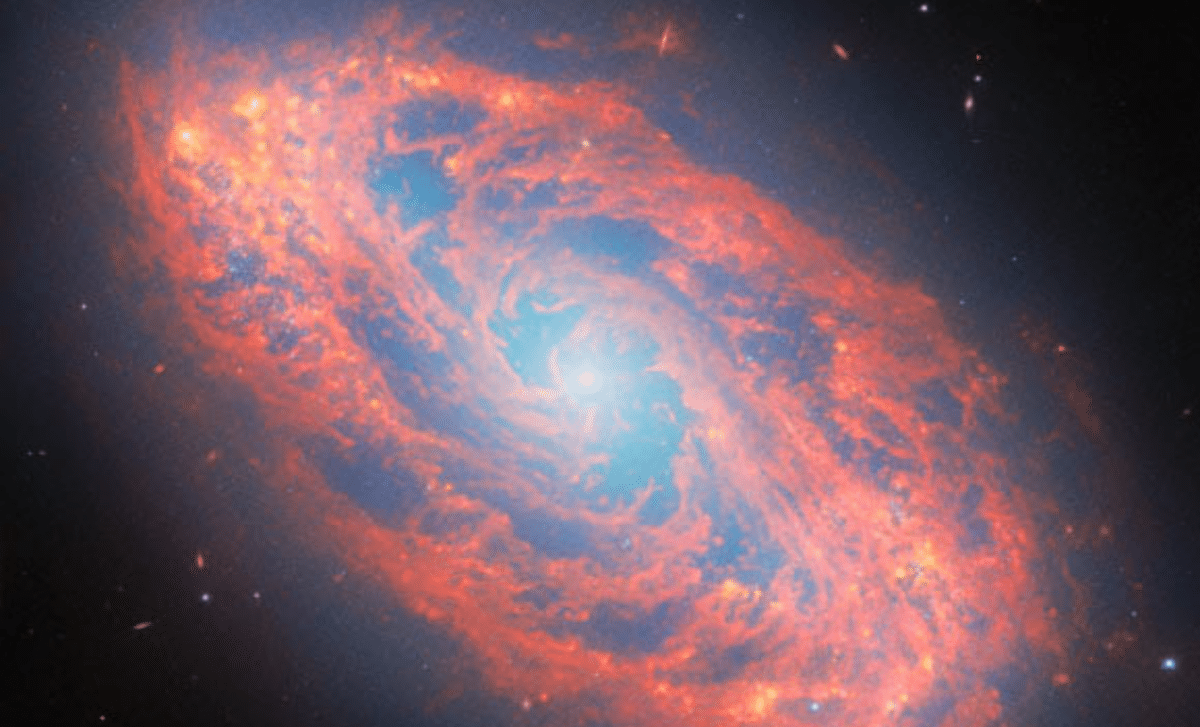
The James Webb Space Telescope has captured an extraordinary infrared image of NGC 5134, a spiral galaxy located about 65 million light-years away. This observation highlights Webb’s ability to uncover unprecedented details of distant cosmic structures, such as the tightly wound spiral arms of the galaxy, which are active sites of star formation. The data provided by both the Mid-Infrared Instrument (MIRI) and the Near-Infrared Camera (NIRCam) create a vivid portrait of the galaxy, revealing complex interactions between star formation and the recycling of gas.
Webb’s Unprecedented View of NGC 5134
Thanks to the advanced capabilities of the James Webb Space Telescope, astronomers are now able to observe distant galaxies with exceptional clarity. One such galaxy, NGC 5134, has been a subject of intense study. “Because of the galaxy’s relative proximity, Webb can spot incredible details in its tightly wound spiral arms,” the Webb astronomers explained in a statement. This allows for a closer examination of the dynamic processes taking place in these spiral structures, which are rich in gas and dust, critical elements in the ongoing cycle of star formation. Webb’s ability to capture such intricate details, especially in infrared wavelengths, offers a new perspective on the creation of stars and their eventual demise.
In NGC 5134, the spiral arms are constantly changing as stars are born, evolve, and eventually die. The image released by Webb showcases these spiral arms in stunning detail, with regions of intense star formation visible throughout the galaxy. As new stars emerge, they push the boundaries of the galaxy’s gas clouds, sometimes using up the available gas to fuel their own birth.
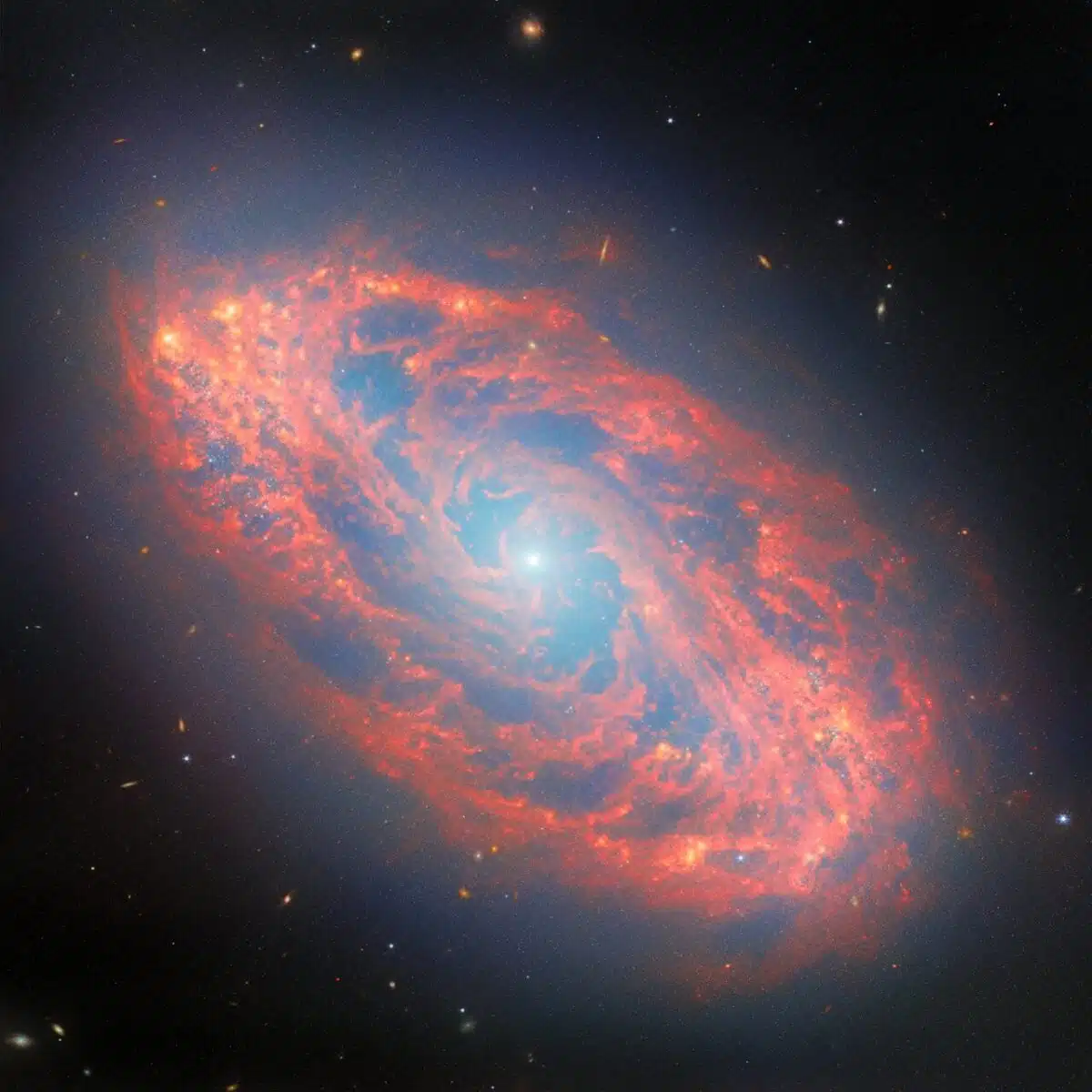 NGC 5134, a spiral galaxy some 65 million light-years away in the constellation of Virgo.
Image credit: NASA / ESA / CSA / Webb / A. Leroy.
The Dance of Dust and Stars in NGC 5134
Webb’s observation of NGC 5134 includes data from both the MIRI and NIRCam instruments, each revealing different aspects of the galaxy. The MIRI captures the light emitted by warm dust that scatters throughout the galaxy, creating a rich tapestry of gas and particles that reveal the chemical processes taking place within NGC 5134’s interstellar clouds.
“Together, the MIRI and NIRCam data paint a portrait of a galaxy in constant ebb and flow,” the researchers noted.
This ebb and flow refers to the interplay between the creation and destruction of stars, which in turn dictates the movement of gas and dust within the galaxy.
The presence of complex molecules like polycyclic aromatic hydrocarbons, interconnected rings of carbon atoms, further enhances the importance of these observations. These molecules provide vital information about the chemistry occurring in the galaxy’s star-forming regions.
Star Formation and Its Impact on NGC 5134
The gas clouds in NGC 5134’s spiral arms are not just visual spectacles; they are the very sites of star formation. These regions are where the raw materials, gas and dust, combine to form new stars.
“The gas clouds that billow along NGC 5134’s spiral arms are the sites of star formation, and each star that forms chips away at the galaxy’s supply of star-forming gas,” the astronomers explained.
This continuous depletion of gas ensures that star formation is an ongoing process, but one that will eventually slow as the galaxy runs out of the necessary raw materials.
However, when stars die, they play a crucial role in replenishing the galaxy’s gas supply. As massive stars reach the end of their lives, they undergo dramatic processes that return elements back into the galaxy. “When stars die, they recycle some of that gas back into the galaxy,” the researchers emphasized.
The Explosive Demise of Massive Stars
Massive stars, which are more than eight times the mass of the Sun, end their lives in spectacular ways. These stars explode in supernovae, powerful events that send vast amounts of material into space. “Massive stars more than about eight times the mass of the Sun do so spectacularly, in cataclysmic supernova explosions that spread stellar material across hundreds of light-years,” the study revealed. These explosions are not only visually awe-inspiring but also play a critical role in distributing essential elements throughout the galaxy, contributing to the next generation of stars and planets.
In contrast, stars like the Sun have a gentler end. They expand into red giants, shedding their outer layers and releasing gas back into space. “Stars like the Sun give back some of their material as well, though more gently,” the researchers noted. This gradual release of material into the interstellar medium is also vital for the galaxy’s ongoing evolution. These dying stars help recycle the elements necessary for the formation of future stars, creating a cyclical process of birth, life, and death that shapes the galaxy over time.