
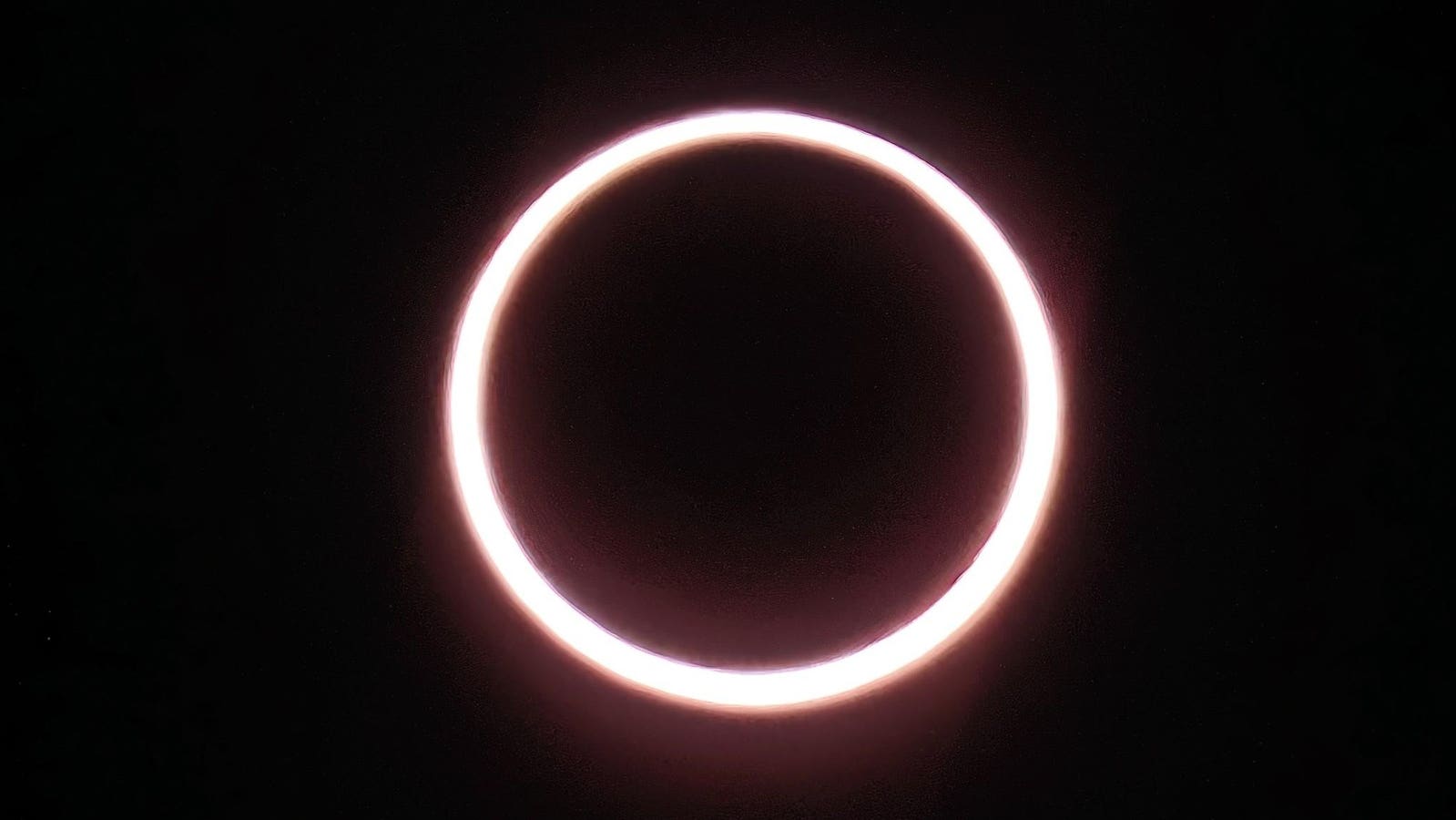
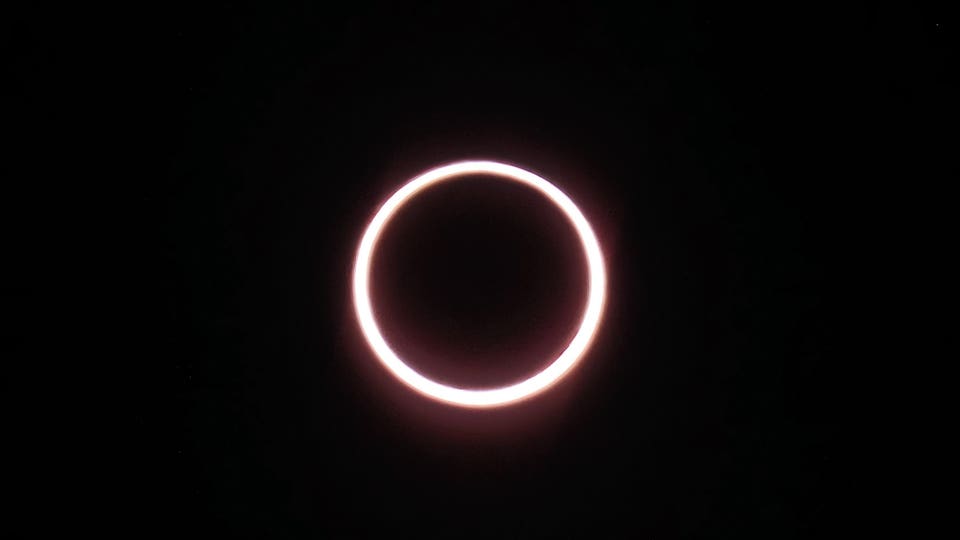
A ‘ring of fire’ solar eclipse seen from Concordia research station in Antarctica on Feb. 17, 2026.
ESA/IPEV/PNRA-A. Traverso
It had been thought that Tuesday, Feb. 17’s annular solar eclipse — visible only from Antarctica — had passed without anyone on Earth witnessing it. However, images have emerged from scientists working in a research station in a remote part of Antarctica. It joins an image from an orbiting satellite as the only evidence that the eclipse occurred at all.
All eclipses come in pairs two weeks apart, with the second — a total lunar eclipse — due to be visible across North America in the early hours of Tuesday, Mar. 3. Before that, skywatchers will have the last views of a challenging “planet parade” this weekend.
ForbesIn Photos: ‘Ring Of Fire’ Solar Eclipse Seen Across Antarctica, AfricaBy Jamie CarterRemote Solar Eclipse
Although the event was seen and photographed as a partial solar eclipse from South Africa, Mauritius and the Indian Ocean, the magical “ring of fire” moment was visible from only two inhabited locations — Concordia Research Station, a French-Italian base in Antarctica’s interior, and Mirny Station, Russia’s coastal outpost in Queen Mary Land. At Concordia, annularity lasted 2 minutes and 1 second, while at Mirny it lasted 1 minute and 52 seconds.
Concordia’s ‘Ring Of Fire’
It was the crew of scientists at Concordia that got lucky, with clear views of the silhouette of a smaller-than-average new moon passing in front of the sun’s center. At the height of the eclipse, 96% of the center of the sun was blocked by the new moon for around two minutes to create a dramatic “ring of fire” — called annularity by astronomers. The partial phases on either side made the event last about 2 hours.
A ‘ring of fire’ solar eclipse seen from Concordia research station in Antarctica on Feb. 17, 2026.
ESA/IPEV/PNRA-A. TraversoAnnular Solar Eclipse Explained
“When we have these alignments of the sun, moon and Earth, one of the variables is the distance of the moon from Earth,” said Graham Jones, an astronomer at Timeanddate.com, in an interview. “The sun and the moon are the same size in our sky, but sometimes the moon is a little bit bigger than the sun, giving us a total eclipse — and sometimes it’s just a little bit smaller than the sun, so can’t cover the whole of the sun’s disk, causing a little ring of the sun’s disk to surround the moon.” This annulus or ring shape is an annular eclipse. At the height of the eclipse, the new moon blocked 96% of the center of the sun to create the dramatic “ring of fire.
The Moon passed directly between the Sun and Earth on Feb. 17, 2026, creating an annular solar eclipse. The European Space Agency’s (ESA) Proba-2 satellite captured this ring from its viewpoint in space.
ESA/Royal Observatory of BelgiumViews From Orbit
In a second eclipse achievement for Europe, the European Space Agency also got a rare view of the “ring of fire” from orbit. Its Proba-2 spacecraft witnessed the eclipse no less than four times — two partial views, one near-total and one perfect ring of fire at 11:31 Universal Time. The images were taken by the spacecraft’s SWAP extreme ultraviolet imager.
Europe is on the cusp of a cluster of central solar eclipses, with Spain seeing total solar eclipses on Aug. 12, 2026, and Aug. 2, 2027, with Spain and Portugal also seeing an annular solar eclipse on Jan. 28, 2028.
ForbesDon’t Miss 2026’s Only ‘Blood Moon’ Total Lunar Eclipse — Coming SoonBy Jamie Carter‘Blood Moon’ Total Lunar Eclipse Incoming
The current eclipse season is not over. In the early hours of March 3, a total lunar eclipse will be visible from North America. Visible before dawn across the U.S. (though best seen in western states), the full worm moon will turn a reddish-pinkish-copper color for 58 minutes as it passes through Earth’s central shadow. It will be the final total lunar eclipse until New Year’s Eve 2028 — and the last one viewable from North America until mid-2029.
Other upcoming skywatching highlights include the April lift-off of NASA’s Artemis 2 mission, and the potential appearance in early April of C/2026 A1 (MAPS). This rare Kreutz sungrazer comet could also be visible in early April.
Wishing you clear skies and wide eyes.