
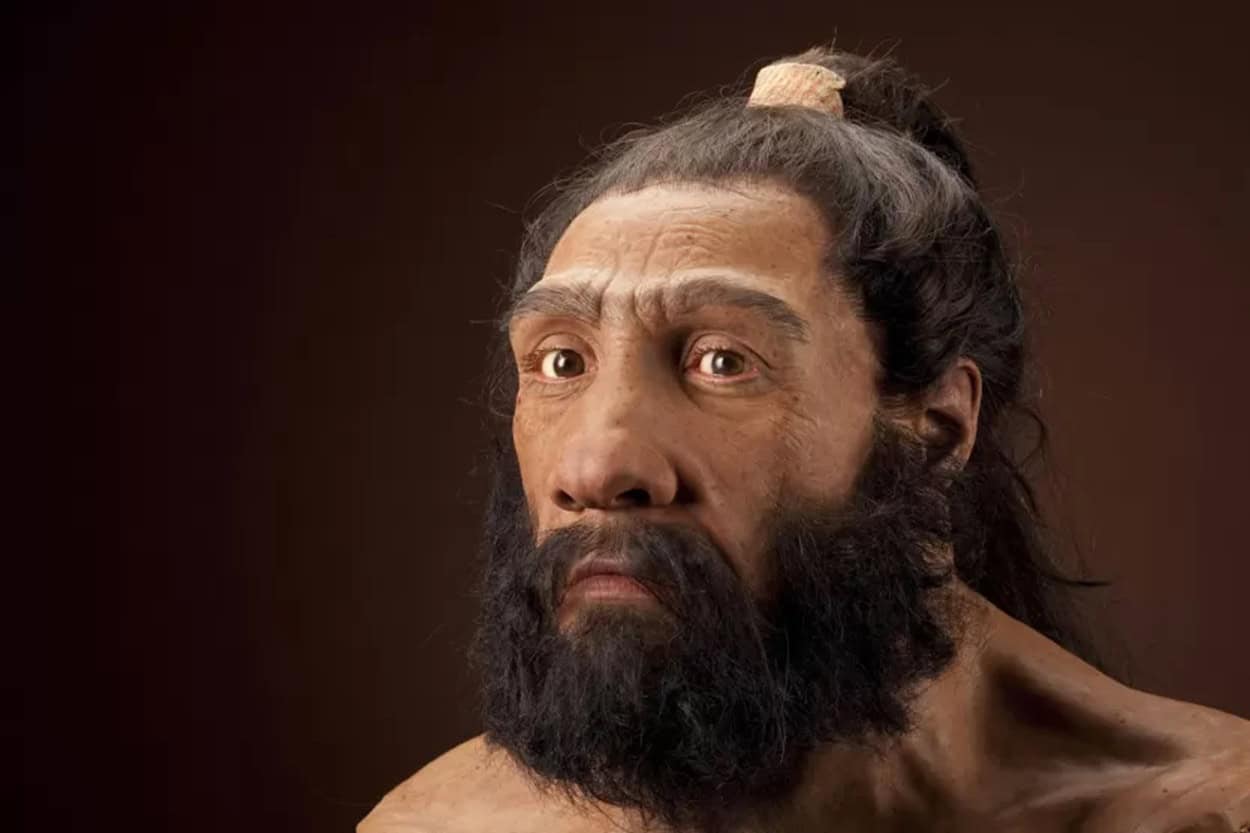
 Image via Wiki Commons.
We now know that humans and Neanderthals interbred several times across thousands of years. Most people of non-African descent carry around 2% Neanderthal DNA as a testament to those ancient love affairs. But a new study adds a surprising pattern.
It turns out those prehistoric hookups weren’t as random as we thought. According to a provocative study published in Science, when Neanderthals and modern humans got together, the couple was most often a Neanderthal man and a human woman.
Neanderthals and the X Chromosome
In 2023, the authors of this research were involved in another study that analyzed the Neanderthal DNA. It was a creative approach: instead of looking at our DNA and looking for Neanderthal heritage, they looked for traces we left behind.
This new analysis builds on that. The researchers report that Neanderthal X chromosomes contain 62% more modern human DNA than their other chromosomes. This is all the more striking because we humans have “Neanderthal deserts” on our X chromosomes.
The X chromosome is sex-related. Most people have 23 pairs of chromosomes, 22 of which mix and match regardless of sex. But the 23rd pair determines a person’s sex: females have two XX chromosomes, while males have an X and a Y. Women pass an X chromosome to every child, whereas men only pass it to their daughters. This means that the X chromosome carries a specific record of female lineage.
The team ran the numbers through complex computer simulations. They tested a scenario where mostly human women migrated into Neanderthal territory. Even then, the math didn’t add up to a 62% excess. The only scenario that fit the data was a distinct mating preference: Neanderthal males and modern human females were the primary pairing.
The groundbreaking study published in Science by Alexander Platt and his team at the University of Pennsylvania suggests the reason for this isn’t biological; it’s social. Simply put, the prehistoric “dating pool” was heavily skewed.
Love, Power, and Ancient Politics
In biology, sex bias often signals a deeper social story. When we see this kind of lopsided genetic flow in animal species, or even in more recent human history, it usually points to a power imbalance or a specific migration pattern.
×
Thank you! One more thing…
Please check your inbox and confirm your subscription.
Perhaps human females found Neanderthal males to be high-status providers. Or perhaps Neanderthal society was “patrilocal” — meaning women moved to join the man’s family — while human society was the opposite. If human women were more likely to wander into Neanderthal camps and stay there, their genes would show up exactly where Platt found them.
However, not all experts are convinced of this hypothesis.
While Brown University population geneticist Sohini Ramachandran told Science that this is a clever analysis, Jeong Chungwon, a professor at the School of Biological Sciences at Seoul National University, expressed skepticism. He told Donga Science that “there could be many complex scenarios where natural selection, population dynamics, and mating preference are all intertwined.” Simply put, a personal preference may not tell the whole story. Furthermore, this preference may not be stable in time.
Male Neanderthals and female modern humans may have preferentially hooked up 250,000 years ago, but this doesn’t mean they did it continuously for 200,000 years. There could be other factors, like natural selection, that explain the differences observed on the X chromosome.
Some researchers, like Duke University paleoanthropologist Steven Churchill, suggest this pattern could hint at something darker than a prehistoric romance. In many historical cases, when one group moves into the territory of another, the dominant group’s males mate with the subordinate group’s females. This can be the result of competition, warfare, or coercion. If Neanderthal males were “monopolizing” human females, it suggests an interaction that was anything but friendly.
The “Why” behind this preference remains the most provocative question, and one that will be difficult to untangle. But more and more, we’re starting to understand the complex ways in which Neanderthals influenced modern humans. For a long time, we viewed Neanderthals as a different “thing”—a separate species that just happened to look like us. Now, we are seeing them as people with preferences, social structures, and complicated relationships.
In many ways, they still live through us.
The study was published in Science.