
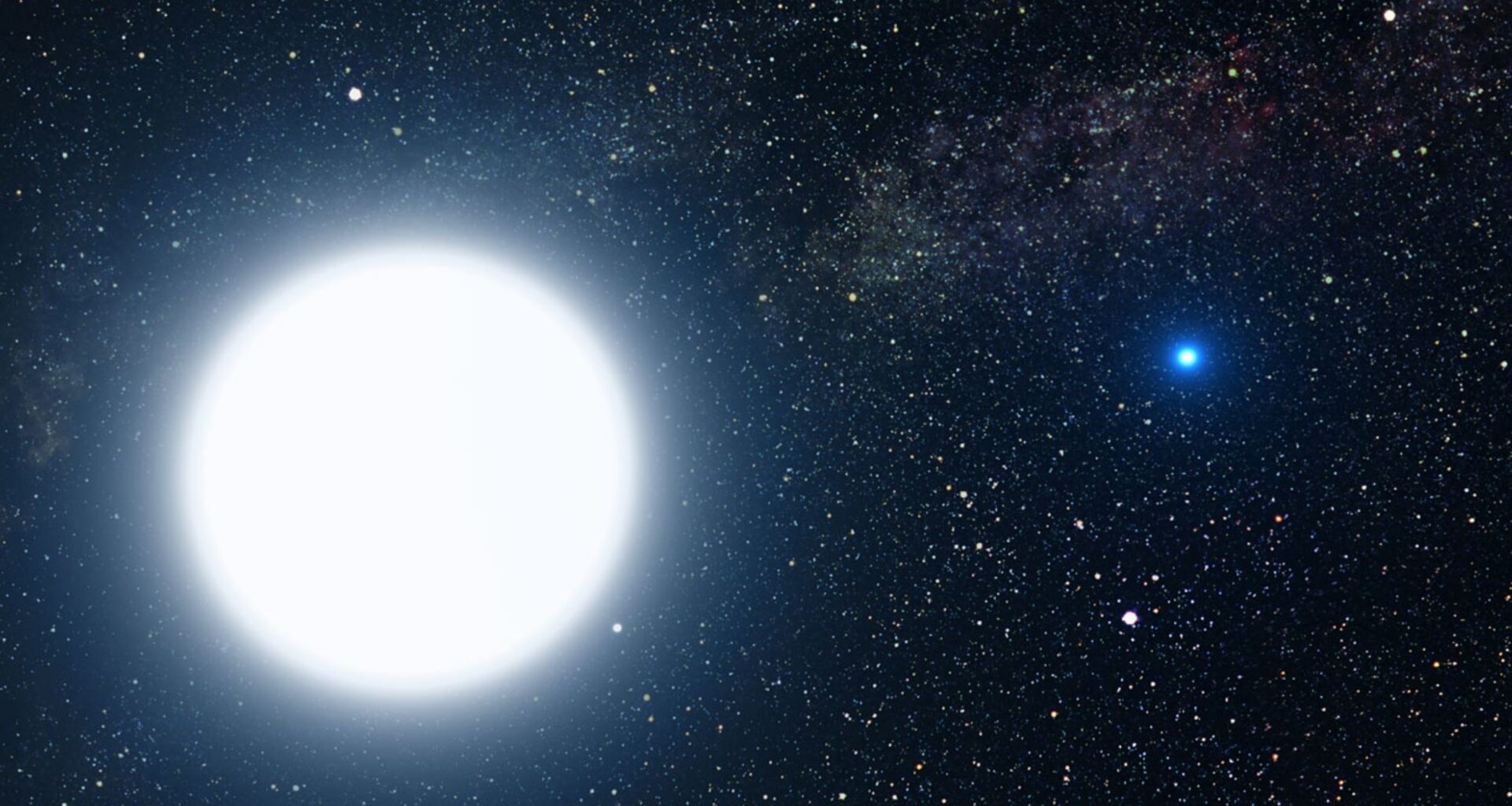
A dead star about 730 light-years from Earth has been sending a powerful wave of fast-moving gas into space for at least 1,000 years.
That kind of long-lasting blast is not supposed to happen around a star like this, and it suggests there is a hidden source of energy that astronomers still cannot explain.
Accidental stellar find

Maps from Chile’s Very Large Telescope traced a bright arc and long tail around the dead star.
While hunting for short-lived stellar explosions, blurry images from Spain four years earlier led Durham University astronomers to the glow.
By matching the arc to the star’s motion, Dr. Simone Scaringi, an astrophysicist, confirmed his accidental find.
“Although we think we know everything about dead stars, they still hold mysteries,” said Scaringi.
Anatomy of a white dwarf
The dead star is a white dwarf, the dense core left after a Sun-like star finally dies. In its tight pairing, a Sun-like companion orbited so close that gravity pulled gas off the companion and toward the dwarf.
Most such pairs grow an accretion disk, a spinning ring of gas that stores incoming matter, around the white dwarf.
Instead, intense magnetism grabbed the flow early, pulling it onto the star before a disk could form.
Why shocks glow
Moving through thin gas between stars, the system built a bow shock, a curved front where fast gas hits space gas.
Compression at that front heated the gas, and the excited atoms released light in different colors.
A narrow tail stretched behind the arc, and its direction lined up with the star’s steady drift across the sky.
That long, clean trail implied a continuing flow, not a one-time blast, which makes the power source even stranger.
The missing disk
Most gas-sharing white dwarfs fling material outward when a disk drives a wind or a surface blast erupts.
Patterns in the glowing gas did not fit a past nuclear flash, and the tail stayed aligned with the moving star.
“The bow shocks we knew of had a disk,” said Scaringi.
Without a disk to fling material, the team had to consider a different power source locked inside the star.
Power of extreme magnetism
Clues in the star’s spectrum pointed to a 42-45 megagauss magnetic field, an invisible force that steers charged particles, around the white dwarf.
Instead of swirling into a broad ring, the incoming gas followed the field lines and struck near the dwarf’s poles.
Yet the bow shock demanded more power than this gas-transfer process can supply, so magnetism alone fell short.
A hidden energy drain, possibly linked to magnetic activity, became the leading suspect behind the stubborn shock wave.
Counting the energy
Energy estimates showed the shock required roughly three times more power than the system normally releases as gas falls inward.
When gas falls onto a compact star, gravity converts that motion into heat and light, which can then power stellar winds.
Checks for other power sources, like stored rotation or a hidden third star, still could not balance the books.
That gap forced the idea that the system loses energy in a way current models barely consider.
A drain on orbits
Over long times, any extra energy loss can change how tightly the two stars orbit each other.
Losing orbital energy usually pulls the pair closer, which can speed up gas transfer and raise the chances of violent outbursts.
Because many close white-dwarf pairs carry strong magnetic fields, the same hidden drain could quietly shape a large population.
If that happens, astronomers may need to rethink how these binaries age, even when they look calm in the telescope.
Why white dwarfs matter
White dwarfs are common end points for stars, so odd behavior in one system can hint at wider rules.
That extra energy loss controls how much matter these binaries leak into the space between stars over time.
“Stars like the Sun will become white dwarfs someday, which is why it’s so important to understand what’s happening, because it affects the evolution of galaxies,” said Scaringi.
Seeing one quiet remnant drive a giant shock wave suggests the galaxy may get more feedback from these systems than expected.
Search for similar systems
Finding more systems like this white dwarf will show whether this odd energy drain is rare or routine.
Wide-field sky surveys can flag faint arcs of glowing gas, and larger telescopes can then measure their motion.
If magnetism plays the key role, astronomers will target other magnetic pairs and watch whether their gas flows ever turn on.
Clearer answers will come only when scientists connect the shock’s size to a specific engine, not just its shape.
Next steps for astronomers
One diskless white dwarf showed that shock waves can persist without the usual disk, forcing a search for hidden power losses.
Future observations will need to test whether magnetism truly bleeds energy from these binaries or whether another mechanism remains unseen.
The study is published in Nature.
—–
Like what you read? Subscribe to our newsletter for engaging articles, exclusive content, and the latest updates.
Check us out on EarthSnap, a free app brought to you by Eric Ralls and Earth.com.
—–