

Track your investments for FREE with Simply Wall St, the portfolio command center trusted by over 7 million individual investors worldwide.
Allegations have emerged that Patria Investments may have overstated performance in certain funds and used off balance sheet loans to manage reported results.
The company has seen its CFO resign, changed auditors, and experienced the exit of a major stakeholder, raising fresh governance and financial risk questions.
These issues have surfaced recently and have not been widely discussed in prior coverage of NasdaqGS:PAX.
For investors considering NasdaqGS:PAX, these governance concerns follow a mixed share price record. The stock trades at $13.12, with a 21.0% gain over the past year but double digit declines of 6.3% over the past week, 15.1% over the past month, and 17.6% year to date. That combination of recent weakness and longer term volatility places additional emphasis on any questions around how results are produced and reported.
In the near term, market attention is likely to center on how Patria Investments responds to the allegations, explains the CFO and auditor changes, and addresses the implications of a major holder stepping away. For dividend focused investors in particular, a central consideration is whether reported earnings and cash generation are as resilient as past disclosures suggest, or whether the risk profile has changed in a way that justifies a closer review of position size and time horizon.
Stay updated on the most important news stories for Patria Investments by adding it to your watchlist or portfolio. Alternatively, explore our Community to discover new perspectives on Patria Investments.
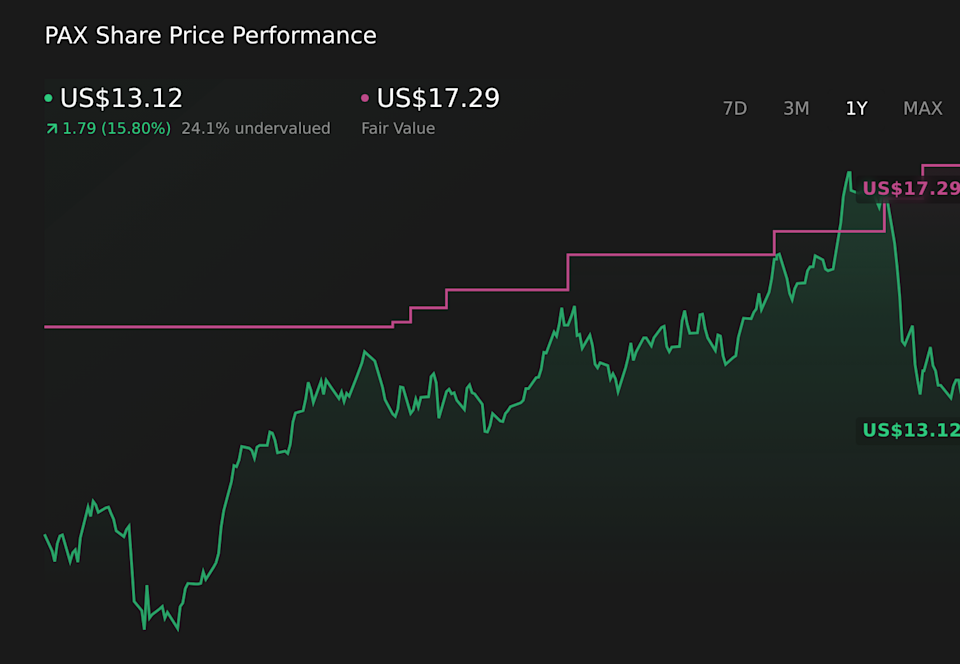 NasdaqGS:PAX 1-Year Stock Price Chart
For an asset manager like Patria Investments, questions around how fund returns are measured and how losses are recognized go straight to the heart of its fee base and balance sheet strength. Allegations of overstated performance and off balance sheet support for troubled holdings raise the possibility that some fee income or carried interest may be less durable than it appears, and that future write downs or restructuring costs could pull forward pressure on earnings and, by extension, on dividend capacity. A CFO resignation, change of auditor, and the exit of a major holder, when taken together, point to a period where regulators, clients, and lenders may scrutinize disclosures more closely, potentially increasing compliance costs or constraining new fundraising until concerns are addressed. For investors, the key question is not only whether any violations occurred, but also how long it could take internal reviews or external probes to reach clarity and whether that timeframe overlaps with upcoming capital raises or refinancing events. In the meantime, higher perceived governance risk can influence how Patria trades relative to listed peers such as Blackstone, KKR, or Carlyle.
The allegations put extra focus on Patria’s expansion in Latin America and fund growth, which had been framed as a key driver of higher fee revenues and scale in the existing narrative.
They directly challenge confidence in execution around acquisitions and rapid platform growth, which the narrative had highlighted as a way to build a larger, more diversified fee-earning base.
The potential use of off balance sheet loans and guarantees to support assets, and the governance questions tied to executive and auditor changes, are not fully reflected in the earlier narrative’s discussion of risks to fundraising and margins.
Knowing what a company is worth starts with understanding its story. Check out one of the top narratives in the Simply Wall St Community for Patria Investments to help decide what it’s worth to you.
⚠️ Regulatory or client actions in response to alleged performance overstatement or masked losses could pressure fee income, fundraising, and dividend coverage.
⚠️ Executive turnover, auditor change, and a major holder exiting can weigh on confidence in financial reporting and increase perceived governance and refinancing risk.
🎁 Strong earnings growth expectations and positive estimate revisions show that some analysts still see upside potential if concerns are addressed convincingly.
🎁 A history of attracted capital to private equity and infrastructure funds may help Patria retain investor relationships if it can provide transparent responses and maintain distribution streams.
From here, keep an eye on any formal investigations, internal review updates, or restatements that could clarify the scale of any issues and the size of potential fines or restrictions. Watch how Patria explains its use of off balance sheet financing, whether the new finance leadership and auditor outline changes to controls, and how institutional clients react in upcoming fundraising cycles. Monitoring any shifts in dividend policy, leverage levels, or guidance on realizations and performance fees can help you gauge whether the risk profile around NasdaqGS:PAX is stabilizing or still in flux.
To ensure you’re always in the loop on how the latest news impacts the investment narrative for Patria Investments, head to the community page for Patria Investments to never miss an update on the top community narratives.
This article by Simply Wall St is general in nature. We provide commentary based on historical data and analyst forecasts only using an unbiased methodology and our articles are not intended to be financial advice. It does not constitute a recommendation to buy or sell any stock, and does not take account of your objectives, or your financial situation. We aim to bring you long-term focused analysis driven by fundamental data. Note that our analysis may not factor in the latest price-sensitive company announcements or qualitative material. Simply Wall St has no position in any stocks mentioned.
Companies discussed in this article include PAX.
Have feedback on this article? Concerned about the content? Get in touch with us directly. Alternatively, email editorial-team@simplywallst.com