
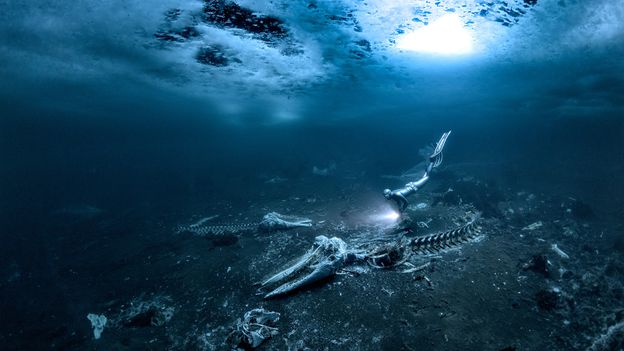
A photographer captured this extraordinary site where whales’ bodies lie in the shallows. Had they died naturally, their bodies would usually be scattered across the ocean. These images tell the story of a deep-sea denied of vital sustenance, and entire ecosystems that will never come to be.
In eastern Greenland, Alex Dawson slipped into the ocean through a hole cut into the pack ice. He sank into the darkness below and – just a few metres down – he found a mass grave of butchered minke whales.
It took an hour of travelling to get to the dive site, by foot and by snowmobile. The air was -20C (-4F), and the team battered by strong winds. “We had a lot of gear,” says Dawson, an acclaimed underwater photographer. “We were six scuba divers, with six divers’ gear. There were cameras, there was food and all kinds of supplies for the day – safety equipment, ice drills…” The equipment was piled on a sledge and pulled by a snowmobile while the team walked on foot. “When you walked, if you didn’t have snowshoes on you stepped through the thin layer of ice, and you got into water almost to your knees – every step,” says Dawson.
“Once we got there it took hours to make the hole,” he continues. Their way into the ocean beneath the ice was a small triangle-shaped hole cut by hand through about a metre (3ft) of ice. “We tried to clear out as much of the slush from the hole as possible,” he says. Then, Dawson – in his thick drysuit, hood and gloves – was first to enter the water.
The site Dawson eventually found below the waves was not only striking, but troubling. In life whales transform their environment, and in death too they play an outsized role on their ecosystems. And here in eastern Greenland, bones that would naturally have fallen to the deep ocean floor instead lie trapped in the shallows.